
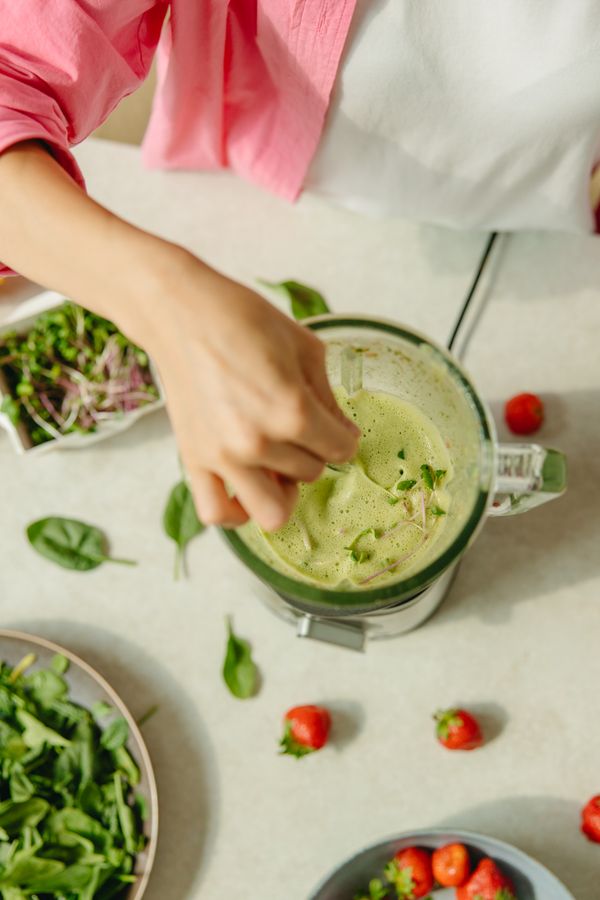
The blender vs food processor question trips up nearly every kitchen shopper at some point. They look similar — both have motors, blades, and containers — and their marketing overlaps so much that it is genuinely confusing. Can a high-powered blender replace a food processor? Can a food processor make smoothies? Do you actually need both, or is one of them an expensive dust-collector waiting to happen?
Here is the fundamental difference, and once you understand it the decision gets much easier: a blender is designed to liquefy, using a tall narrow jar and a vortex that pulls ingredients down into the blades. A food processor is designed to chop, slice, shred, and mix, using a wide shallow bowl and interchangeable discs and blades that process food more evenly without turning it to liquid.
In this blender vs food processor comparison for 2026, we explain how each machine works, compare them head-to-head on smoothies and drinks, chopping and prep, dough and batters, nut butters, cleaning, noise, capacity, price, and counter space. You will get a comparison table, a clear verdict for different cooks, and answers to the questions shoppers ask most.
Blender vs Food Processor: The Short Answer
Buy a blender if your priorities are smoothies, protein shakes, soups, sauces, and frozen drinks. Nothing purees like a good blender, and high-performance models from Vitamix, Blendtec, and Ninja can crush ice and frozen fruit into silk. If liquids are your main event, the blender wins outright.
Buy a food processor if your priorities are chopping vegetables, slicing, shredding cheese, making pie dough, breadcrumbs, or energy balls. Its wide bowl and interchangeable blades handle solid foods with a uniformity and control that blenders cannot match. For general meal prep, the food processor is the harder worker.
Bottom line: they are complementary tools, not substitutes. If you can only buy one, match it to your most frequent task — liquids point to the blender, solid prep points to the food processor.
How a Blender Works
A blender\’s jar is tall and narrow, tapering toward the blade assembly at the bottom. When the motor spins the blades at up to 20,000+ RPM in high-performance models, it creates a vortex that continuously pulls ingredients down into the blades and circulates them. This design excels at breaking down soft and liquid ingredients into smooth, homogenous mixtures.
Blender power is measured in watts and, more meaningfully, in blade speed and jar design. Personal blenders like the NutriBullet run 600–900 watts and handle smoothies well. Full-size high-performance blenders run 1,400–2,000 watts and can pulverize ice, frozen fruit, and even nuts. Most 2026 models include preset programs for smoothies, ice crush, and soup, plus tamper tools for thick blends.
The blender\’s weakness is dry or thick solid processing. Without enough liquid, ingredients bounce around above the blades or get flung to the jar walls, requiring constant stopping and scraping. This is exactly where food processors take over.
How a Food Processor Works
A food processor uses a wide, squat work bowl with an S-shaped metal blade at the bottom. Ingredients sit in a broad layer rather than a deep column, so the blade contacts more of the food with each rotation. Pulse control lets you chop in short bursts for precise texture — from coarse chunks to fine mince — without liquefying.
The real power of a food processor is its attachments. Reversible slicing and shredding discs turn out uniform potato gratin slices and shredded cheese in seconds. Dough blades handle pie crust and pizza dough. Larger models (11–14 cups) from Cuisinart, Breville, and KitchenAid can knead bread dough that would stall a blender instantly.
Capacities range from 3-cup mini choppers to 14-cup full-size machines. The wide feed tube on modern models accepts whole potatoes and blocks of cheese, minimizing pre-cutting. For batch meal prep, uniform slicing, and anything involving dough, the food processor is in a different league from the blender.
Head-to-Head: Blender vs Food Processor
Smoothies, Shakes, and Drinks
The blender dominates this category completely. Its vortex action and high blade speed produce genuinely smooth results with frozen fruit, ice, leafy greens, and protein powder — no chunks, no grit. A food processor can technically blend a smoothie, but the wide bowl leaves pockets of unblended ingredients, the texture stays coarse, and pouring from the bowl is awkward.
If your morning routine revolves around smoothies, this single category settles the entire debate in favor of the blender. Even budget blenders outperform premium food processors at drinks.
- Blender: silky smoothies, crushed ice, frozen cocktails — unmatched
- Food processor: coarse, uneven results; wrong tool for drinks
- Winner: blender, by a landslide
Chopping, Slicing, and Shredding
The food processor is the prep cook\’s best friend. Pulse a few times for perfectly diced onions without tears, shred a block of cheddar in seconds, or slice a pile of cucumbers uniformly for pickles. The slicing disc alone justifies the purchase for anyone who cooks vegetables regularly.
A blender can chop in theory, but in practice it produces uneven results — some pieces turn to mush while others stay chunky — because the tall jar and vortex are designed for liquids. For solid prep work, the food processor wins decisively.
- Blender: uneven chopping; over-processes some pieces while missing others
- Food processor: uniform chop, slice, shred, and dice with pulse control
- Winner: food processor, decisively
Soups and Sauces
Blenders produce the silkiest pureed soups — think butternut squash soup or tomato basil with restaurant-level smoothness. High-performance models can even heat soup through blade friction, though dedicated soup programs on standard models work fine with hot ingredients added carefully.
Food processors make chunkier, more rustic soups and handle pesto, salsa, and hummus beautifully — arguably better than blenders, which can over-process pesto into a paste and make hummus gummy. For silky purees choose the blender; for textured sauces and dips choose the food processor.
- Blender: silkiest pureed soups and smooth sauces
- Food processor: better texture control for pesto, salsa, hummus
- Winner: tie — depends on the texture you want
Dough, Batters, and Baking Prep
Food processors handle pie dough, pizza dough, and cookie dough with ease — the dough blade brings pastry together in under a minute, and the wide bowl gives you room to work. Many bakers consider the food processor their secret weapon for flaky pie crust, since the cold butter stays in distinct pieces.
Blenders are poor dough machines. Thick batters stall the vortex, overheat the motor, and require constant scraping. Pancake batter is about the thickest mixture a blender handles gracefully. Serious bakers should not expect a blender to cover dough duties.
- Blender: thin batters only; stalls on dough
- Food processor: excellent for pie dough, pizza dough, breadcrumbs
- Winner: food processor
Nut Butters and Thick Pastes
This is a closer fight than most people expect. High-performance blenders make incredibly smooth nut butter thanks to their powerful motors and tampers — but the process is loud, slow, and hard on the machine. Food processors make excellent nut butter with less drama: the wide bowl keeps the nuts in contact with the blade, and the motor runs cooler.
For occasional nut butter, either works. For regular batches, the food processor is the more pleasant and durable choice.
- Blender: ultra-smooth results but loud and laborious
- Food processor: easier, cooler-running nut butter batches
- Winner: food processor, narrowly
Cleaning and Ease of Use
Blenders are famously easy to clean: add warm water and a drop of soap, run for 30 seconds, rinse. The self-cleaning trick works brilliantly for daily smoothie duty. Deep cleaning around the blade assembly and gasket takes more effort, but routine cleanup is minimal.
Food processors have more parts — bowl, lid, pusher, blade, discs — and every one of them needs washing. Most are dishwasher-safe, which helps, but assembly and disassembly add friction to every use. Sharp blades also demand careful handling. For daily use, the blender\’s simplicity is a meaningful quality-of-life advantage.
- Blender: 30-second self-clean; minimal parts
- Food processor: more parts, dishwasher-safe but fiddly
- Winner: blender
Noise
Both are loud, but high-performance blenders are in a special category — running a Vitamix at full speed is a genuine conversation-stopper. Food processors are loud in a lower, less piercing way, and pulse operation means the noise comes in short bursts rather than sustained roars.
- Blender: very loud at full speed, sustained noise
- Food processor: loud but in shorter pulses
- Winner: food processor, slightly
Capacity and Batch Size
Full-size blenders typically hold 48–64 ounces, but the effective blending capacity is less — overfilling kills the vortex. Food processors range from 7 to 14 cups, and the wide bowl handles its stated capacity honestly for chopping tasks. For feeding a family or meal-prepping vegetables for the week, the food processor\’s usable capacity is larger.
- Blender: 48–64 oz jars; effective capacity lower for thick blends
- Food processor: 7–14 cup bowls; honest capacity for solid foods
- Winner: food processor for batch prep
Price and Counter Space
Both categories span wide price ranges. Decent full-size blenders start around $50–$100, with high-performance models running $300–$600. Food processors run $60–$150 for solid mid-size models and $200–$350 for premium 12–14 cup machines. Neither is cheap at the top end; both are affordable at the entry level.
Counter space is the real constraint. Both appliances are bulky, and owning both means dedicating serious real estate. If space is tight, choose based on your most frequent task — or consider a blender with food-processor attachments, a popular 2026 compromise from brands like Ninja.
- Blender: $50–$600; tall profile fits under most cabinets
- Food processor: $60–$350; wide footprint, bulky attachments to store
- Winner: tie — similar cost, both demand space
Blender vs Food Processor: Comparison Table
| Task | Blender | Food Processor |
|---|---|---|
| Smoothies & shakes | Excellent — the best tool | Poor |
| Crushed ice & frozen drinks | Excellent | Not recommended |
| Chopping vegetables | Uneven | Excellent with pulse control |
| Slicing & shredding | Not possible | Excellent with discs |
| Pureed soups | Silkiest results | Good, more rustic |
| Pesto, salsa, hummus | Can over-process | Excellent texture control |
| Pie & pizza dough | Poor | Excellent |
| Nut butter | Very smooth but laborious | Easy and reliable |
| Cleaning effort | 30-second self-clean | More parts to wash |
| Typical price range | $50–$600 | $60–$350 |
Which Should You Buy? Our 2026 Verdict
Buy a blender if: smoothies, protein shakes, pureed soups, or frozen drinks are part of your daily routine. It is also the better pick if you want the easiest cleanup and the smallest daily-use friction. A quality full-size blender is one of the highest-ROI appliances in any kitchen.
Buy a food processor if: you cook real meals regularly and want to slash prep time — uniform chopping, slicing, shredding, plus dough and baking prep. It is the workhorse for anyone who chops more than they blend.
Buy both if: you are building a serious kitchen. They genuinely do different jobs, and cooks who own both reach for each constantly. If budget or space forces one choice, be honest about your habits: count how many times per week you make drinks versus how many times you chop vegetables. The answer points straight at your appliance.
The 2026 compromise: several brands now sell blender bases with food-processor attachment bowls. These hybrids are genuinely useful for small kitchens, though the attachments rarely match a dedicated food processor\’s capacity or disc quality. They are a good bridge, not a full replacement.
Blender vs Food Processor FAQ
Can a Vitamix replace a food processor?
Not fully. A high-performance blender like a Vitamix excels at anything liquid or frozen, but it cannot slice, shred, or produce uniformly chopped vegetables, and it handles dough poorly. Many Vitamix owners eventually add a food processor for prep work.
Can a food processor make smoothies?
Technically yes, but the results disappoint — expect a coarse, uneven texture with unblended bits. The wide bowl and S-blade are not designed for liquids. If smoothies matter to you, buy a blender.
Which is better for baby food?
Both work, but the blender produces smoother purees for young babies, while the food processor\’s pulse control is ideal for chunkier textures as babies grow. Many parents start with a blender and add a mini food processor later.
Do I need a food processor if I have good knife skills?
Good knife skills cover chopping, but a food processor still saves significant time on shredding cheese, slicing gratins uniformly, making breadcrumbs, and mixing dough. It is a time-saver rather than a skill replacement.
What size food processor should I buy?
For most households, an 11–14 cup model is the sweet spot — large enough for pizza dough and batch prep without being absurd. Singles and couples who mainly chop small quantities can manage with a 7–9 cup model or even a 3-cup mini chopper as a supplement.
Are blender-food processor combo units worth it?
They are a reasonable compromise for small kitchens and tight budgets. The blender function is usually full-strength; the food-processor attachment is serviceable for basic chopping but typically smaller and less capable than a dedicated machine.
Which lasts longer?
Both can last a decade or more from reputable brands. High-performance blenders often carry 7–10 year warranties, and food processors from established brands are famously durable — many kitchens still run 20-year-old Cuisinarts. Buy quality once.
