
Affiliate Disclosure: As an Amazon Associate I earn from qualifying purchases.
n
The most effective small kitchen organization hacks exploit vertical space, cabinet doors, and the insides of drawers — the storage most kitchens waste. Combined with a zone-based layout and a ruthless one-in-one-out rule, these strategies can effectively double a small kitchen’s usable storage without any renovation.
Small kitchens punish disorganization disproportionately: in a large kitchen, a cluttered counter is an eyesore; in a small one, it’s the difference between being able to cook and not. This guide covers the three pillars of small-kitchen order — using hidden space, organizing by cooking zone, and maintaining the system — with specific, affordable hacks for each. No remodel required, and most cost under $25.
Pillar 1: Exploit Hidden and Vertical Space
Cabinet doors: free real estate
The inside of every cabinet door is usable storage going to waste. Mount slim racks or adhesive organizers inside doors for spices, wraps, lids, and cleaning supplies. over cabinet door organizer Check Price on Amazon → Under-sink doors are perfect for spray bottles and trash bags; pantry doors hold spice racks that free an entire shelf.
Walls: think in three dimensions
A wall-mounted rail with hooks (the classic IKEA-style system) holds utensils, pots, and even small shelves along a backsplash or empty wall — moving a dozen items off the counter and out of drawers. Magnetic knife strips free an entire drawer or counter block while keeping knives safer and more accessible than a crowded drawer. magnetic knife strip wall mount Check Price on Amazon →
Above cabinets and the fridge
The dusty void above wall cabinets and the fridge top fits attractive baskets for rarely-used items: the turkey roaster, the fondue set, backup paper goods. Use closed baskets (not open piles) so it looks intentional and stays dust-free. Reserve this zone strictly for items used monthly or less.
Toe-kick drawers
The recessed space beneath base cabinets can house shallow drawers for baking sheets, placemats, and serving trays — items that are flat, awkward, and currently leaning precariously somewhere. Aftermarket toe-kick drawer kits exist, or note it as a high-value upgrade for your next remodel.
Pillar 2: Organize by Cooking Zone
Professional kitchens are laid out in stations, and small home kitchens should steal the concept: store things where they’re used, not where they fit. This eliminates the constant crisscrossing that makes small kitchens feel chaotic.
| Zone | Location | What lives here |
|---|---|---|
| Prep | Around the main counter/cutting area | Knives, cutting boards, mixing bowls, measuring tools |
| Cooking | Around the stove | Oils, salt/pepper, spatulas, wooden spoons, pot holders |
| Baking | One dedicated cabinet or shelf | Flour, sugar, baking pans, mixer attachments |
| Storage | Pantry area | Dry goods in uniform airtight containers, canned goods |
| Cleaning | Under the sink | Dish soap, sponges, trash bags, spray bottles |
The zone system also tells you what to declutter: anything that doesn’t belong to a zone is a candidate for removal. If you haven’t used the bread machine in a year, it doesn’t need a zone — it needs a new home outside the kitchen.
Pillar 3: Drawer and Cabinet Engineering
Drawer dividers and organizers
Junk drawers aren’t a personality trait — they’re a missing-divider problem. Adjustable bamboo dividers turn any drawer into a custom organizer for under $20. adjustable bamboo drawer dividers Check Price on Amazon → The utensil drawer gets compartments; the “everything” drawer gets zones (batteries, tape, tools) instead of a tangle.
Vertical pan and lid storage
Stacking pots wastes the vertical space inside deep cabinets and makes every retrieval a noisy excavation. Vertical file-style organizers let pans and lids slide out like records — vertical pan and lid organizer Check Price on Amazon → transforms the most frustrating cabinet in the kitchen. Tension rods mounted vertically inside a cabinet create a DIY version for lids.
Risers and shelf inserts
Cabinet shelves are spaced for the tallest item, wasting inches above everything shorter. Wire or bamboo risers create a second level for mugs, cans, and bowls — effectively doubling shelf capacity for a few dollars. Measure your shelf heights before buying; risers come in several heights.
Turntables (lazy Susans)
Deep corner cabinets and deep pantry shelves are where items go to expire unseen. A turntable brings the back row to the front with a spin — use them for oils and vinegars, spices, and condiments. turntable lazy susan for cabinets Check Price on Amazon → Two-tier versions multiply the effect in tall cabinets.
Pull-out cabinet organizers
For base cabinets, pull-out sliding baskets convert deep, dark caves into accessible drawers. They’re the single highest-impact upgrade for lower cabinets, especially under sinks and in corner units. Even one pull-out in your most-used base cabinet changes daily cooking.
The Countertop Rule
In a small kitchen, counter space is cooking space — every appliance living on it is square footage you can’t prep on. The rule: only daily-use items earn counter residence (typically the coffee maker and knife block, maybe the toaster). Everything used weekly or less lives in a cabinet.
For the items that stay, corral them: a tray or small shelf unit groups the oil, salt, and utensils by the stove into one visual unit instead of scattered clutter. Appliance garages (a cabinet with a roll-up or lift door) hide the toaster and mixer while keeping them plugged in and accessible.
Decluttering: The One-In-One-Out System
Organization systems fail when volume keeps growing. The one-in-one-out rule — every new kitchen item entering means one leaves — caps the total at what your space can hold. Apply it ruthlessly to:
- Duplicate tools: three wooden spoons is a collection; keep the two best
- Single-use gadgets: the avocado slicer, banana hanger, and strawberry huller vs. a knife that does all three
- Mugs and water bottles: cap at what fits the designated shelf — extras go
- Plastic containers: keep only sets with matching lids; recycle the orphans
- Expired and stale food: the pantry purge (see our deep-cleaning checklist) frees shocking amounts of space
Small-Kitchen Layout Tricks
- Fold-down tables and rolling carts: a narrow rolling cart (slim rolling kitchen cart Check Price on Amazon →) slides into a 6-inch gap and provides mobile prep space plus storage — the small-kitchen MVP.
- Over-the-sink dish racks and cutting boards: reclaim the sink footprint as prep space when the sink isn’t in use.
- Ceiling pot racks: in kitchens with high ceilings, hanging pots overhead frees an entire cabinet — but only if you can reach them comfortably and the ceiling supports the weight.
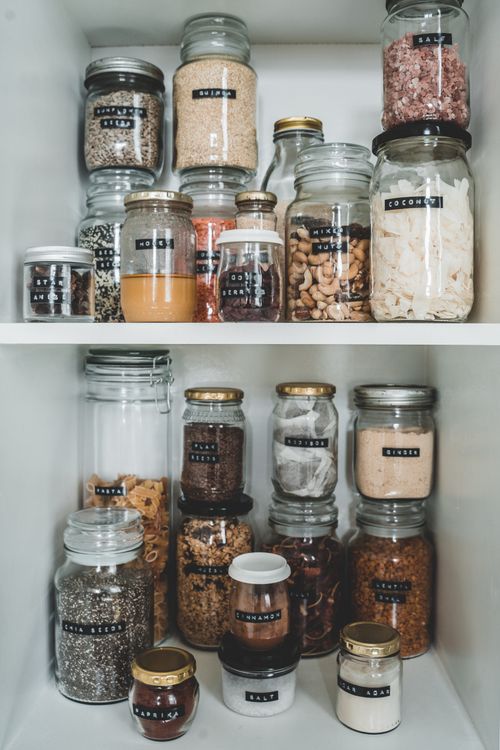
- Clear containers everywhere: uniform clear or labeled containers let you see inventory at a glance, preventing duplicate purchases that eat space.
- Decant ruthlessly: bulky packaging wastes 30–40% of its shelf volume; decanting into square airtight containers tessellates perfectly.
Maintaining the System
Organization decays without maintenance. Build these micro-habits:
- The nightly reset: 10 minutes returning everything to its zone — the system only works if items live in their homes.
- Weekly fridge and counter audit: toss expired items, return strays to their zones.
- Seasonal purge: quarterly, pull each zone’s contents and apply one-in-one-out honestly.
- Label the zones: a label maker on shelves and containers makes the system survive other household members who “don’t know where things go.”
Taming the Under-Sink Cabinet
The under-sink cabinet is the Bermuda Triangle of small kitchens — dark, awkwardly plumbed, and full of half-used bottles. Reclaim it in an hour: pull everything out, discard expired or duplicated products (you do not need three drain cleaners), and wipe the cabinet floor — leaks often go unnoticed here, so check for water damage while you’re in there.
Reorganize with a two-tier sliding organizer (under sink sliding organizer Check Price on Amazon →) that works around the pipes, grouping by task: daily dish supplies front and center, deep-cleaning products behind, trash bags and spare sponges in a bin on the door. Add a small waterproof mat under everything — the next leak will announce itself on the mat instead of silently swelling the cabinet floor. A battery push-light stuck to the cabinet ceiling ($5) transforms the usability of this dark space.
Inside-Cabinet and Pantry Door Storage
Cabinet doors are the most underused square footage in the kitchen. Slim adhesive or screw-mounted racks inside pantry doors hold spice jars, freeing an entire shelf. Inside upper cabinet doors near the stove, mount a rack for wraps, foils, and parchment — items that currently unroll themselves across a drawer. Under-sink doors take spray bottles on a mounted rack, keeping them upright and visible instead of toppling in the dark.
Inside the cabinets themselves, add pull-out drawers to deep base cabinets — the single highest-impact upgrade for lower storage, converting dark caves into accessible sliding shelves. For uppers, shelf risers double capacity for mugs and cans, and turntables rescue deep corner cabinets from becoming expiration-date graveyards. Measure before buying anything; cabinet interiors vary more than product listings assume.
The “Landing Strip” Concept
Small kitchens need a designated landing strip — one clear zone (even just 18 inches of counter) where groceries land, mail gets sorted, and keys live. Without it, every flat surface becomes a dumping ground and the whole kitchen reads as chaotic. Defend the landing strip ruthlessly: it’s the only counter allowed to hold non-cooking items, and it gets cleared nightly as part of the reset.
Pair it with a wall-mounted file or basket for the paper that migrates kitchenward — takeout menus, school forms, coupons. The principle: clutter isn’t a moral failing, it’s homeless stuff. Give the inevitable incoming items a small, bounded home and they stop colonizing the prep areas. In a small kitchen, this one habit can matter more than any organizer you buy.
Frequently Asked Questions
How do I organize a very small kitchen with no pantry?
Create pantry zones in existing cabinets using risers, turntables, and uniform airtight containers — a single well-organized cabinet shelf holds more than a chaotic pantry closet. Add a slim rolling cart for overflow, use wall and door space for spices and wraps, and decant everything to eliminate packaging waste. The constraint forces efficiency.
What should stay on the counter in a small kitchen?
Only items used daily: typically the coffee maker, knife block or strip alternative, and possibly the toaster. Everything else — stand mixer, blender, food processor — should live in cabinets and come out for use. Each permanent counter resident costs you prep space you’ll miss every time you cook.
How do I store pots and pans in a small kitchen?
Store them vertically using a file-style pan organizer so each slides out without unstacking, or hang them on a wall rail or ceiling rack if space allows. Nest what’s nestable with protectors between nonstick surfaces, and store lids vertically in a separate organizer — lids are the real space thieves.
Are magnetic knife strips safe?
Yes, when properly mounted — they’re arguably safer than loose knives in a crowded drawer. Mount the strip at a height and location away from high-traffic edges, use a strong magnet rated for knife weight, and place/blade-up with a rolling motion rather than slapping. Keep them out of reach of small children.
How do I maximize cabinet space in a rental kitchen?
Renters should focus on non-permanent upgrades: adhesive door organizers, tension rods, freestanding risers and turntables, over-door racks, and rolling carts. Avoid drilling by using heavy-duty adhesive hooks and magnetic solutions. Everything listed in this guide’s pillar sections is renter-friendly except toe-kick drawers and hard-mounted pull-outs.
What’s the best way to organize spices in a small kitchen?
Decant into uniform small jars, label the lids (visible from above), and store in a drawer insert, a door-mounted rack, or a tiered riser — alphabetical or by cuisine. Drawer storage is ideal in small kitchens because it uses shallow space efficiently and keeps counters clear. Discard ground spices older than a year; they’re taking up space for no flavor.
How often should I declutter my kitchen?
A quick monthly scan for obvious dead weight plus a thorough seasonal purge works well. The one-in-one-out rule handles the inflow between purges. Tie the seasonal purge to your quarterly deep-clean rotation so the kitchen gets organized and deep-cleaned in the same session.
Do I need matching containers for pantry organization?
Matching isn’t about aesthetics — uniform square or rectangular containers tessellate without wasted gaps, while a jumble of round and odd-sized packaging wastes up to 40% of shelf volume. Clear containers add the bonus of visible inventory. You don’t need an expensive brand; uniformity of shape matters more than the logo.
