
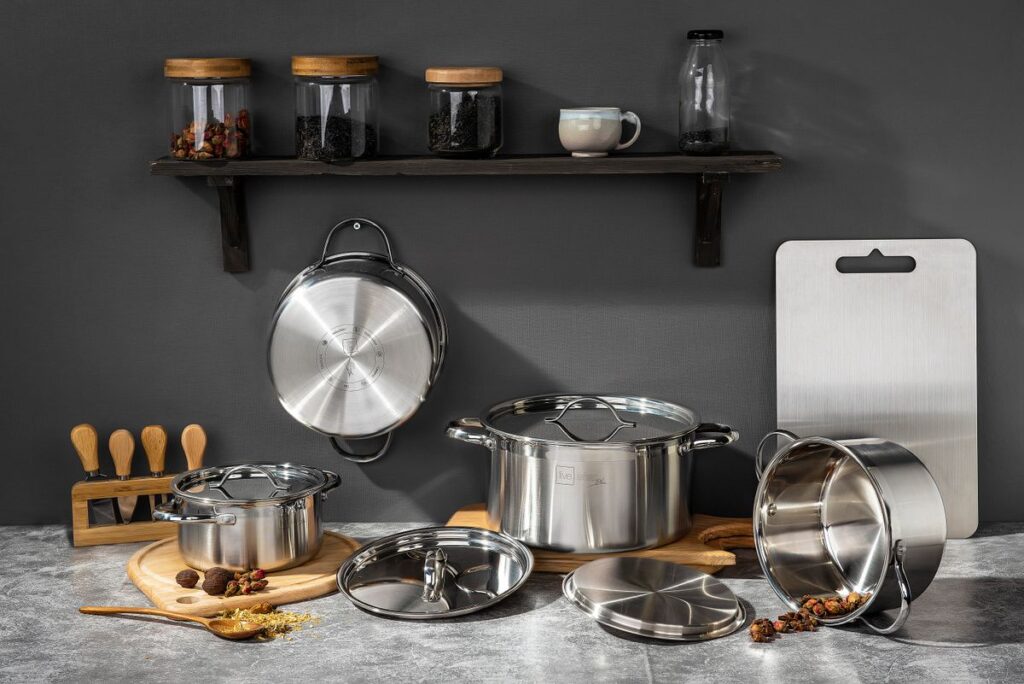
Induction cookware trends 2026 are reshaping pan design from the base up. As induction cooktops take a growing share of kitchen renovations and new builds, manufacturers no longer treat induction compatibility as a checkbox — they engineer for it as the primary use case. Flatter bases, thicker magnetic layers, noise-dampening construction, and honest compatibility labeling define this year\’s shift. Here is what is changing and how to buy pans that truly perform on induction.
Why Induction Changes Pan Design
Induction cooking works through electromagnetism: the cooktop generates a magnetic field that induces current directly in the pan\’s base, heating the pan itself rather than a burner heating the pan. This demands two things from cookware — magnetic material and flat, full contact — and punishes their absence more severely than gas or electric ever did. A warped pan on gas still cooks; a warped pan on induction heats in a ring pattern with a cold center. Understanding induction cookware trends 2026 starts with this physics: the pan is the heating element.
Trend 1: Induction-First Engineering
The headline shift: leading brands now design premium lines for induction first, optimizing base composition, thickness, and flatness for magnetic heating, with gas and electric as compatible secondaries. This reverses the historical order and produces measurably better induction performance — faster, more even heating with less of the buzzing and cycling that plagued early induction cookware. When shopping, \”designed for induction\” now signals genuine engineering rather than marketing.
Trend 2: Thicker, Smarter Magnetic Bases
The magnetic layer is where induction performance lives, and 2026\’s bases are getting more sophisticated. Thicker ferritic stainless layers couple more strongly with the magnetic field, converting energy efficiently and spreading heat before it reaches the cooking surface. Multi-layer base sandwiches — magnetic steel, aluminum core, stainless cooking surface — are precision-tuned so each layer does its job: couple, spread, cook. Cheap pans with thin magnetic discs bonded to aluminum bodies remain the worst induction performers, heating unevenly and buzzing audibly.
Trend 3: Flatness as a Specification
Base flatness, once an afterthought, is now a marketed specification — and rightly so. Induction requires intimate contact between pan base and glass surface; even slight warping creates air gaps that collapse heating efficiency in spots. Quality 2026 induction cookware is machined or precision-pressed to tighter flatness tolerances, and some brands publish flatness specs. The practical test remains simple: a pan that spins or rocks on a flat counter will perform poorly on induction. Check before you buy, and re-check yearly — thermal cycling can warp thin pans over time.
Trend 4: Noise Reduction
Induction buzzing — the audible vibration some pans produce under magnetic fields — has been a persistent annoyance, worst in lightweight, thin, or multi-layer pans with loose-feeling construction. Newer designs dampen it through tighter layer bonding, heavier base mass, and geometries that resist resonant vibration. It is rarely eliminated entirely at maximum power, but 2026\’s better pans hum quietly where older ones buzzed loudly. If you are sensitive to kitchen noise, heavier clad construction is the reliable fix.
Trend 5: Honest Compatibility Labeling
After years of vague \”induction compatible\” claims on marginally performing pans, labeling is improving — partly through retailer pressure, partly through consumer education. The magnet test (a fridge magnet should stick firmly across the entire base, not just the center disc) is now common knowledge, and brands increasingly specify base construction rather than hiding behind the compatibility badge. Still verify yourself: labeling indicates the pan works on induction, not that it works well.
Material Guide: What Works on Induction
| Material | Induction Performance | Notes |
|---|---|---|
| Cast iron | Excellent | Naturally magnetic; heavy base = great contact |
| Carbon steel | Excellent | Magnetic; thin pans heat very fast — learn control |
| Clad stainless (magnetic) | Excellent | The induction sweet spot; verify 18/0 exterior |
| Enameled cast iron | Excellent | Flat heavy base ideal; avoid sliding on glass |
| Hard-anodized aluminum | Good if magnetic base | Needs bonded steel plate; check specs |
| Copper | Good if magnetic base | Modern induction-ready copper includes steel layer |
| Plain aluminum / copper | Does not work | Non-magnetic — no heating at all |
What Does Not Work (and Workarounds)
Plain aluminum, plain copper, and glass cookware will not heat on induction at all — the magnetic field has nothing to couple with. Workarounds exist: induction interface discs (steel plates that sit between cooktop and pan) technically work but defeat induction\’s efficiency and responsiveness, heating slowly and unevenly. They are emergency bridges, not solutions. The real answer for beloved non-magnetic pans is replacement with induction-ready versions — and in 2026, nearly every pan category offers them.
Buying Checklist: Induction-Ready Pans in 2026
- Magnet test: a magnet should grip firmly across the whole base — weak or center-only grip signals a thin disc design.
- Flatness: no rocking or spinning on a flat surface; check both new and periodically thereafter.
- Base thickness: thicker magnetic bases heat more evenly and buzz less — heft is a feature on induction.
- Size matching: pan base should roughly match the induction zone size; tiny pans on huge zones (and vice versa) perform poorly.
- Handle heat: induction keeps sides cooler than gas, but handles near the base still get hot — check handle design.
- \”Designed for induction\” vs \”compatible\”: prefer the former; it signals base engineering, not just a magnetic disc.
Care Specifics for Induction Cooking
Induction\’s speed demands adjusted habits: pans heat shockingly fast, so preheating needs less time and lower settings than gas-trained instincts suggest — overheating empty pans is easier and more damaging. Lift rather than slide pans on glass surfaces to avoid scratching; grit trapped under a pan grinds the glass. Keep the cooktop clean — burnt-on residue between glass and pan base insulates and causes hot spots. And match pan size to zone: induction is least forgiving of mismatch among all heat sources.
The 2026 Market: What to Buy
The practical takeaway from induction cookware trends 2026: if you cook on induction now or might within the pan\’s lifetime, default to magnetic clad stainless, cast iron, or carbon steel — the materials that are natively excellent on induction. For nonstick needs, choose hard-anodized or hybrid pans with substantial bonded magnetic bases, not thin discs. Avoid anything where the induction compatibility feels like an afterthought, because on induction, the base is the pan\’s engine — and engines matter.
Switching to Induction: The Pan Audit Checklist
Considering an induction cooktop? Audit your cookware before you commit — the results determine whether the switch costs hundreds in replacement pans or nothing at all. Walk through your cabinet with a fridge magnet: test every pan\’s base, noting which grip firmly (keepers), which grip weakly or only in the center (marginal — usable but uneven), and which do not grip at all (replacements needed). Most cooks discover their cast iron, carbon steel, and clad stainless pass easily, while plain aluminum nonstick and old copper fail.
Budget the replacements honestly: a marginal disc-bottom aluminum nonstick skillet that \”works\” on induction will heat in a ring pattern and frustrate you daily — replacing it with a proper induction-ready pan is part of the cooktop\’s true cost. Prioritize the daily drivers first (skillet, saucepan), since occasional-use pieces can wait. And keep one gas or portable burner (a cheap butane stove) during the transition — it smooths the learning curve and handles any beloved non-magnetic pan you cannot bear to replace. The induction cookware trends 2026 all point the same direction: audit first, buy once, and let the magnet decide.
Induction Myths Worth Retiring
Several persistent myths distort induction decisions. Myth 1: \”Induction requires special expensive pans.\” Reality: any magnetic pan works, and cast iron and carbon steel — among the cheapest quality cookware — are ideal. Myth 2: \”You cannot toss food on induction.\” Reality: lifting the pan briefly is fine; the field re-engages instantly on contact. Only prolonged hovering matters, and no stir-fry technique requires it.
Myth 3: \”Induction is fragile and fussy.\” Reality: the glass is tougher than it looks (though cast iron should be lifted, not slid), and modern units are reliable. Myth 4: \”Food tastes different on induction.\” Reality: heat is heat — induction changes the delivery, not the chemistry. What actually differs is control: instant response rewards attention and punishes distraction, so the adjustment is in the cook\’s habits, not the food\’s flavor. Retire the myths, keep the magnet test, and induction becomes the upgrade its advocates promise.
Frequently Asked Questions
How do I know if my pans work on induction?
Hold a magnet to the base — if it sticks firmly, the pan will heat on induction. Firm grip across the whole base indicates good performance; weak or center-only grip suggests a thin disc design that will heat unevenly. When in doubt, test the actual pan on the cooktop before committing.
Why does my pan buzz on induction?
The magnetic field vibrates the pan\’s layers, especially at high power — thin, lightweight, or loosely bonded multi-layer pans buzz most. Heavier, tightly bonded clad construction buzzes least. Some buzzing at maximum power is normal; loud buzzing at moderate settings suggests a poor base design.
Can induction damage cookware?
Induction heats so fast that it can warp thin pans and overheat empty ones more easily than gas — thermal shock from plunging a hot pan into water is equally damaging. Use moderate preheat settings, avoid maximum power on empty pans, and prefer thicker-based cookware for longevity.
Do I need special cleaners for induction cooktops?
The glass surface needs non-abrasive care: ceramic cooktop cleaner and a soft cloth or scraper for burnt residue. Keep pan bases clean too — carbonized crud on the base transfers to the glass and bakes on. Clean spills promptly; sugary spills can pit the glass if left to burn.
Is induction cooking faster than gas?
For boiling water, yes — measurably. Induction transfers roughly 85–90 percent of energy to the pan versus ~40 percent for gas, so water boils faster with less waste heat. For technique-driven cooking the speed advantage matters less than the precise, instant control.
Will my copper pans work on induction?
Only modern induction-ready copper with a bonded magnetic stainless base layer. Traditional pure copper and vintage pieces will not heat. Check with a magnet — if it does not stick firmly, the pan needs an induction-ready replacement.
What pan size matches my induction zones?
Match the pan\’s base diameter to the zone\’s marked circle as closely as possible. Undersized pans heat inefficiently and can confuse sensors; oversized pans heat only the contacted area, leaving cold edges. Most manufacturers print zone diameters in the manual.
Can I use my old nonstick pans on a new induction cooktop?
Only if a magnet sticks firmly to their bases — many older aluminum nonstick pans lack magnetic layers entirely. Test each pan; replace failures with induction-ready versions rather than using interface discs, which waste energy and heat unevenly. Budget this replacement into the cooktop\’s true cost.
Does induction work during a power outage?
No — induction requires electricity, unlike gas. If outage resilience matters, keep a portable butane burner as backup; it also handles any non-magnetic pans you kept. This is a genuine lifestyle consideration in areas with unreliable power, worth weighing before switching.
Do I need to replace my bakeware for induction?
No — bakeware goes in the oven, where induction is irrelevant. Only stovetop cookware needs magnetic bases. This is a common point of confusion: your sheet pans, roasting pans, and dutch ovens used for baking are unaffected, though a dutch oven used on the induction cooktop itself does need its magnetic base (cast iron qualifies).
Why do some induction-ready pans still heat unevenly?
Usually a thin magnetic disc bonded to a thick aluminum body — the disc couples with the field only in the center, creating a hot ring with cooler edges. Fully clad construction with a thick magnetic layer spread across the whole base heats far more evenly. The magnet test across the entire base reveals the difference before you buy.
Is induction cooking safe?
Yes — induction cooktops are among the safest options available. The glass surface stays relatively cool since heat generates in the pan itself, reducing burn risk, and most units auto-shutoff when no pan is detected. The electromagnetic field is non-ionizing and drops to negligible levels inches from the surface, well within international safety standards.
