
Intro
Every home cook has lived this moment: you press a tomato and it squishes instead of slices. The fix isn’t a new knife — it’s a good knife sharpener. Dull knives are genuinely more dangerous than sharp ones, because they force you to push harder and slip more easily. The good news is that keeping your knives in working order no longer requires a whetstone apprenticeship. Today’s sharpeners are built with beginners in mind, with preset angles and simple pull-through slots that take the guesswork out of the process.
This guide compares five well-regarded, widely available sharpeners across the three main types: pull-through, electric, and whetstone. These picks are based on manufacturer specifications, third-party reviews, and aggregated buyer feedback — no lab coats, no hype. Whether you want the fastest fix or the most satisfying ritual, one of these five will fit your kitchen.
Our Top Picks
- Best overall for beginners: KitchenIQ Edge Grip 2-Stage — dead simple, fits in a drawer, works in seconds.
- Best for straight + serrated knives: AccuSharp 001C — the long-time favorite that sharpens almost everything with a blade.
- Most versatile: Work Sharp Pivot Pro — knives, scissors, and garden tools in one handheld package.
- Best electric: Presto 08810 Professional — push-button sharpening with a three-stage system.
- Best whetstone kit: Sharp Pebble 1000/6000 — the classic starter stone with an angle guide included.
KitchenIQ Edge Grip 2-Stage Knife Sharpener
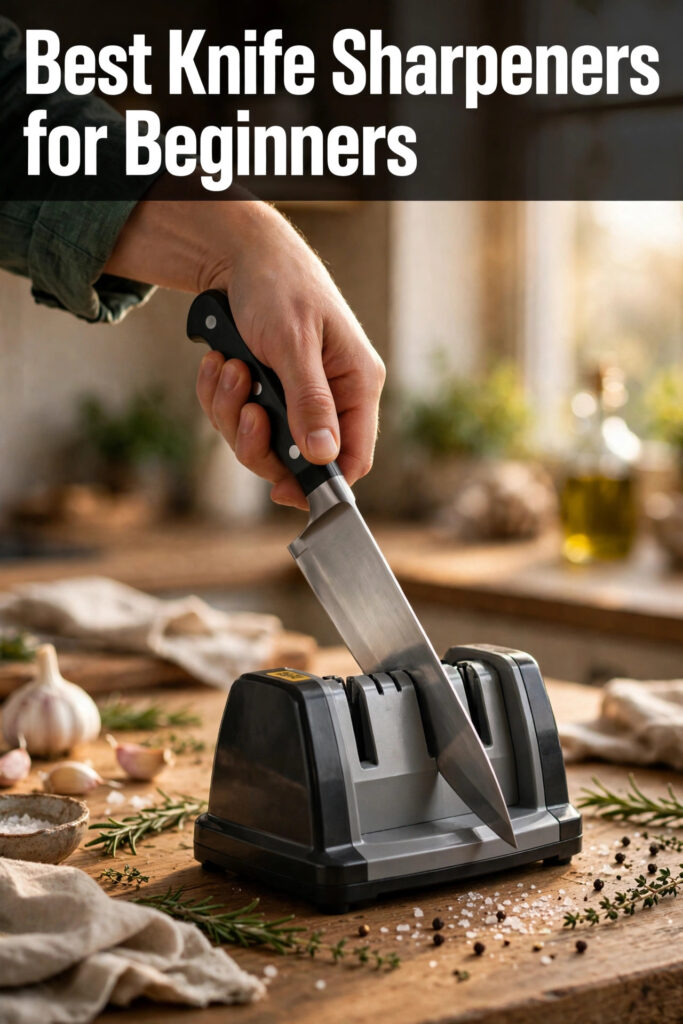
If you’ve never sharpened a knife before, start here. The KitchenIQ Edge Grip is a palm-sized pull-through sharpener with two stages: a coarse tungsten carbide slot that resets a dull edge, and a fine ceramic slot that hones and polishes it. You pull the blade through each slot a few times, heel to tip — no water, no oil, no angle to hold by hand. The base hooks over a counter edge, which is genuinely useful for long chef’s knives where the tip would otherwise drag on the countertop. Reviewers consistently praise how sturdy it feels, and it’s the kind of tool that lives in a drawer and actually gets used.
Pros:
- Easiest possible entry point — no setup, no technique to learn
- Compact enough for any kitchen drawer
- Coarse carbide slot handles genuinely dull knives, not just touch-ups
- Fine ceramic stage gives a smooth, polished edge
Cons:
- Aggressive carbide stage removes more metal than gentler methods, so don’t use it every day
- Small size can feel awkward in larger hands
- Not the best choice for thin Japanese-style blades, which need a more delicate touch
AccuSharp 001C Knife & Tool Sharpener
The AccuSharp has been around for decades, and there’s a reason it keeps selling: it’s basically foolproof. Instead of fixed slots, you hold this ergonomic handheld tool and draw it across a stationary blade — the diamond-honed tungsten carbide bar does the work. It sharpens straight-edge and serrated knives alike, and buyers report it works on everything from chef’s knives to axes and lawn tools. A full-length finger guard protects your hand, and the carbide blade is reversible, effectively doubling its lifespan.
Pros:
- Works on serrated blades, not just straight edges
- Reversible tungsten carbide blade doubles the tool’s lifespan
- Full-length finger guard makes it genuinely safe for beginners
- Extremely versatile — handles pocket knives, cleavers, even garden tools
Cons:
- Single aggressive carbide stage, with no finer honing stage built in
- Like all carbide sharpeners, it removes metal quickly — overuse shortens knife life
- Sharpening happens by moving the tool, which takes a little practice to keep even
Work Sharp Pivot Pro Knife & Tool Sharpener
Work Sharp is a name knife people know, and the Pivot Pro packs a surprising amount of capability into a handheld tool. The main knife module uses convex carbide plates plus fine ceramic rods, and its Pivot Response design lets the abrasives follow the curve of the blade, keeping the edge consistent along its full length. It also includes removable modules for scissors/shears and for garden tools, plus a medium-grit diamond plate for rougher jobs. For a beginner who wants one tool for kitchen knives and most other household blades, it’s hard to beat on versatility.
Pros:
- Sharpens knives, scissors, garden tools, and more with dedicated modules
- Pivot Response follows the blade’s curve for a more consistent edge
- Ceramic rods give a finer honing finish than carbide-only tools
- Can lock out the pivot for gentler touch-ups with less material removal
Cons:
- More parts and modules than a simple two-slot sharpener — slightly more to learn
- Handheld design means you hold the tool and blade, which is less stable than a countertop unit
- Not a substitute for a whetstone if you want a truly refined edge
Presto 08810 Professional Electric Knife Sharpener
If you’d rather push a button than think about technique, an electric sharpener is the answer, and the Presto 08810 is the beginner-friendly classic. It uses a three-stage system with interchangeable sharpening wheels: the first stage grinds and resets the edge, the second refines it, and the third polishes it to a razor-sharp finish. You simply draw the knife through each slot a few times with light pressure — the machine handles the angle. It works on most straight-edge kitchen and sporting knives, and it’s one of the most affordable electric options from an established brand.
Pros:
- Fully guided — the machine holds the angle, so technique is nearly irrelevant
- Three stages take a blade from dull to polished in one session
- Fast and nearly effortless once you learn the basic motion
- Reasonably priced for an electric sharpener
Cons:
- Takes up counter or cabinet space, unlike a drawer-sized manual sharpener
- Removes metal faster than hand methods — use the coarse stage sparingly
- The blade guides need care; dragging sideways can scratch the blade
Sharp Pebble Premium Whetstone Kit (1000/6000 Grit)
For beginners who want to learn the real craft, the Sharp Pebble kit is the standard recommendation. The double-sided stone gives you a 1000-grit side for sharpening and a 6000-grit side for polishing. Crucially, it ships with an angle guide that clips onto the blade and keeps you at the correct angle while you learn — plus a non-slip bamboo base, a flattening stone, and clear instructions. A whetstone removes the least metal of any method and produces the longest-lasting, keenest edge.
Pros:
- Removes the least metal of any sharpening method — kindest to your knives
- Included angle guide makes learning dramatically easier than freehand
- Complete kit: bamboo base, flattening stone, and instructions in the box
- The 6000-grit side gives a polished, razor finish pull-throughs can’t match
Cons:
- Steepest learning curve of any pick here — expect practice before great results
- Slowest method; each knife takes several minutes
- The stone must be soaked before use and flattened periodically to stay true
Buying Guide
Pick your type first. Pull-through sharpeners (KitchenIQ, AccuSharp) are the fastest and simplest: drag the knife through a fixed slot a few times. Electric sharpeners (Presto) do the same thing with a motor and are even more foolproof. Whetstones (Sharp Pebble) take the most time and practice but give the best edge and the gentlest treatment.
Look for angle guidance. The number-one beginner mistake is sharpening at the wrong angle. Pull-through and electric models fix the angle for you; if you go the whetstone route, make sure the kit includes an angle guide, as the Sharp Pebble does.
Check serrated-blade compatibility. Most pull-through and electric sharpeners are designed for straight-edge blades only. Serrated knives (bread knives, steak knives) need a different approach — the AccuSharp handles them, and a whetstone used carefully on the flat side works too.
Think about safety. A full-length finger guard (AccuSharp), a non-slip base (KitchenIQ, Sharp Pebble), or a countertop design all reduce the chance of a slip. Always sharpen away from your body and keep your fingers clear of the blade path.
Ease of use vs. edge quality. There’s a real trade-off: faster methods remove more metal and produce a shorter-lived edge, while slower methods are kinder and sharper. For most home cooks, a pull-through for weekly touch-ups plus a whetstone for periodic maintenance is the ideal pairing.
Grit stages matter. A coarse stage repairs damage and resets the edge; a fine stage polishes and hones it. Two stages are the minimum for a versatile sharpener.
FAQs
Do pull-through sharpeners damage knives? They don’t destroy knives in normal use, but they do remove more metal than a whetstone or ceramic rod. Used occasionally — when a knife is genuinely dull — they’re fine. Used every day, they’ll shorten a knife’s life noticeably. Use the coarse stage only when needed and the fine stage for regular touch-ups.
How often should I sharpen my knives? It depends on use. A daily-use chef’s knife benefits from a few passes on a fine stage or honing rod every couple of weeks, with a full sharpening a few times a year. The paper test is your guide: if a knife won’t slice paper cleanly, it’s time.
Whetstone or pull-through for a total beginner? Start with a pull-through if your priority is convenience — you’ll actually use it. Move to a whetstone when you want better edges and don’t mind spending ten minutes per knife. Many cooks end up owning both.
Can you sharpen serrated knives at home? Yes, but not with a standard pull-through slot, which can flatten the serrations. The AccuSharp is one of the few simple tools that handles serrated edges well. Otherwise, use a tapered ceramic rod on each serration, or take the knife to a professional — serrated blades need sharpening far less often than straight ones.
How do I know when my knife is actually sharp? The classic paper test: a sharp knife slices a sheet of printer paper cleanly with no tearing. A sharp blade also bites into a tomato’s skin with almost no pressure. If you’re sawing or pressing hard, the knife is dull.
