
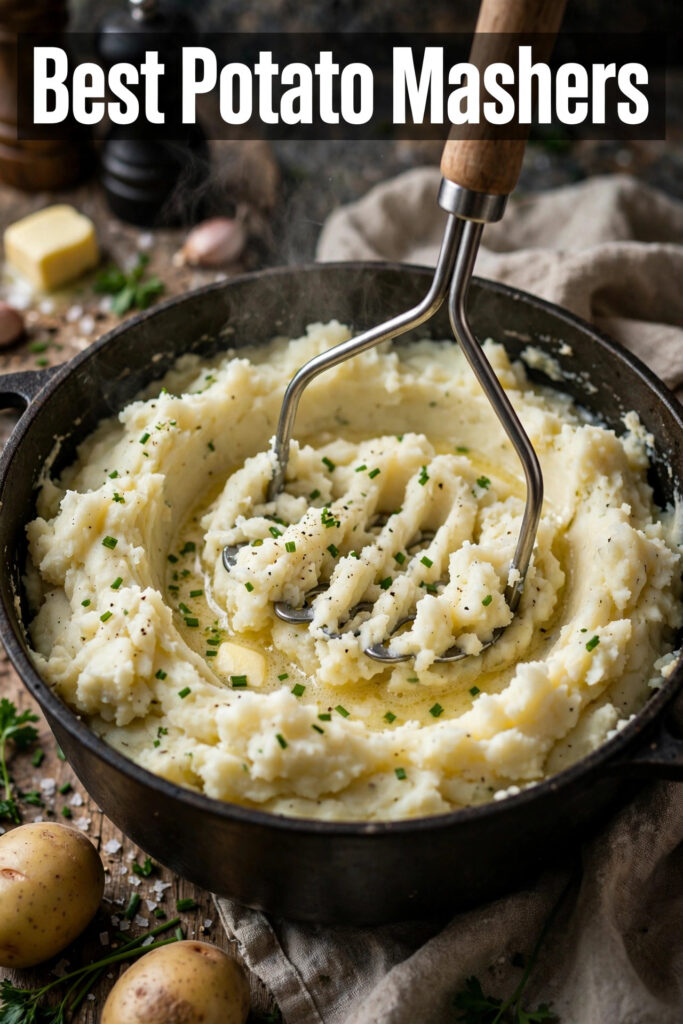
Intro
The best potato masher for mashed potatoes turns a pot of boiled spuds into fluffy, lump-free mash in minutes — without overworking the starch into glue. The trick is the head: perforated plates press potatoes into a smooth, even mash faster than old wire zigzags, and a sturdy, rigid build means the masher does the work instead of your arms. Below, we compare six of the best-selling potato mashers and ricers available right now, from the test-kitchen favorite to a non-stick-safe nylon pick.
Our Top Picks
Zyliss Stainless Steel Potato Masher
The Zyliss Stainless Steel Potato Masher is the top pick of America’s Test Kitchen and our best overall choice. Its thick, rigid perforated disk mashes potatoes to a fine, even texture, the tall profile keeps your hands away from the steam, and the soft-touch handle stays comfortable through a big holiday batch. It is the masher to buy if you only want to buy one.
Pros:
- Test-kitchen favorite with a thick, rigid perforated head that will not flex
- Produces a fine, even mash quickly
- Tall design keeps hands safely away from hot potatoes
- Comfortable soft-touch handle
Cons:
- Larger perforations can leave a few small lumps if you rush
- Stainless head can scratch non-stick pots, so mash in a different pot
- Pricier than basic wire mashers
OXO Good Grips Smooth Potato Masher
The OXO Good Grips Smooth Potato Masher is the classic reliable pick, with a broad stainless steel head and OXO’s famously comfortable non-slip grip. It makes smooth, lump-free mashed potatoes with minimal effort, and the head is wide enough to cover a whole pot quickly. A great choice for cooks who mash potatoes weekly.
Pros:
- Wide stainless steel head covers more potato per press
- Soft, non-slip grip stays secure with wet hands
- Makes smooth, lump-free mash with little effort
- Dishwasher-safe and built to last
Cons:
- Not ideal for very deep pots — the handle is on the shorter side
- Stainless head is not safe for non-stick cookware
- Heavier than wire-style mashers
KitchenAid Gourmet Potato Masher
The KitchenAid Gourmet Potato Masher is the budget pick that punches above its price. It is lightweight, easy to wield, and its medium round head with small square perforations mashes thoroughly and moves nimbly around the pot. If you want a dependable masher for occasional use, this is hard to beat for the money.
Pros:
- Budget-friendly price
- Lightweight and easy to use for a full pot
- Small square perforations produce a thorough, even mash
- Compact head reaches into pot corners
Cons:
- Shorter handle puts hands closer to hot potatoes, especially in a Dutch oven
- Lighter build flexes more under heavy use than premium models
- Smaller head means more passes on a very large batch
Calphalon Nylon Potato Masher Utensil
The Calphalon Nylon Potato Masher is the pick for non-stick cookware. Its nylon head will not scratch Teflon or ceramic coatings, it is heat-resistant to 400°F so you can mash straight from the stove, and the wide handle gives a secure grip. Backed by a lifetime warranty, it is the worry-free option for cooks who mash right in the pot they cooked in.
Pros:
- Nylon head is safe for non-stick and ceramic cookware
- Heat-resistant to 400°F for mashing straight off the heat
- Wide, ergonomic handle for a secure grip
- Lifetime warranty
Cons:
- Nylon is less rigid than stainless steel, so very firm potatoes need more passes
- The head design gives a slightly more rustic texture than a perforated plate
- Bulkier to store than a slim wire masher
KUKPO Stainless Steel Potato Masher
The KUKPO Stainless Steel Potato Masher stands out with its broad, horizontal handle — a design that lets you press with both hands or with a flat palm, making it the best choice for anyone with limited grip strength or wrist pain. The sturdy stainless construction handles big batches without flexing, and the wide head mashes fast.
Pros:
- Broad horizontal handle allows two-handed or palm pressing
- Excellent for cooks with limited hand strength or wrist issues
- Sturdy stainless steel build that does not flex
- Wide head mashes a large pot quickly
Cons:
- The unusual handle shape takes a little getting used to
- Not the best choice for small saucepans — the head is wide
- Heavier than the KitchenAid budget pick
OXO Good Grips 3-in-1 Adjustable Potato Ricer
The OXO Good Grips 3-in-1 Adjustable Potato Ricer is the upgrade pick for the smoothest possible mash. Its adjustable head switches between fine, medium, and coarse textures, pressing cooked potatoes through small holes for a lump-free, pillowy result that a regular masher cannot quite match. It also handles sweet potatoes, carrots, and even chunky applesauce.
Pros:
- Adjustable fine, medium, and coarse settings for total texture control
- Produces the smoothest, most lump-free mash of any tool here
- Also works for other vegetables and applesauce
- Durable stainless steel construction
Cons:
- Slower than a masher — you press potatoes through in batches
- More parts to clean than a simple masher
- Costs more than every standard masher on this list
Buying Guide
Head design matters most. Perforated plates beat wavy wire heads for smooth mashed potatoes: they press the potato through evenly and quickly, while wire heads tend to leave lumps and take longer. If you love rustic, chunky mash, a wire head is fine — but for classic fluffy mash, choose a plate.
Rigidity. A masher made from thick, rigid metal will not flex or warp when you lean into a pot of firm potatoes. Thin, flimsy mashers bend, waste your effort, and eventually snap at the joint.
Handle length and grip. A longer handle keeps your hands away from steam and hot potatoes, which matters most in a deep Dutch oven. A soft, non-slip grip helps on long mashing sessions, and a horizontal handle like the KUKPO’s is a genuine help for weak wrists.
Cookware safety. If you mash directly in a non-stick or ceramic pot, choose a nylon or silicone head like the Calphalon — a stainless head will score the coating. Otherwise, stainless is the more durable choice.
Masher vs. ricer. A masher is faster and simpler; a ricer is slower but produces the silkiest texture. If Thanksgiving mash is your signature dish, the ricer is worth the extra effort. For weeknight sides, a good masher wins.
FAQs
What is the best potato masher for smooth mashed potatoes? A perforated-plate masher like the Zyliss or OXO Smooth, or better yet a ricer like the OXO 3-in-1 Adjustable, gives the smoothest results. Boil the potatoes until fully tender first — no tool can fix undercooked potatoes.
Can I use a potato masher on non-stick pans? Only with a nylon or silicone head. Stainless steel mashers will scratch non-stick and ceramic coatings. Either mash in a different pot or choose the Calphalon nylon masher.
Why are my mashed potatoes gluey? Overworking is the usual culprit: mashing too long, or using a blender or food processor, ruptures starch cells and turns the mash pasty. Mash just until smooth, add warm butter and milk, and stop as soon as it looks right.
Is a potato ricer better than a masher? For the smoothest, most lump-free texture, yes — a ricer presses potatoes through fine holes without overworking them. For speed and everyday use, a masher is faster and easier to clean.
How do I clean a potato masher? Most stainless and nylon mashers are dishwasher-safe, but potato starch dries into a cement if left sitting. Rinse the head right after use, and soak briefly in hot soapy water before washing.
