
Intro
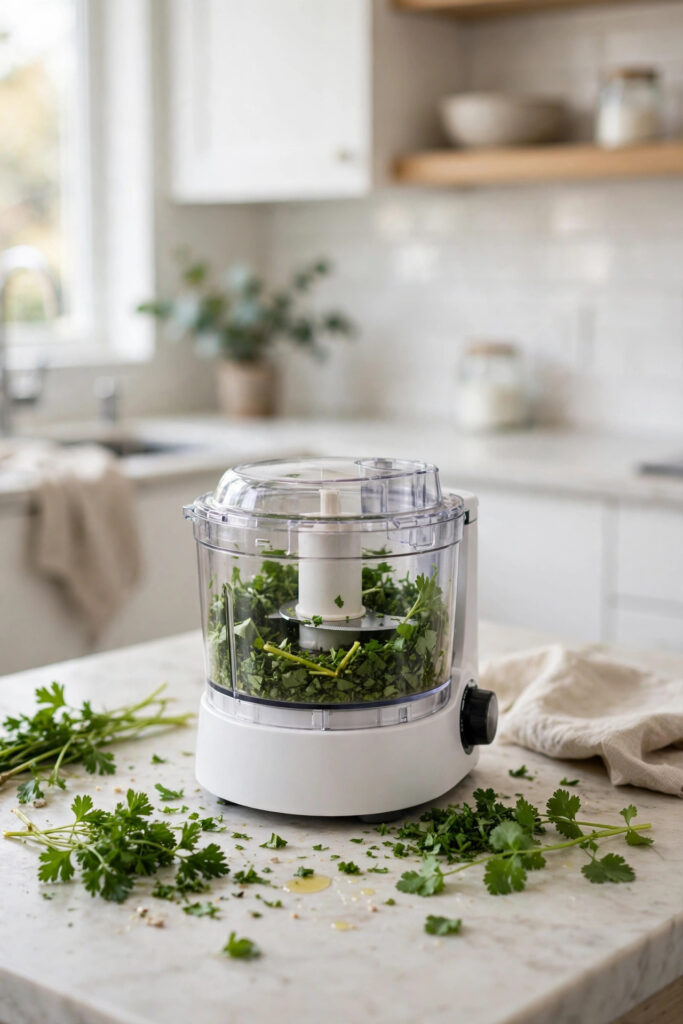
The best mini food processor for small kitchens is the one that earns its counter space — small enough to live on the counter or in a single cabinet, strong enough to chop an onion without turning it to mush, and easy enough to clean that you actually use it on a Tuesday night. A full-size processor is overkill for most weeknight jobs; a mini handles herbs, garlic, salsa, pesto, and dressings in seconds, and it fits in a drawer when you are done.
The sweet spot is 3–4 cups: below 3 cups you are limited to garnish-size jobs, above 4 cups you are in full-size territory with a full-size footprint. What matters most is pulse control — short bursts that let you stop at a chop instead of sliding into a puree — and a bowl, lid, and blades that go straight in the dishwasher. Below, we’ve compared six mini food processors available right now for small kitchens, weighing capacity, power, and how they handle real weeknight jobs.
Our Top Picks
Cuisinart Mini-Prep Plus Food Processor (DLC-2A)
The Cuisinart Mini-Prep Plus is our best overall pick. Its auto-reversing SmartPower blade gives you chop mode for herbs and vegetables and grind mode for hard cheese and nuts, and it delivers the most consistent chop in its class. The 250W motor is plenty for small batches, the bowl and lid are dishwasher-safe, and the footprint is tiny — about 5 x 7 x 9.25 inches.
Pros:
- Auto-reversing SmartPower blade — chop mode for herbs and vegetables, grind mode for hard cheese and nuts
- Most consistent chop in its class
- 250W motor with a tiny footprint, about 5 x 7 x 9.25 inches
- Bowl and lid are dishwasher-safe
Cons:
- 24 oz (3-cup) bowl is too small for family-size batches
- No slicing or shredding functions — chop and grind only
- No variable speeds beyond the two blade modes
KitchenAid 3.5-Cup Food Chopper (KFC3516)
The KitchenAid 3.5-Cup Food Chopper is our best pick for sauces, dressings, and salsa. Its 3.5-cup bowl is the largest among the true minis, it has two speeds plus pulse, and the drizzle basin in the lid lets you emulsify dressings and mayonnaise while the machine runs. A pour spout and locking blade let you serve straight from the bowl, and it comes in many colors.
Pros:
- 3.5-cup bowl — the largest here
- Two speeds plus pulse, with a drizzle basin in the lid for emulsifying dressings and mayo
- Pour spout and locking blade let you serve straight from the bowl
- Comes in many colors to match your kitchen
Cons:
- 240W motor is slightly less powerful than the Cuisinart
- Bigger bowl means a slightly bigger footprint
- Not for large batches either — 3.5 cups is still a mini
Hamilton Beach 3-Cup Stack & Press Food Chopper (72740)
The Hamilton Beach Stack & Press is our best pick for power-first buyers. Its 350W motor is the most powerful in this roundup, and the stack-and-press operation has no buttons to learn — just stack the bowl and press the lid. Stainless steel blades, dishwasher-safe bowl, lid, and blades, and a 4.6-star owner rating round out a strong package.
Pros:
- 350W motor — the most powerful in this roundup
- Simple stack-and-press operation with no buttons to learn
- Stainless steel blades; bowl, lid, and blades are dishwasher-safe
- 4.6-star rated by owners
Cons:
- Single-speed, no variable control — easy to over-chop onions into mush if you press too long
- Some owners find the bowl and lid awkward to clean
- Plastic parts feel less durable than the Cuisinart or KitchenAid
Ninja Food Chopper Express Chop (NJ110GR)
The Ninja Express Chop is our best pick for singles and couples. Its 200W motor with one-touch pulse is very easy to control, the 16 oz bowl is perfect for single servings, and a splash guard keeps the mess in. It is 4.7-star rated and extremely compact — the smallest footprint here after the BLACK+DECKER.
Pros:
- 200W motor with one-touch pulse — very easy to control
- 16 oz bowl is perfect for single servings of garlic, herbs, and salsa
- Splash guard keeps mess in; 4.7-star rated
- Extremely compact
Cons:
- 16 oz is the smallest capacity here — not enough for a full salsa batch
- No speeds, pulse only
- Light-duty only — not for hard cheese or large batches
BLACK+DECKER 1.5-Cup Electric Food Chopper
The BLACK+DECKER 1.5-Cup Chopper is our best budget pick. It is the cheapest entry point here, with dishwasher-safe parts and sharp stainless steel blades, and a 150W motor that handles herbs, garlic, and nuts. It is truly tiny — it fits in a drawer — which makes it the pick for the smallest kitchens and the smallest budgets.
Pros:
- Cheapest entry point in this roundup
- Dishwasher-safe parts and sharp stainless steel blades
- 150W motor handles herbs, garlic, and nuts
- Truly tiny — fits in a drawer
Cons:
- 1.5-cup bowl is too small for anything beyond garnish-size jobs
- Pulse only, no variable speeds
- Blade handle can be slippery when wet
Cuisinart Elemental 4-Cup Chopper/Grinder (FP-5)
The Cuisinart Elemental 4-Cup is our best pick for small kitchens that still want shredding. Its 4-cup capacity is the largest bowl here, and a reversible shredding disc adds slicing and shredding the other models lack — so it can grate cheese and shred carrots as well as chop. It carries the same Cuisinart build quality as the Mini-Prep Plus.
Pros:
- 4-cup capacity — the largest bowl here
- Reversible shredding disc adds slicing and shredding the other models lack
- Same Cuisinart build quality as the Mini-Prep Plus
Cons:
- Bigger footprint than the true minis — borderline for a “small kitchen” pick
- Costs more than the 3-cup models
- Fewer dedicated reviews than the other picks here, so pros and cons are spec-based
Buying Guide
Capacity — 3 to 4 cups is the sweet spot: Below 3 cups you are limited to garnish-size jobs — a clove of garlic, a handful of herbs. At 3–4 cups you can make a full batch of salsa, pesto, or hummus for two to four people. Above 4 cups, you are in full-size processor territory with a full-size footprint, which defeats the point in a small kitchen.
Pulse control beats multiple speeds: The most common mini-processor mistake is over-chopping onions into mush. Short pulses — one second on, lift, check — give you a chop you can stop at. Multiple speeds sound useful, but for a 3-cup bowl, pulse control is what actually prevents puree. The Ninja and BLACK+DECKER are pulse-only and that is fine; the Hamilton Beach’s single-speed stack-and-press demands a light touch.
Dishwasher-safe parts matter more than motor watts: You will use the processor you can clean in ten seconds, not the one with the biggest motor. A bowl, lid, and blades that go straight in the dishwasher (Cuisinart, KitchenAid, Hamilton Beach) turn a 30-second job into a real habit; hand-washing a fixed blade assembly turns it into a chore you skip.
The drizzle basin is the differentiator for dressings: Only the KitchenAid has a drizzle basin in the lid — a small opening that lets you stream oil in slowly while the machine runs, which is how you emulsify mayonnaise and vinaigrettes without them breaking. If you make dressings weekly, that one feature is worth choosing the KitchenAid for.
Footprint — measure before you buy: Mini processors range from drawer-sized (BLACK+DECKER, Ninja) to a small countertop appliance (Cuisinart Elemental). Measure the cabinet or counter spot where it will live, including the height with the lid on — a processor that does not fit its home ends up in a box.
FAQs
What size mini food processor do I need? For one or two people, 1.5–3 cups covers herbs, garlic, and single-serve salsa. For a family of four, 3.5–4 cups is the minimum for a full batch of salsa, pesto, or hummus. Above 4 cups you are buying a full-size processor, not a mini.
Can a mini food processor make pesto and hummus? Yes — both are ideal mini-processor jobs, as long as the bowl is big enough. A 3-cup bowl makes a small batch of pesto or hummus for two to four people; work in two batches for more. Add liquid through the lid while pulsing for the smoothest result.
Mini food processor vs. blender — which is better for chopping? A mini processor, every time. Blenders need liquid to move food past the blades and turn dry ingredients into puree; a processor’s wide bowl and pulse control chop dry ingredients evenly without liquid. Use a blender for smoothies and soups, a processor for chopping, slicing, and dough.
Can I put mini food processor parts in the dishwasher? Most bowls, lids, and blades here are dishwasher-safe — Cuisinart, KitchenAid, Hamilton Beach, and BLACK+DECKER all say so. The motor base never goes in water; wipe it with a damp cloth. Check your model’s manual, since some blades dull faster with repeated dishwasher cycles.
How do I keep onions from turning to mush in a mini food processor? Pulse in one-second bursts and check after every two or three pulses. Cut the onion into quarters first so the pieces are even, and stop as soon as the pieces look right — the blades keep cutting for a split second after you release the button.
Is a mini food processor worth it if I already have a full-size one? Yes, if you cook for one or two people or chop small amounts often. A full-size processor’s wide bowl leaves small quantities smeared up the sides where the blades cannot reach; a mini’s narrow bowl keeps a handful of herbs or a single onion in contact with the blade.
