Intro
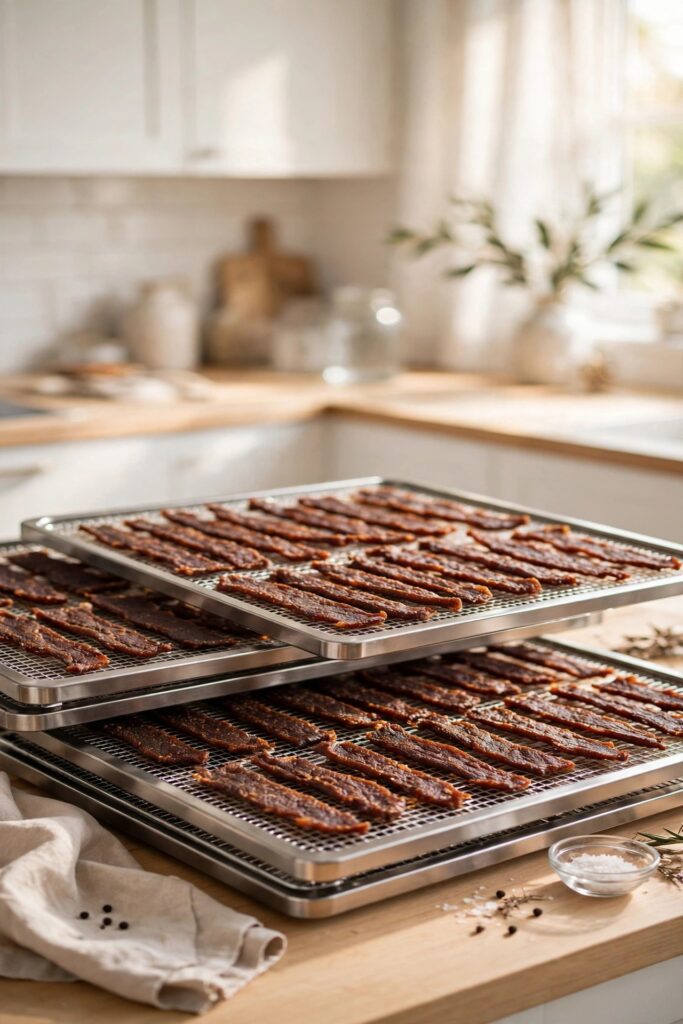
The best food dehydrators for jerky do one job that punishes shortcuts: hold a steady, safe temperature for hours while thin strips of meat dry evenly. Jerky is not like drying apple slices — if the temperature drifts low, the meat spends too long in the danger zone; if it runs hot and uneven, the outside hardens while the inside stays moist. The machine that wins is the one you can trust alone with a batch overnight.
The buying question is temperature control plus tray space. The USDA recommends heating meat to 160°F when making jerky, so a dehydrator that tops out below that limits what you can safely make — look for a 165°F ceiling and a thermostat you can set by the degree, not a vague dial. Tray count and shape decide batch size: square trays fit jerky strips better than round ones, and nine trays dry a whole batch at once where five trays mean two runs. Below, we have compared five dehydrators available right now, weighing temperature accuracy, capacity, airflow, and how miserable the trays are to clean after a fatty batch.
Our Top Picks
COSORI Premium Food Dehydrator CP267-FD
The COSORI Premium CP267-FD is our best overall pick for jerky. It is the most complete jerky machine for most kitchens: a 165°F ceiling you set to the degree on a digital panel, six stainless steel trays that go straight in the dishwasher after a fatty batch, and a 48-hour timer with auto shut-off so you can load it at night and walk away. The rear-mounted fan moves air horizontally across every tray, so the top shelf finishes at the same time as the bottom with no rotating.
Pros:
- Digital temperature control from 95°F to 165°F in precise steps — hits the USDA jerky target
- Six stainless steel trays are dishwasher safe after greasy jerky batches
- 48-hour timer with auto shut-off for overnight runs
- Horizontal airflow dries all trays evenly with no rotation
Cons:
- Six trays is a medium batch — serious jerky makers will want more capacity
- Stainless steel body is heavier and pricier than plastic rivals
- Glass door shows the batch but needs wiping to stay clear
Excalibur 3926TB 9-Tray Food Dehydrator
The Excalibur 3926TB is our best pick for big batches. Nine trays give you 15 square feet of drying space in a single load — a whole round of jerky at once — with Excalibur’s Parallexx horizontal airflow pushing heated air evenly across every tray, so nothing needs rotating. The adjustable thermostat runs 105°F to 165°F with a 26-hour timer, and the 10-year warranty is the longest in this roundup. Note before buying: the maker no longer lists the 3926TB on its own store, and its Amazon listing had no live offer when checked in October 2026 — verify availability and price on the listing before ordering.
Pros:
- 15 square feet across 9 trays — the biggest batch in this roundup
- Horizontal airflow dries every tray at the same rate, no rotation needed
- 105°F to 165°F thermostat with a 26-hour timer and auto shut-off
- 10-year warranty, the longest here
Cons:
- Availability is uncertain — check the listing for a live offer before buying
- Large footprint — it takes real counter or shelf space
- The most expensive machine in this roundup when in stock
Nesco Snackmaster Pro FD-75A
The Nesco Snackmaster Pro FD-75A is our best budget pick for first-time jerky makers. It is the cheapest way into real jerky: five trays that expand to twelve, a top-mounted fan and heater that keep drips out of the heating element, and jerky seasoning and cure included in the box so your first batch needs nothing extra. The adjustable dial runs 95°F to 160°F — enough for jerky, though the 160°F ceiling is exactly the USDA minimum, so give strips the full recommended time.
Pros:
- Lowest price in this roundup by a wide margin
- Jerky seasoning and cure included in the box
- Top-mounted fan keeps drips out of the heater
- Trays expand from 5 to 12 for bigger batches
Cons:
- No timer — you have to watch the clock and switch it off yourself
- 160°F ceiling is exactly the USDA minimum, with no margin above it
- Dial thermostat is less precise than digital controls
Nesco Gardenmaster FD-1040
The Nesco Gardenmaster FD-1040 is our best expandable pick. It starts with four trays and expands to twenty, so it grows from a first jerky batch to a full harvest season without buying a second machine. The 1000-watt top-mounted fan drives Nesco’s Converga-Flow air down the outside walls of the trays, and the digital control runs 90°F to 160°F with a 48-hour programmable timer. It is the pick if you want one machine that handles jerky now and fruit, herbs, and garden produce later.
Pros:
- Expands from 4 to 20 trays — the most flexible capacity here
- 1000 watts dries large loads faster than the 600-watt rivals
- Digital control with a 48-hour timer and auto shut-off
- Top-mounted fan keeps drips away from the heater
Cons:
- 160°F ceiling, like the Snackmaster — no margin above the USDA minimum
- Buying extra trays to reach full capacity adds cost
- Tall stacked design needs vertical storage space
Nesco FD-80A Square Food Dehydrator
The Nesco FD-80A Square is our best jerky-specialist pick. Square trays fit jerky strips better than round ones — no curved edges wasting space, no trimming strips to fit a circle — and the opaque Vita-Save exterior blocks light to preserve nutrients while the top-mounted fan keeps airflow even. The adjustable thermostat runs 95°F to 160°F, and it is the machine jerky forums recommend most often for dedicated home jerky production at a budget price.
Pros:
- Square trays fit jerky strips with no wasted space
- Opaque exterior blocks light, which helps preserve nutrients
- Top-mounted fan for even airflow and drip protection
- Forum favorite for dedicated jerky making at a budget price
Cons:
- 160°F ceiling with no margin above the USDA minimum
- No timer, like the Snackmaster Pro
- Smaller total capacity than the COSORI or Excalibur
Buying Guide
Temperature control is a safety feature, not a luxury: The USDA recommends heating meat to 160°F when making jerky to eliminate pathogens. A dehydrator with a 165°F ceiling (COSORI, Excalibur) gives you margin above that line and a thermostat you can set by the degree. Machines that top out at exactly 160°F (all three Nesco models here) can still make safe jerky, but you must give strips the full recommended time and verify doneness — there is no room for a dial that runs cool. Avoid any dehydrator with a fixed temperature or a ceiling below 160°F for jerky.
Square trays fit jerky strips better: Jerky strips are long and straight. Round trays waste the corners and force you to trim strips or curl them; square trays (Nesco FD-80A, COSORI, Excalibur) lay strips flat edge to edge. If jerky is your main job, tray shape matters as much as tray count.
Count trays in square feet, not just numbers: Nine 15-by-15-inch Excalibur trays give 15 square feet — a whole batch at once. Five small round Nesco trays hold far less, even before you count the expansion trays. Work out how much jerky you make per batch: weekend snackers are fine with five or six trays, hunters and bulk buyers need nine or an expandable stack.
Airflow decides whether you rotate trays: Horizontal airflow (COSORI rear fan, Excalibur Parallexx) pushes heated air across every tray at once, so all trays finish together. Top-fan vertical designs (Nesco Converga-Flow) work well but dry the trays nearest the fan fastest, so check and rotate halfway through. Either design makes good jerky — horizontal just asks less of you.
Cleanup matters more than you think: Fatty jerky leaves trays greasy. Stainless steel trays (COSORI) go in the dishwasher; plastic trays need hand washing and a degreasing soak. A top-mounted fan also helps, because drips fall away from the heater instead of baking onto it. If you make jerky weekly, dishwasher-safe trays are worth paying for.
A timer lets you walk away: Jerky takes 4 to 8 hours or more. A 26- or 48-hour timer with auto shut-off (COSORI, Excalibur, Gardenmaster) means you can load the machine at night and sleep. No-timer machines (Snackmaster Pro, FD-80A) are cheaper but need you to watch the clock — set a phone alarm, or you will over-dry a batch.
FAQs
What is the best food dehydrator for jerky? The COSORI Premium CP267-FD is our top pick — a 165°F digital ceiling, six dishwasher-safe stainless trays, and a 48-hour timer. For the biggest batches, the Excalibur 3926TB with 15 square feet of tray space is the pick, if you can find a live listing.
What temperature should I dehydrate jerky at? The USDA recommends heating meat to 160°F when making jerky. Set your dehydrator to 160–165°F and dry until the strips bend and crack but do not snap. A machine with a 165°F ceiling gives you margin; a 160°F ceiling is the minimum and needs the full recommended drying time.
How long does it take to dehydrate jerky? Most beef jerky takes 4 to 8 hours depending on strip thickness, meat leanness, and humidity. Start checking at 4 hours: properly dried jerky bends and cracks on the surface but does not break in half.
Do I need a timer on a food dehydrator for jerky? You do not need one, but it helps a lot — jerky runs for hours, and a timer with auto shut-off stops the batch from over-drying while you sleep or work. If your machine has no timer, set a phone alarm and check the strips on schedule.
Are square or round trays better for jerky? Square trays are better for jerky because long strips lay flat edge to edge with no wasted space. Round trays force trimming or curling. If jerky is your main use, prefer square trays.
Can I use a food dehydrator for jerky without curing salt? You can, but cure (sodium nitrite) is the standard safety step for shelf-stable jerky, and the Nesco Snackmaster Pro includes jerky seasoning and cure in the box. Follow a tested jerky recipe, keep the meat refrigerated until it goes in the dehydrator, and store finished jerky in the fridge if you skip the cure.