Intro
The best pour over coffee makers turn hot water, a paper filter, and a slow spiral pour into the cleanest, brightest cup you can brew at home — a cup where the coffee’s own flavor does the talking, with no machine getting in the way. It is also the simplest brewer to buy badly: a dripper that stalls, a carafe that cools before the second cup, or the wrong size for your household.
The buying question is glass versus ceramic dripper, and single-cup versus carafe. A ceramic dripper (Hario V60, Kalita Wave) holds heat steady through the brew and suits one or two cups at a time. A glass carafe brewer (Chemex) brews a whole pot for the table in one go and looks good doing it, but the glass cools faster and breaks if knocked. And size matters more than it seems: a size 02 dripper brews one to four cups, while a 6-cup Chemex brews for a crowd — buy for the mornings you actually have. Below, we have compared five pour over coffee makers available right now, weighing brew control, forgiveness, capacity, and durability.
Our Top Picks
Hario V60 Ceramic Coffee Dripper Size 02
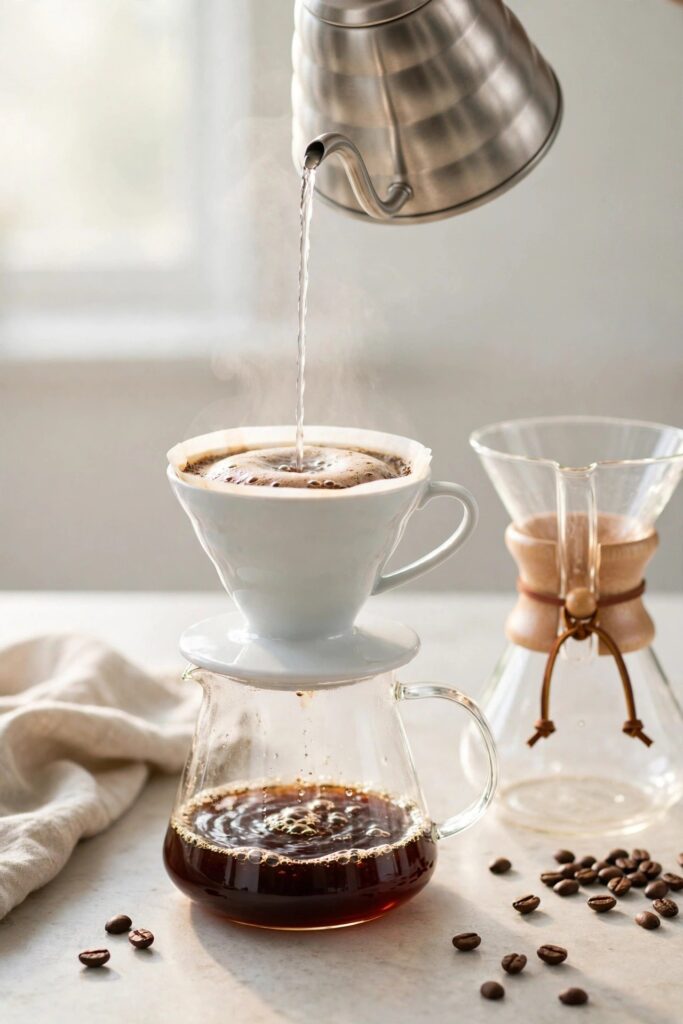
The Hario V60 is our best overall pick. It is the dripper that defined the modern pour over movement: a steep 60-degree cone with spiral ribs and one large drain hole, so the speed of your pour controls the extraction — and the flavor. Coffee Tested names it its best overall pour over coffee maker for 2026, and owner consensus across tens of thousands of reviews puts it at the top of the class. The ceramic size 02 brews one to four cups, holds heat well through the brew, and costs less than most of the competition.
Pros:
- The benchmark pour over dripper — unmatched control over flavor and clarity
- Ceramic body holds heat steady through the brew
- Coffee Tested’s best overall pour over coffee maker for 2026
- Inexpensive for a best-in-class brewer, with widely available size 02 filters
Cons:
- Demands a steady pour — sloppy technique shows in the cup
- No carafe included, so you brew into your own mug or server
- Ceramic can chip or crack if dropped
Chemex Classic Series Pour Over Coffeemaker 6-Cup
The Chemex Classic 6-Cup is our best large-batch pick. It is both dripper and carafe in one elegant hourglass of borosilicate glass — a design barely changed since the 1940s — and it brews six cups at once for the whole table. Its thick bonded paper filters are heavier than standard pour over papers, trapping nearly all the oils and micro-fines, which produces one of the cleanest, most sediment-free cups of any brewer here. Every 2026 roundup we checked puts it at the top for serving a group.
Pros:
- Brews six cups at once — the only pick here built for a crowd
- Thick bonded filters give the cleanest, most sediment-free cup in this roundup
- Dripper and carafe in one, in an iconic design that has lasted since the 1940s
- Borosilicate glass is non-porous, so it never picks up flavors
Cons:
- Glass loses heat faster than ceramic and breaks if knocked
- Uses its own bonded filters, which cost more than standard V60 or Melitta papers
- Filters are sold separately, and the brewer is the priciest glass pick here
Kalita Wave 185 Glass Dripper
The Kalita Wave 185 is our best pick for beginners. Where the V60 punishes a wobbly pour, the Kalita forgives it: a flat bottom and wave-shaped filters spread the water evenly across the coffee bed, and three small drain holes slow the flow for a longer, more even extraction. Review consensus across 2026 roundups calls it the easiest dripper to get a good cup from on day one, and the glass version lets you watch the bloom. It brews two to four cups at a time.
Pros:
- Flat-bottom design forgives uneven pouring — the easiest good cup here
- Three small drain holes slow the flow for even extraction
- Glass body lets you watch the bloom
- Named the best pick for beginners across multiple 2026 roundups
Cons:
- Wave filters cost more and are harder to find than standard V60 papers
- Glass dripper loses heat faster than ceramic
- Less control than the V60 for brewers who want to fine-tune every variable
Fellow Stagg [X] Pour-Over Set
The Fellow Stagg [X] Pour-Over Set is our best design-led pick. It is a complete brewing set rather than a bare dripper: a plastic-free dripper with a vacuum-insulated double-wall glass carafe, a built-in ratio aid printed on the side, and 20 filters in the box. The steep walls and small drain hole give it a V60-like clarity, while the insulated carafe keeps a second cup hot — the one thing the Chemex cannot do. It is the set to buy if you want a beautiful, complete pour over station in one box.
Pros:
- Complete set: dripper, double-wall insulated carafe, and filters included
- Built-in ratio aid makes dialing in the coffee-to-water ratio easy
- Insulated carafe keeps coffee hot for a second cup
- Plastic-free build with a clean, modern design
Cons:
- More expensive than a bare V60 or Kalita dripper
- Smaller capacity than the 6-cup Chemex for big households
- Filters are Fellow’s own size, so stock up before you run out
Melitta Pour-Over Coffee Brewer Cone 1-Cup
The Melitta Pour-Over Coffee Brewer Cone is our best budget pick. It is the simplest brewer in this roundup and the cheapest by a wide margin: a BPA-free plastic cone that sits on top of any standard mug, takes widely available Melitta No. 2 cone filters, and brews one perfect cup with nothing but hot water. A viewing slot lets you see the liquid level so the mug never overflows, and the cone is virtually unbreakable — owners report using the same one for years, and it travels well in a bag.
Pros:
- The cheapest pour over brewer here by a wide margin
- Virtually unbreakable BPA-free plastic — great for travel and camping
- Uses standard No. 2 cone filters, available almost anywhere
- Viewing slot prevents mug overflow; starter filters included
Cons:
- Single-cup capacity only — no good for brewing for two or more
- Plastic loses heat faster than ceramic
- Slow flow through the small drain hole can extend brew time
Buying Guide
Glass for the table, ceramic for control: This is the whole decision. A ceramic dripper (Hario V60, Kalita Wave) holds heat through the brew, which matters when you pour slowly over two or three minutes. A glass carafe brewer (Chemex) brews a whole pot at once and serves it beautifully, but the glass cools faster and breaks if knocked. If you brew one or two cups and drink them right away, ceramic is the pick. If the pot sits on the table while people help themselves, glass is the pick — or buy an insulated carafe set like the Fellow Stagg [X].
Single-cup versus carafe: A size 02 dripper brews one to four cups into a mug or server; a 6-cup Chemex brews for a crowd in one go. Buy for your real mornings, not your ambitions: a big carafe brewed for one person leaves half a pot going stale, and a single-cup cone brewed four times in a row is a chore before breakfast.
Cone versus flat bottom: Cone drippers (Hario V60, Chemex) funnel water to a single point, which rewards a careful pour with the brightest, clearest cup — and punishes a sloppy one. Flat-bottom drippers (Kalita Wave) spread the bed out and even out your mistakes, so they brew a good cup with less technique. Beginners should start flat; brewers who enjoy the ritual should go cone.
Paper filters are part of the system: Paper gives the cleanest cup, because it traps oils and fines. But each dripper takes its own filter — V60 size 02, Kalita Wave 185, Chemex bonded, Melitta No. 2 — and the cost adds up. Check that your filters are easy to buy where you shop before you commit, and rinse the paper with hot water before brewing to wash away any papery taste.
A gooseneck kettle is not optional: Pour over needs a slow, controlled pour, and a regular kettle cannot do it. A gooseneck kettle with a narrow spout lets you pour in slow circles and control the flow rate — it is the single biggest upgrade after the dripper itself.
Use a scale and a timer: Eyeballing the dose is how pour over goes wrong. Use a kitchen scale and a ratio of roughly 1 gram of coffee to 15–16 grams of water, bloom the grounds with a little water for 30–45 seconds, then pour in slow circles for a total brew time of about three minutes.
FAQs
What is the best pour over coffee maker? The Hario V60 Ceramic Dripper Size 02 is our top pick — the benchmark for control and flavor clarity, and Coffee Tested’s best overall for 2026. For a crowd, the Chemex 6-Cup is the pick; for beginners, the Kalita Wave 185.
Is a ceramic or glass pour over dripper better? Ceramic holds heat better through the brew, which helps extraction stay even. Glass lets you watch the bloom and is lighter, but cools faster and breaks if dropped. For a single dripper you will use daily, ceramic is the safer pick.
What size pour over dripper should I buy? Size 02 (Hario V60, Kalita Wave 185) brews one to four cups and suits most households. A 6-cup Chemex brews for a group. If you only ever brew one mug, a single-cup cone like the Melitta is the cheapest way in.
Do I need special filters for a pour over coffee maker? Yes — each dripper takes its own filter shape and size: V60 size 02, Kalita Wave 185, Chemex bonded, or Melitta No. 2. They are not interchangeable, so check availability and price before you buy the dripper.
Why does my pour over coffee taste weak? Usually the grind is too coarse, the pour was too fast, or you used too little coffee. Grind medium-fine, use about 1 gram of coffee per 15–16 grams of water, and pour slowly in circles so the water stays in contact with the grounds for around three minutes.
Do I need a gooseneck kettle for pour over coffee? It is strongly recommended. A gooseneck kettle’s narrow spout gives you the slow, controlled pour that pour over depends on — a regular kettle pours too fast and floods the bed, which makes the cup thin and uneven.