Intro
The best citrus juicers turn a bag of oranges into a glass of fresh juice in about a minute — no carton, no preservatives, no pasteurized flatness, just the bright, pulpy juice you actually wanted. It is also a simple tool to buy badly: a flimsy handheld squeezer that leaves half the juice in the peel, an electric reamer that sprays pulp everywhere, or a heavy cast-iron press with nowhere to live on your counter.
The buying question is manual press versus electric. A cast-iron manual press (Zulay) squeezes the most juice from each orange with one pull of a lever, lasts for years, and needs no power — but it is heavy, takes up counter space, and is overkill for one glass. An electric juicer (Breville Citrus Press Pro, Cuisinart CCJ-500) does the work for you and juices a whole pitcher in minutes, but it needs an outlet, makes noise, and costs more. And for a single glass or a recipe, a handheld press or a simple reamer is often all you need. Below, we have compared five citrus juicers available right now, weighing juice yield, effort, cleanup, and capacity.
Our Top Picks
Zulay Kitchen Cast-Iron Orange Juice Squeezer
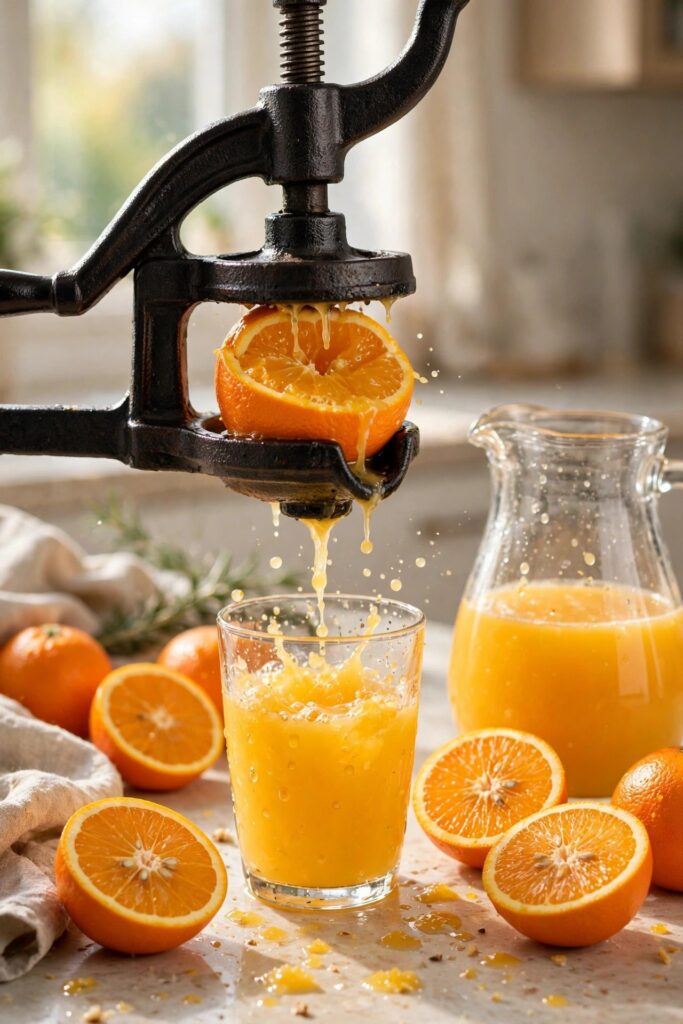
The Zulay Cast-Iron Orange Juice Squeezer is our best overall pick. It is a commercial-style countertop lever press: a heavy cast-iron frame and a long compound lever that crushes a whole orange half into a nearly dry shell of pulp with one pull. Testing by Mr Kitchen Adviser measured about 3.5 ounces of juice per medium orange — the highest yield of any juicer in its group — and owner consensus across tens of thousands of reviews rates it near the top of the manual class. The stainless bowl and strainer cone detach for easy cleaning, and it is backed by a lifetime guarantee.
Pros:
- Highest juice yield here — about 3.5 oz per medium orange in testing
- Cast-iron frame and long lever do the work with minimal effort
- Handles lemons, limes, oranges, grapefruits, and pomegranates
- Detachable stainless bowl and cone are dishwasher safe; lifetime guarantee
Cons:
- Heavy at about 14 pounds and needs dedicated counter or cupboard space
- Can slide forward on smooth counters under pressure
- Cast iron can rust if not dried right after washing
Breville Citrus Press Pro
The Breville Citrus Press Pro is our best electric pick. It is the highest-yield electric citrus juicer in independent testing: Mr Kitchen Adviser measured 37.85% of a lemon’s weight returned as juice, the best of the five electrics and manuals it tested, and it juices an 8-ounce glass of orange juice in under a minute. A 110-watt motor spins the finned cone only when you press down, and a triple-hinged cantilever arm does the pressing with one hand, so there is almost no effort at all. It is the machine to buy if your household drinks fresh juice every morning.
Pros:
- Highest-yield electric in independent testing — about 38% of fruit weight as juice
- One-hand cantilever arm and pressure-activated motor — almost no effort
- An 8-ounce glass of orange juice in under a minute
- Built-in cord storage and a drip-stop spout keep the counter clean
Cons:
- The most expensive juicer in this roundup
- Large footprint — needs a permanent spot on the counter
- Heavier and bulkier to store than a manual press or reamer
Cuisinart CCJ-500 Pulp Control Citrus Juicer
The Cuisinart CCJ-500 is our best value electric pick. It is the budget way into powered juicing: a motorized reamer with three pulp-control settings (low, medium, high) so you choose how much pulp lands in your glass, a final-spin feature that squeezes the last drops from the rind, and a 34-ounce pitcher that collects a whole batch. It juices oranges, lemons, limes, and grapefruit, and it costs a fraction of the Breville while doing the same morning job — just with a little more hands-on effort.
Pros:
- Three pulp-control settings — low, medium, and high
- Final-spin feature extracts the last drops from the rind
- 34-ounce pitcher collects a full batch for the family
- A fraction of the Breville’s price for the same daily job
Cons:
- You press each half down by hand, so it takes more effort than the Breville’s arm
- Lower-powered motor can stall on very large grapefruit halves
- Plastic build feels less premium than the Breville or the Zulay
Chef’n FreshForce Citrus Juicer
The Chef’n FreshForce Citrus Juicer is our best handheld press pick. It is a two-handed squeezer that works like a garlic press for oranges: place a half in the cup, squeeze the handles together, and the dual-gear mechanism does the work your hands cannot. Mr Kitchen Adviser rated it 4.5 out of 5 and found it finished ten lemons in just over two minutes, the fastest handheld squeezer in its test. It needs no power, no counter space, and rinses clean in seconds — the pick for one glass, a cocktail, or a recipe.
Pros:
- Dual-gear mechanism squeezes more juice than a basic handheld squeezer
- Fastest handheld in independent testing — ten lemons in just over two minutes
- No power, no counter space, and rinses clean in seconds
- Catches seeds while letting the juice flow through
Cons:
- Still needs real hand strength for a full pitcher of orange juice
- One half at a time — slow for batch juicing
- Sized for lemons and limes; large oranges can feel tight in the cup
OXO Good Grips 2-in-1 Citrus Juicer
The OXO Good Grips 2-in-1 Citrus Juicer is our best reamer pick. It is a countertop reamer with a measuring cup built in: twist the orange half on the ridged cone and the juice collects in a clear cup marked up to 1.5 cups, with a drip-free pour spout for serving. Two snap-on reamers cover small fruit (lemons and limes) and large fruit (oranges and grapefruit), and the whole thing is dishwasher safe. It is the pick for cooks who juice for recipes and want to measure as they go.
Pros:
- Built-in measuring cup marked up to 1.5 cups (350 ml)
- Two reamer sizes cover lemons and limes through grapefruit
- Drip-free pour spout and dishwasher-safe parts
- Backed by OXO’s satisfaction guarantee
Cons:
- Manual twisting takes the most effort of any pick here
- Clear cup can cloud over time with heavy use
- Too small for juicing a whole pitcher at once
Buying Guide
Manual press for yield, electric for speed: This is the whole decision. A cast-iron manual press (Zulay) gets the most juice out of each orange — about 3.5 ounces per medium orange in testing — and it never needs power, but it is heavy and slow to set up for one glass. An electric juicer (Breville, Cuisinart) juices a pitcher in minutes with almost no effort, but it needs an outlet and counter space. If you juice a few oranges most mornings, a manual press pays for itself in yield. If you juice for a family every day, electric wins on speed.
Yield is the number that matters: Independent testing puts electric juicers at roughly 36–38% of the fruit’s weight as juice, manual lever presses at a similar level or better, and handheld squeezers and reamers lower, around 23–25%. The difference between a good press and a cheap squeezer is real money over a winter of oranges — a high-yield juicer pays for itself in fruit saved.
Match the juicer to the job: One glass for yourself? A handheld press (Chef’n FreshForce) or a reamer (OXO) is enough. A pitcher for the family? You need a press (Zulay) or an electric (Breville, Cuisinart). Cocktails and recipes? A reamer with a measuring cup (OXO) is the most useful tool in the drawer.
Pulp control is worth having: Some people want smooth juice, others want pulp. The Cuisinart CCJ-500 has three pulp settings; the Breville strains through a fine cone; the Zulay’s stainless strainer cone keeps seeds and most pulp out. If you care about pulp, check the juicer’s straining before you buy.
Cleanup decides whether you use it: A juicer that takes five minutes to clean gets used once. The Zulay’s bowl and cone detach and go in the dishwasher, the Cuisinart’s parts are dishwasher safe, and the Chef’n rinses in seconds. Dry cast-iron parts right after washing or they can rust.
Size and storage: A cast-iron press weighs about 14 pounds and needs a permanent home; an electric press is bulky too. A handheld squeezer and a reamer fit in a drawer. Before buying a big press, make sure you have somewhere for it to live — a juicer in a cupboard behind the slow cooker is a juicer you never use.
FAQs
What is the best citrus juicer for fresh orange juice? The Zulay Cast-Iron Orange Juice Squeezer is our top pick — the highest juice yield here, about 3.5 ounces per medium orange, with a lifetime guarantee. For electric, the Breville Citrus Press Pro is the pick.
Is a manual or electric citrus juicer better? A manual press squeezes more juice per orange and lasts for years with no power, but takes effort and space. An electric juicer is faster and easier for daily family juicing, but needs an outlet and costs more. For one glass a day, manual wins; for a pitcher a day, electric wins.
How much juice does one orange make? A medium orange yields about 3 to 3.5 ounces of juice with a good press — roughly a third of a cup. It takes about three medium oranges to fill an 8-ounce glass.
Do citrus juicers work for grapefruit and lemons too? Yes — all five picks here handle lemons, limes, oranges, and grapefruit. The Zulay press and the Breville handle grapefruit best because of their size; the Chef’n handheld is sized mainly for lemons and limes.
How do I clean a citrus juicer? Rinse or wipe the parts right after juicing, before the pulp dries. Most parts here are dishwasher safe, including the Zulay’s bowl and cone, the Cuisinart’s pitcher, and the OXO’s cup and reamers. Dry cast-iron parts immediately to prevent rust.
Should I refrigerate fresh orange juice? Yes — fresh-squeezed orange juice has no preservatives, so refrigerate it and drink it within two to three days. It tastes best the day it is squeezed, so juice what you will drink.