Intro
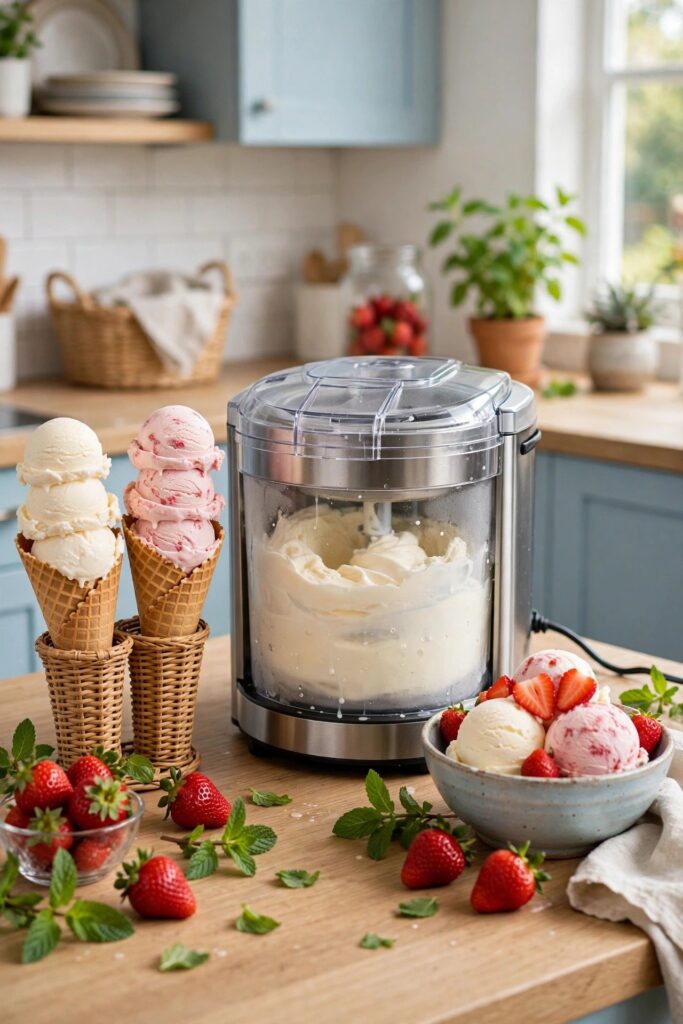
The best ice cream makers for home turn a chilled base into soft-serve in about twenty minutes — no ice, no salt, no standing over a hand crank. The catch is that the three types on the market work in completely different ways, and picking the wrong one for your habits is the only way to buy badly.
The buying question is freezer-bowl versus compressor versus Ninja CREAMi. Freezer-bowl machines (Cuisinart ICE-21 and ICE-70) are cheap and churn classic creamy ice cream, but the bowl must spend 12 to 24 hours in the freezer before every batch, and you get one batch per freeze. Compressor machines (Whynter ICM-201SB, Breville Smart Scoop) have a built-in freezer, so you can churn batch after batch on demand — but they cost several times more and are heavy. The Ninja CREAMi is neither: it shaves a pint you froze solid the day before into ice cream, sorbet, or milkshakes in minutes, which makes it brilliant for single servings and low-sugar bases but a poor fit for a big family batch. Below, we have compared six ice cream makers available right now, weighing churn quality, capacity, convenience, and value.
Our Top Picks
Cuisinart ICE-21 1.5-Quart Ice Cream Maker
The Cuisinart ICE-21 is our best overall pick. It is the consensus choice across 2026 roundups for a reason: one button, a 1.5-quart freezer bowl, and smooth, creamy ice cream in about 20 minutes once the bowl is frozen solid. Multiple reviewers found its texture essentially identical to machines costing five times as much — the difference is planning, not quality. It is the machine to buy if you make ice cream a few times a month and can plan a day ahead.
Pros:
- Best texture for the money — reviewers rate it alongside compressor machines
- Simple one-button operation with almost no learning curve
- 1.5-quart capacity suits a family dessert
- The lowest price in this roundup by a wide margin
Cons:
- The freezer bowl needs 16 to 24 hours in the freezer before every batch
- One batch per freeze — no back-to-back batches without a spare bowl
- The bowl takes up permanent freezer space if you keep it ready
Whynter ICM-201SB 2.1-Quart Compressor Ice Cream Maker
The Whynter ICM-201SB is our best compressor pick. America’s Test Kitchen names it the best self-refrigerating ice cream maker, and it earns that title by removing the one thing freezer-bowl owners complain about: planning. Its built-in compressor freezes as it churns, so there is nothing to pre-freeze and you can make batch after batch — a mango batch reaches soft-serve in about 30 minutes. At 2.1 quarts it also makes the largest batches in this roundup.
Pros:
- Built-in compressor — no pre-freezing, ever, and back-to-back batches
- America’s Test Kitchen’s best self-refrigerating pick
- Largest capacity here at 2.1 quarts
- Stainless steel bowl and a timer with an auto shut-off
Cons:
- Costs several times more than a freezer-bowl machine
- Heavy and bulky — it needs a permanent counter spot
- Churn takes longer than a pre-frozen bowl, around 25 to 40 minutes
Ninja CREAMi NC301 7-in-1 Ice Cream Maker
The Ninja CREAMi NC301 is our best versatility pick. It does not churn at all: you freeze your base solid for 24 hours in a 16-ounce pint, then a high-speed blade shaves it into ice cream, sorbet, gelato, milkshakes, or smoothie bowls in two to five minutes. That makes it the only machine here that handles protein bases, dairy-free bases, and low-sugar recipes well — and the Re-Spin cycle fixes icy first passes. It is a different machine from a churner, and the right one if variety and single servings matter more than big batches.
Pros:
- Seven programs cover ice cream, sorbet, gelato, milkshakes, and smoothie bowls
- Handles protein, dairy-free, and low-sugar bases other churners cannot
- Ready in minutes once the pint is frozen — no churning wait
- Pint containers, lids, and paddle are top-rack dishwasher safe
Cons:
- Only one pint (16 oz) at a time — not a family-batch machine
- The base still needs 24 hours in the freezer, so the wait is not gone, just moved
- Loud during the 2 to 5 minute spin cycle
Cuisinart ICE-70 2-Quart Ice Cream Maker
The Cuisinart ICE-70 is our best freezer-bowl upgrade pick. It keeps the ICE-21’s simple freezer-bowl approach and adds the controls that make repeat batches easier: a digital LCD timer, three speed settings for ice cream, gelato, and sorbet, and a larger 2-quart capacity. The gelato setting churns slower for a denser texture, and the sorbet setting avoids the crumbly texture cheaper machines produce. It is the pick if you love the Cuisinart approach but want a bigger batch and more control.
Pros:
- Larger 2-quart capacity — the biggest freezer-bowl batch here
- Three settings for ice cream, gelato, and sorbet
- LCD timer and countdown display make recipes repeatable
- Same proven Cuisinart freezer-bowl reliability at a mid-range price
Cons:
- Still needs 12 to 24 hours of bowl pre-freezing before every batch
- One batch per freeze, like the ICE-21
- The freezer bowl is bigger, so it takes more freezer space
Breville Smart Scoop BCI600 Ice Cream Maker
The Breville Smart Scoop is our best premium pick. It is the most complete compressor machine you can buy for a home kitchen: a built-in compressor with a pre-cool function that chills the bowl before you pour, 12 hardness settings from soft-serve to hard scoop, and automatic programs for ice cream, gelato, sorbet, and frozen yogurt. When the batch reaches your chosen firmness it beeps, and the Keep Cool function holds it at serving temperature for up to three hours. It is expensive and its 1.1-quart bowl is smaller than the Whynter’s, but for texture perfectionists it is the most hands-off machine here.
Pros:
- 12 hardness settings and auto programs for ice cream, gelato, sorbet, and frozen yogurt
- Pre-cool function chills the bowl for the best freezing from the start
- Keep Cool holds finished ice cream at serving temperature for up to 3 hours
- No pre-freezing and no freezer space needed
Cons:
- The most expensive machine in this roundup
- 1.1-quart bowl is the smallest compressor batch here
- Bulky on the counter and heavy to move
KitchenAid Ice Cream Maker Attachment KICA0WH
The KitchenAid Ice Cream Maker Attachment is our best pick for stand-mixer owners. If you already own a KitchenAid stand mixer, this attachment turns it into an ice cream maker for the price of a freezer-bowl machine: a 2-quart freeze bowl that fits the mixer, a dasher that churns as the mixer runs, and the same 20-minute churn as the Cuisinart. It is the cheapest way into homemade ice cream for the millions of kitchens that already have the mixer — and the worst value if you would be buying a mixer just to use it.
Pros:
- Turns a stand mixer you already own into an ice cream maker
- 2-quart capacity — a full family batch
- Simple, proven design with few parts to break
- Easy to store: the bowl lives in the freezer, the dasher in a drawer
Cons:
- Useless without a KitchenAid stand mixer — it is an attachment, not a machine
- The bowl still needs 16 to 24 hours of pre-freezing
- One batch per freeze, and the bowl is heavy when full
Buying Guide
Freezer-bowl for planned batches, compressor for spontaneity: This is the whole decision. Freezer-bowl machines (Cuisinart ICE-21, ICE-70, KitchenAid attachment) cost the least and churn excellent ice cream, but the bowl needs 12 to 24 hours in the freezer and you get one batch per freeze. Compressor machines (Whynter ICM-201SB, Breville Smart Scoop) freeze as they churn, so you can decide at 8pm and eat ice cream at 9pm, and make batch after batch — for two to five times the price and a permanent spot on the counter.
The Ninja CREAMi is a third category, not a churner: It freezes your base solid first, then shaves it into a creamy texture in minutes. Buy it for single servings, protein and low-sugar bases, and variety across seven programs — not as a shortcut to big family batches, and not to skip the planning, since the pint still needs 24 hours in the freezer.
Capacity is about your household, not your ambition: A 1.5-quart batch (Cuisinart ICE-21, Breville) serves four to six; a 2-quart batch (ICE-70, KitchenAid attachment) serves six to eight; the Whynter’s 2.1 quarts is the biggest single batch here. A single Ninja pint is one or two servings. Remember that churned ice cream is soft-serve when it comes out — it needs two or more hours in the freezer to firm up to scoopable, so churn earlier than you plan to serve.
Chill the base first, whatever machine you buy: A cold base churns faster and smoother on every machine here. Make your custard or base the night before, chill it thoroughly in the fridge, and add mix-ins only in the last few minutes of churning so they stay distributed instead of sinking. Warm base in a freezer-bowl machine is the most common reason a batch turns out icy.
Check the parts you will replace: Freezer bowls do not wear out, but they do take up freezer space — measure before you buy. Ninja pint containers and lids are sold separately if you want a rotation ready in the freezer. Before buying a premium compressor, check the warranty: Cuisinart covers its machines for three years, Breville for one.
Clean it the easy way: Never put a freezer bowl in the dishwasher — hand-wash it and dry it fully before it goes back in the freezer, or ice crystals will form on the inside and slow the next churn. Compressor bowls and paddles wipe clean, and Ninja pint containers, lids, and paddles are top-rack dishwasher safe.
FAQs
What is the best ice cream maker for home? The Cuisinart ICE-21 is our top pick — the best texture for the money, one-button operation, and a 1.5-quart batch in about 20 minutes. If you want to skip pre-freezing entirely, the Whynter ICM-201SB compressor is the pick.
Is a compressor ice cream maker worth the extra money? Yes, if you make ice cream often or on impulse. A compressor means no pre-freezing and back-to-back batches. If you only make ice cream a few times a summer and can plan a day ahead, a freezer-bowl machine like the Cuisinart ICE-21 gives you the same texture for far less money.
How is the Ninja CREAMi different from a regular ice cream maker? It does not churn a liquid base. You freeze your base solid for 24 hours in a pint, then a blade shaves it into ice cream in two to five minutes. It is best for single servings, protein and low-sugar bases, and variety — not for big family batches.
How long does homemade ice cream take to firm up? Churned ice cream comes out soft-serve. Transfer it to an airtight container and freeze it for at least two hours for a scoopable texture. Ninja CREAMi pints are ready to eat straight from the machine.
Do I need to pre-freeze the bowl for a compressor ice cream maker? No. Compressor machines like the Whynter ICM-201SB and Breville Smart Scoop have built-in refrigeration, so there is nothing to pre-freeze. Freezer-bowl machines like the Cuisinart ICE-21 and ICE-70 need 12 to 24 hours of bowl freezing before every batch.
Can I make dairy-free ice cream in these machines? Yes — all six handle dairy-free bases, but the Ninja CREAMi is the strongest choice for them, since its shaving process works well with coconut, oat, and almond-milk bases that can turn icy in a churner. Use the Re-Spin cycle if the first pass comes out crumbly.