
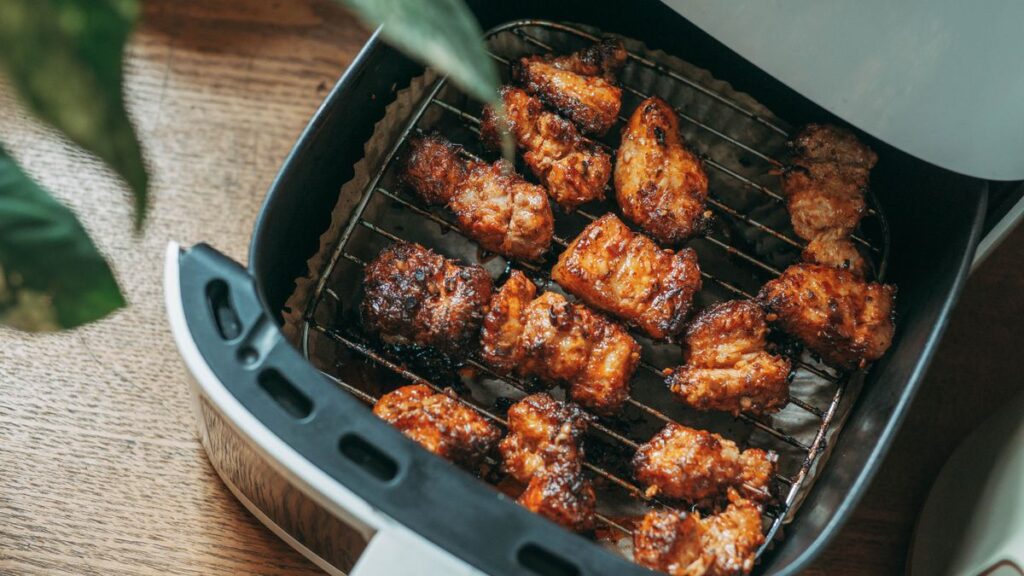
Buy an air fryer if your priority is maximum crispiness for frozen foods, wings, and small-batch roasting — its compact chamber and intense fan deliver crunch a toaster oven can\’t match. Buy a toaster oven if you want versatility: baking, broiling, toasting, and reheating for 2–4 people in one appliance. If you can only have one, the toaster oven does more jobs; if crispy texture is the goal, the air fryer wins decisively.
These appliances overlap heavily — both are countertop convection ovens — but their engineering differs in ways that matter. Air fryers use a small chamber and high-speed fan for intense heat transfer (the crisping advantage); toaster ovens use a larger chamber with more even heat and more cooking modes (the versatility advantage). This research-based comparison breaks down performance, capacity, energy, and cost based on published specifications and aggregated owner reviews, so you can match the machine to your cooking.
Air Fryer vs Toaster Oven: Head-to-Head
| Factor | Air Fryer | Toaster Oven | Winner |
|---|---|---|---|
| Crispiness (frozen foods, wings) | Excellent — intense convection | Good, less intense | Air fryer |
| Capacity | 2–5 qt (1–3 servings) | Fits 9×13 pan, whole chicken | Toaster oven |
| Versatility (bake, broil, toast) | Limited modes | Bake, broil, toast, roast, dehydrate | Toaster oven |
| Speed (preheat + cook) | Very fast (small chamber) | Fast, slightly slower | Air fryer |
| Energy use | Lower per session | Low, slightly higher | Air fryer (slight) |
| Toast quality | Uneven, not its job | Excellent, purpose-built | Toaster oven |
| Baking (cakes, bread) | Small batches only | Full-size baking | Toaster oven |
| Countertop footprint | Compact vertical | Wide horizontal | Depends on space |
| Ease of cleaning | Basket, generally easy | Crumb tray + interior | Air fryer (slight) |
| Price range | $60–$200 | $80–$300 | Air fryer (slight) |
The Core Difference: Chamber Size and Air Speed
An air fryer is essentially a toaster oven optimized for one thing: a small cooking chamber (typically 2–5 quarts) with a powerful fan positioned close to the food. The small volume means the fan\’s airflow is concentrated — heat transfer is intense and fast, which is exactly what creates crispy exteriors on wings, fries, and breaded foods. Preheat takes 2–3 minutes because there\’s so little air to heat.
A toaster oven has a larger chamber (fitting a 9×13 pan or 12-inch pizza in full-size models) with gentler, more even convection. That space enables real baking — cakes rise evenly, casseroles fit, a whole chicken roasts — plus dedicated toast and broil elements positioned for those jobs. Preheat takes longer (5–8 minutes), but the even heat suits a wider range of cooking.
Air fryer: small chamber + fast fan = intense crisping. Toaster oven: larger chamber + even heat = versatile cooking. The physics explains every difference in the table above.
How We Researched This Comparison
We did not conduct hands-on lab testing. This comparison is based on published specifications (capacity, wattage, cooking modes, dimensions) of leading models in each category, cooking physics (convection heat transfer principles), energy-use estimates from wattage and typical cook times, and aggregated long-term owner reviews from major retailers, cross-checked against test-kitchen comparisons published through 2026.
Crispiness: Air Fryer\’s Decisive Win
For frozen french fries, chicken wings, breaded foods, and reheated pizza, the air fryer is categorically better. The concentrated high-velocity airflow drives moisture off food surfaces rapidly — the mechanism of crisping — producing crunch that approaches deep-frying with a fraction of the oil. Owner reviews consistently describe air-fried wings as \”better than restaurant\” while toaster-oven versions are merely \”good.\”
Toaster ovens crisp adequately but can\’t match the intensity; their larger chamber diffuses the airflow. If your primary use case is crispy snacks and sides, this single factor may decide it. Note that air fryer accessories (racks, perforated liners) further improve results — see our accessories guide.
Versatility: Toaster Oven\’s Decisive Win
A toaster oven replaces more appliances. Quality models bake (cakes, bread, cookies), broil (with proper top elements), toast (evenly, unlike air fryers), roast (vegetables, chicken), reheat (pizza revives beautifully), and often dehydrate and keep warm. For a small household, a good toaster oven can genuinely substitute for the big oven on most days.
Air fryers bake small items adequately (a 7-inch cake pan fits most) and roast small portions well, but they\’re cramped for real baking and poor at toast. As a single countertop appliance for varied cooking, the toaster oven\’s mode range is unmatched.
Capacity: Who Are You Cooking For?
1–2 people: An air fryer\’s 3–5 quart basket handles most meals; its speed shines for small portions. 3–4 people: The toaster oven pulls ahead — fitting family-size portions, a 9×13 casserole, or a 12-inch pizza. Air fryers force batching for families, which erases their speed advantage. Entertaining: Toaster oven, no contest — though many owners eventually have both.
Energy Use and Running Costs
Both use far less energy than a full-size oven (typically 1,400–1,800W vs 2,400–5,000W, and heating a fraction of the volume). The air fryer edges ahead per session due to shorter cook times — a 15-minute air fry session at 1,500W costs roughly 8–12 cents at average electricity rates. But the real savings come from not heating the big oven: either appliance cuts the energy of oven cooking by 50–70% for suitable meals.
What Owners Actually Report
Aggregated owner reviews reveal a pattern: air fryer buyers rave about specific foods (wings, fries, reheated leftovers) but some report the novelty fading as batch-cooking limits frustrate. Toaster oven buyers report steadier long-term satisfaction — the appliance becomes a daily driver replacing the big oven. The happiest owners? Those who bought for a specific job rather than hype: crisp lovers with air fryers, small-household cooks with toaster ovens.
Can One Replace the Other?
Partially. Many modern \”air fryer toaster ovens\” combine both — a toaster-oven form factor with an air-fry mode and fan. These hybrids are genuinely good compromises: they air-fry nearly as well as basket models (slightly less intense) while retaining full toaster-oven versatility. If you\’re torn, a quality air-fryer toaster oven (like the Breville Smart Oven Air Fryer Pro or Cuisinart Air Fryer Toaster Oven) may be the actual answer.
Our Recommendations by Scenario
- Frozen-food crisp lover, 1–2 people: Basket air fryer (see our Cosori TurboBlaze review context) — maximum crunch, minimal fuss.
- Small household wanting one appliance: Toaster oven — bakes, broils, toasts, roasts; the true oven replacement.
- Family of 4+: Toaster oven for capacity, or a large air-fryer toaster oven hybrid.
- Already have a good oven, want crisping: Basket air fryer as a specialist.
- Can\’t decide: Air-fryer toaster oven hybrid — 90% of both.
- Dorm / office / RV: Basket air fryer — compact, fast, minimal heat output into the room.
Air Fryer vs Toaster Oven FAQs
Is an air fryer just a small convection oven?
Essentially yes — but the small chamber and high fan speed make a real performance difference for crisping. It\’s a convection oven optimized for intense heat transfer rather than even baking. The distinction matters: it explains why air fryers crisp better and bake worse than larger convection ovens.
Can a toaster oven replace an air fryer?
For most cooking, yes — especially models with a dedicated air-fry mode, which close 90% of the crisping gap. A plain toaster oven without air-fry mode crisps adequately but not spectacularly. If maximum crunch on wings and fries is the priority, a basket air fryer still wins.
Which uses less electricity?
The air fryer, slightly — shorter cook times at similar wattage. But both use 50–70% less energy than a full-size oven for suitable meals. The savings versus your big oven dwarf the difference between the two countertop appliances.
Can you bake a cake in an air fryer?
Small ones, yes — a 7-inch pan fits most basket fryers, and the intense convection bakes nicely. But capacity limits you to small batches, and delicate cakes can brown too fast on top. For regular baking, a toaster oven is the far better tool.
Do I need both an air fryer and a toaster oven?
Most households don\’t — a good air-fryer toaster oven hybrid covers both roles well. Enthusiasts who air-fry daily and bake regularly sometimes keep both, but start with one (or a hybrid) and add the second only if you hit real limits.
Which is better for reheating pizza?
The air fryer reheats single slices to crispy perfection in 3–4 minutes — widely considered the best pizza-reheating method short of a pizza oven. Toaster ovens handle whole pizzas and multiple slices better. For one or two slices: air fryer. For the whole pie: toaster oven.
Are air fryer toaster oven combos any good?
Yes — the good ones (Breville, Cuisinart, Ninja) are genuinely versatile: they air-fry nearly as well as basket models while baking, broiling, and toasting like proper toaster ovens. They cost more and take more counter space, but for the undecided buyer they\’re often the right single purchase.
Top Hybrid Models Worth Considering
If the comparison leaves you torn, hybrids deserve a serious look. The Breville Smart Oven Air Fryer Pro is the premium benchmark: Element iQ heating, 13 functions including genuinely effective air frying, and capacity for a 14-lb turkey — it\’s the countertop oven that convinced many owners to rarely use their big oven. The Cuisinart Air Fryer Toaster Oven offers strong air-frying plus full toaster-oven versatility at a mid-range price, with consistently good owner reviews. The Ninja Foodi 10-in-1 XL Pro adds a smart thermometer and two-level cooking for families.
Hybrids compromise slightly on both extremes: air-frying is ~90% as intense as a dedicated basket fryer (larger chamber diffuses airflow), and they cost more and take more counter space than either single-purpose machine. But for the \”I want one appliance\” buyer, a good hybrid is the highest-satisfaction purchase in the category — the versatility of a toaster oven with crisping close enough that most owners never miss a basket fryer.
Amazon CTA: Check the current price of the Breville Smart Oven Air Fryer Pro on Amazon
Energy Cost Math: Real Numbers
Let\’s quantify it. A typical air fryer draws ~1,500W; a 20-minute session uses 0.5 kWh — at the US average of ~$0.17/kWh, that\’s about 9 cents per session. A toaster oven at 1,800W for 25 minutes uses 0.75 kWh (~13 cents). A full-size electric oven at 3,000W+ with 15-minute preheat plus 30-minute cook uses ~2.5+ kWh (~43 cents). Cook 5 countertop meals weekly instead of oven meals and you save roughly $80–100 per year in energy — plus a cooler kitchen in summer, which has its own AC savings.
The Final Verdict
Choose the air fryer if: crispiness is your top priority, you cook for 1–2, you want the fastest option, or you already own a good oven and want a crisping specialist. Choose the toaster oven if: you want one versatile appliance, you bake, you cook for 3+, or you want the best toast. Choose a hybrid if: you want it all in one footprint and accept 90% crisping performance. There\’s no wrong answer — only the wrong match for your cooking. And honestly? The most common owner trajectory is starting with one and adding the other within two years, because they genuinely complement each other.
Cleaning and Maintenance Compared
Daily cleaning favors the air fryer slightly: the nonstick basket and crisper plate rinse clean or go in the dishwasher, and there\’s little interior to wipe. But baked-on grease in basket corners can be stubborn — soak promptly and avoid metal utensils that scratch the coating. Toaster ovens need crumb-tray emptying (30 seconds), interior wiping, and occasional glass-door cleaning; the larger interior takes a minute longer but nothing bakes on as aggressively thanks to gentler airflow.
Long-term, both last 3–7 years with normal use. Air fryer nonstick baskets are the wear item — replacement baskets are often available, and using liners dramatically extends coating life. Toaster oven heating elements rarely fail; door hinges and timers are the usual aging points. Neither needs descaling or filter replacement — maintenance is essentially wiping and common sense.
Who Should Skip Both?
Honesty matters: if you have a modern full-size oven with true convection and you cook mostly large-batch meals, a countertop appliance may gather dust. Solo dwellers who eat out mostly won\’t recoup the counter space. And if your kitchen already overflows with gadgets, the most sustainable purchase is the one you don\’t make. But for everyone else — small households, crisp lovers, summer cooks avoiding oven heat — one of these earns its place quickly.
