
Intro
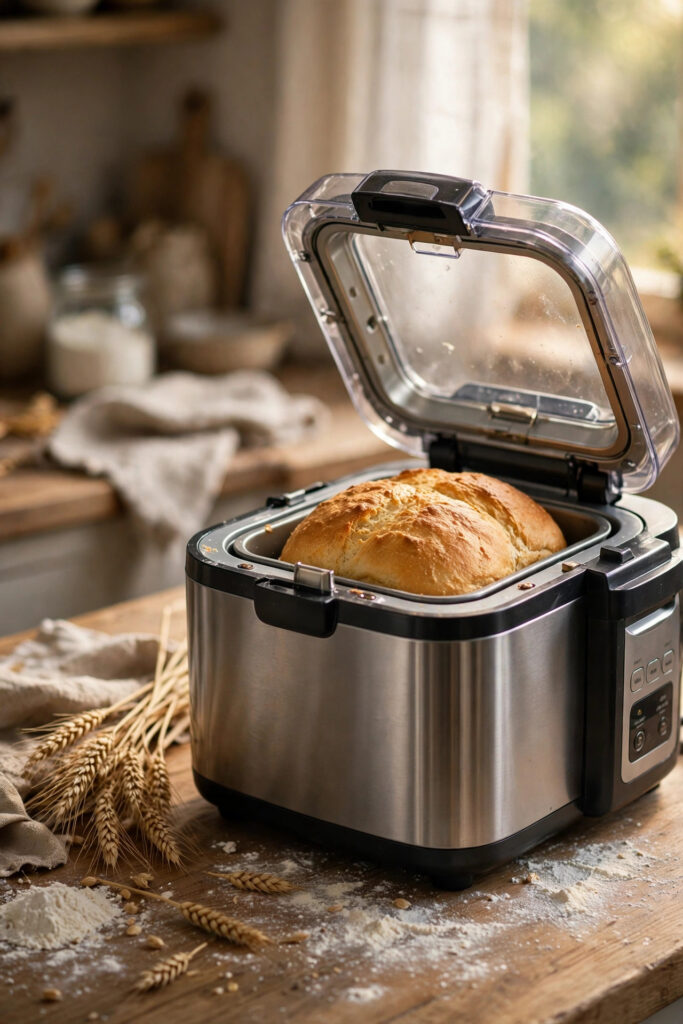
The best bread machine for beginners turns flour, water, yeast, and a button press into a warm loaf — no kneading, no proofing schedule, no guesswork. You measure the ingredients, pick a program, and come back to fresh bread. It’s the easiest way into homemade bread, and in winter, when the kitchen is already warm and the house smells like a bakery, it’s hard to beat.
The right first machine depends on how much you want to spend and how often you’ll bake. A simple budget model is perfect if you’re trying bread-making out; a premium machine is worth it if you plan to bake several times a week for years. Below, we’ve researched the top-rated bread machines available right now, comparing them for ease of use, loaf quality, and beginner-friendly features.
Our Top Picks
KBS Pro 710W Bread Maker
The KBS Pro 710W Bread Maker is our best overall value pick — the most frequently top-ranked value machine in 2026 beginner roundups, with 11,000+ verified Amazon reviews cited by reviewers. A powerful 710W motor, a healthy ceramic pan, and a fully automatic fruit-and-nut dispenser make it a genuinely hands-off first machine, and its 17 programs cover white, whole wheat, gluten-free, jam, yogurt, and cake.
Pros:
- Ceramic pan (no PFAS nonstick coating concerns) that releases loaves cleanly
- Automatic fruit and nut dispenser adds mix-ins at the right moment with no babysitting
- 17 programs covering white, whole wheat, gluten-free, jam, yogurt, and cake
- Strong owner-review volume backing its reliability for the price
Cons:
- Louder than some rivals during the kneading cycle, per owner reports
- Some owners report the machine doesn’t always stir heavy dough thoroughly
- KBS is a newer brand than Zojirushi or Cuisinart, so long-term longevity is less proven
- No collapsible paddle — the kneading paddle leaves a hole in the bottom of the loaf
Hamilton Beach Programmable Bread Maker
The Hamilton Beach Programmable Bread Maker is our best pick for most beginners — the default first machine in multiple 2026 guides and the safe, trusted-brand choice. With 12–14 settings covering white, whole wheat, French, and sweet breads, three crust shades, a 13-hour delay timer, and a nonstick pan that releases cleanly, reviewers call it the easiest trusted-brand machine to get a good first loaf from.
Pros:
- Simple, forgiving controls — reviewers call it the easiest trusted-brand machine to get a good first loaf from
- Gluten-free and artisan settings included on the 29987/29985 variants
- Compact, lightweight footprint that fits small kitchens
- Consistently top-rated by owners in the sub-$120 tier for loaf reliability
Cons:
- Vertical pan bakes tall, narrow loaves with taller-than-normal slices
- Some owners report the machine bounces or vibrates on the counter during the mix cycle
- A minority of owners report heating elements failing early
- Basic feature set — no automatic fruit/nut dispenser or custom programs
Cuisinart CBK-110 Compact Automatic Bread Maker
The Cuisinart CBK-110 Compact Automatic Bread Maker is our best compact pick — America’s Test Kitchen’s recommended mid-range pick and the most-reviewed compact machine in this guide. Its smart vertical design saves counter space while still baking a full 2 lb loaf, with 12 programs and a convection fan for even baking, plus a 13-hour delay timer.
Pros:
- Compact vertical footprint — the best space-saver here for small kitchens
- Convection fan promotes even browning and a consistent crumb
- 12 programs including gluten-free, plus a 13-hour delay timer
- Attractive stainless-steel design that looks good left out on the counter
Cons:
- A minority of owners report units failing within the first year
- Compact pan can feel cramped for larger recipes
- Some owners report rubber feet detaching over time
- Pricier than the Hamilton Beach for a similar basic loaf
Oster Expressbake Bread Maker
The Oster Expressbake Bread Maker is our best budget pick. Its ExpressBake cycle bakes a loaf in under an hour, the controls are dead simple, and it’s one of the cheapest name-brand machines available — a solid entry point for a beginner who wants fast, simple loaves. It has 12 settings including gluten-free, a 13-hour delay timer, and a removable nonstick pan that makes cleanup easy.
Pros:
- ExpressBake rapid cycle produces a loaf in under an hour
- Very simple one-touch controls with almost no learning curve
- 12 settings including gluten-free, plus a 13-hour delay timer
- Removable nonstick pan makes cleanup easy
Cons:
- Rapid-bake loaves come out denser with a tighter crumb than slow-cycle bread
- Some owners report uneven browning and results that depend heavily on exact liquid/flour ratios
- Kneading paddle leaves a hole in the bottom of the loaf
- Lighter build quality — long-term durability is a recurring buyer question, and the nonstick coating can wear over time
Cuisinart CBK-200 Convection Bread Maker
The Cuisinart CBK-200 Convection Bread Maker is our best versatile pick — the step-up Cuisinart for beginners who want more from their machine. With 16 preset menus, a large 2 lb capacity, three crust settings, and an automatic fruit-and-nut dispenser, it’s frequently called the best all-around beginner machine in review roundups, and its low-carb and gluten-free settings cover special diets too.
Pros:
- 16 programs plus convection baking for even, consistent results
- Automatic fruit and nut dispenser for raisin bread, nut loaves, and similar
- Low-carb and gluten-free settings included
- Solid, durable build that reviewers expect to last well past year one
Cons:
- Some owners report bread browning too dark or burning on anything above the light crust setting
- Larger and heavier than the compact CBK-110
- Pricier than the Hamilton Beach and Oster budget picks
- No collapsible paddle — the paddle leaves a hole in the finished loaf
Breville Custom Loaf Bread Maker
The Breville Custom Loaf Bread Maker is our best pick for experimenters — the “grow into it” machine for beginners who like to tinker. It’s the only mainstream machine that lets you edit each stage (knead, rise, bake) and save your own recipes, plus it has an automatic fruit-and-nut dispenser and a collapsible paddle that folds flat before baking, leaving a smaller hole in the loaf. Its horizontal pan bakes 1–2.5 lb loaves in a traditional sandwich shape.
Pros:
- Fully programmable custom stages — 9 custom settings you can save, ideal for gluten-free blends and experimenting
- Collapsible paddle folds down before baking, minimizing the hole in the loaf
- Step-by-step LCD progress display shows exactly which stage the bake is in
- Horizontal pan bakes 1–2.5 lb loaves in a traditional sandwich shape
Cons:
- Menu system has a real learning curve — owners describe it as the least intuitive in its class, so budget an afternoon with the manual
- Top crust runs paler than the bottom on taller loaves
- Noisy during the mixing cycle, per owner reports
- Premium price — roughly double a Cuisinart CBK-110, and overkill if you’ll only ever press Basic
Zojirushi Home Bakery Virtuoso Plus Breadmaker
The Zojirushi Home Bakery Virtuoso Plus Breadmaker is our best premium pick — the consensus premium machine across review roundups and America’s Test Kitchen recommendations. Dual kneading paddles, a lid heater for even top-crust browning, and a horizontal 2 lb pan that produces proper sandwich-shaped loaves make it the “buy once” machine for beginners who plan to bake several times a week, and owner reports of decade-plus lifespans are common.
Pros:
- Dual kneading paddles develop dough evenly and eliminate the single-paddle-stuck-in-loaf problem
- Dual heaters (including a lid heater) brown the top crust evenly, unlike single-heater machines
- Horizontal pan bakes traditional sandwich-shaped loaves, not tall vertical ones
- Long track record — owner reports of decade-plus lifespans are common
Cons:
- Premium price, by far the most expensive machine in this guide
- Large footprint that eats counter space
- Overkill for a beginner who isn’t sure they’ll bake regularly
- Some owners report paddle wear/stripping over time and occasional rising issues
Buying Guide
Loaf shape — horizontal vs. vertical: Horizontal pans (Zojirushi, Breville, KBS) bake traditional sandwich-shaped loaves with normal slices. Vertical pans (Hamilton Beach, Cuisinart CBK-110, Oster) bake tall, narrow loaves with taller slices — fine for toast, awkward for sandwiches. If you mostly make sandwich bread, a horizontal pan is worth prioritizing.
Programs — how many do you actually need: Every machine here covers white, whole wheat, and French. The differences are in the extras: gluten-free, jam, cake, yogurt, and custom programs. Beginners should make sure gluten-free is included if anyone in the house needs it; beyond that, more programs mostly mean more buttons you’ll never press.
Fruit and nut dispenser — the set-and-forget upgrade: A dispenser (KBS, Cuisinart CBK-200, Breville) drops mix-ins in at the right moment automatically. Without one, you have to listen for a beep and add raisins or nuts by hand mid-cycle. If you bake a lot of raisin bread or nut loaves, it’s a genuine quality-of-life feature.
Delay timer — wake up to fresh bread: All seven machines here have a delay timer of 13 hours or more. Load the ingredients at night, set the timer, and the loaf finishes as you wake up. It’s the single most-used feature on a bread machine, so make sure yours has it — and never use the delay timer with perishable ingredients like milk or eggs.
Paddle hole — the unavoidable trade-off: Every bread machine except the Breville leaves a hole in the bottom of the loaf where the kneading paddle sits. It’s cosmetic, not a flaw, and the slices around it are perfectly good. A collapsible paddle (Breville) minimizes it, but don’t pay double just to avoid it.
Size and noise — the counter reality: Bread machines are big and they knead loudly. Measure your counter and your storage shelf before buying — the Zojirushi and Breville need real space — and if you bake at night, check owner reviews for noise complaints. A machine you can’t store is a machine you won’t use.
FAQs
Is a bread machine worth it for a beginner? Yes — it’s the easiest way to start baking bread. You measure ingredients, press a button, and get a fresh loaf with no kneading or proofing schedule to learn. If you bake even once a week, a budget machine like the Hamilton Beach or Oster pays for itself quickly compared with bakery bread.
What is the best bread machine for a first-time buyer? For most beginners, the Hamilton Beach Programmable is the safest first machine — simple controls, trusted brand, and a low price. If you want more features for the money, the KBS Pro 710W is the best value pick, and the Zojirushi Virtuoso Plus is the buy-once premium choice.
Do bread machines make good bread? Yes, with the right recipe and measurements. Bread machines are sensitive to the flour-to-liquid ratio, so measure carefully — weighing ingredients on a kitchen scale gives the most consistent results. The rapid-bake cycles on budget machines produce denser loaves; the standard 3–4 hour cycle gives the best crumb.
Can I make gluten-free bread in a bread machine? Yes, if the machine has a gluten-free program — the KBS, Hamilton Beach (29987/29985 variants), Cuisinart CBK-110 and CBK-200, Breville, and Zojirushi all include one. Gluten-free dough behaves differently from wheat dough, so use a recipe designed for bread machines and don’t expect the same rise.
Why does my bread have a hole in the bottom? That’s where the kneading paddle sits. Every bread machine leaves a paddle hole except models with a collapsible paddle, like the Breville Custom Loaf. It’s normal and harmless — just slice around it.
Can I use the delay timer with milk and eggs? No — don’t use the delay timer with perishable ingredients. Milk, eggs, and butter left at room temperature for hours can spoil. Use water-based recipes (or shelf-stable milk powder) for overnight delayed bakes.
