
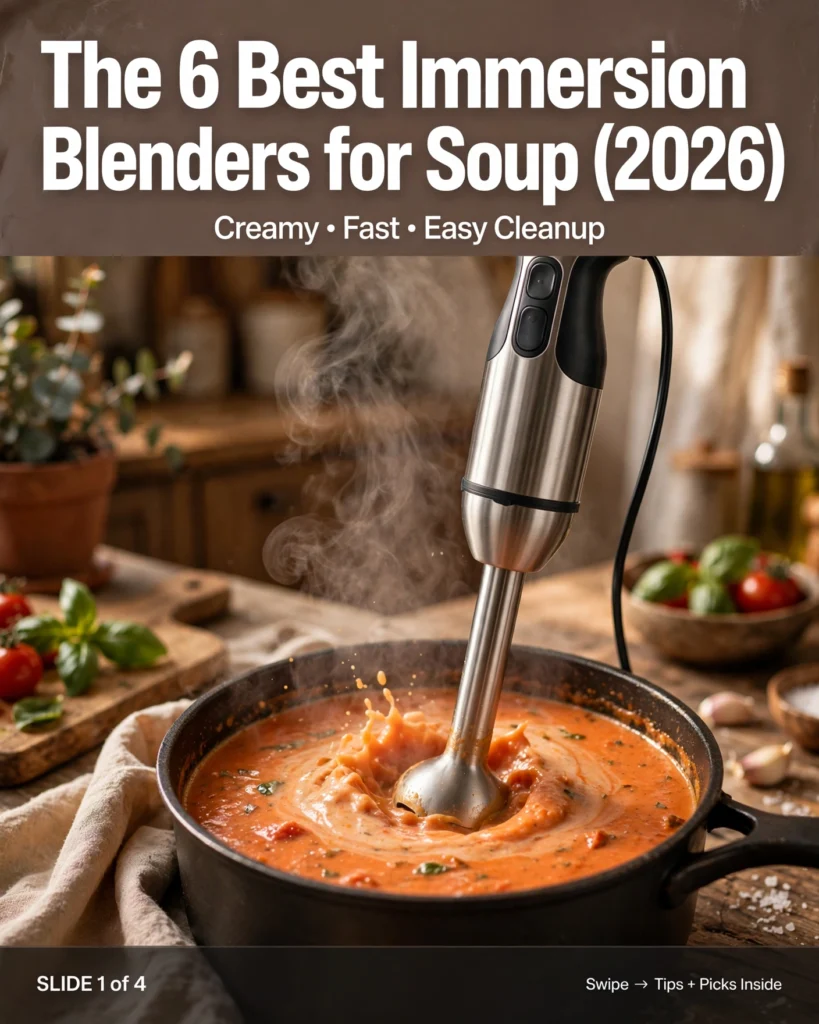
Intro
Transferring a pot of bubbling soup into a jug blender in batches is a mess waiting to happen — and the steam pressure can blow the lid clean off. An immersion blender solves it completely: drop the shaft into the pot, blend for a minute, and your soup is silky. No transferring, no extra dishes, no burns.
But not every stick blender handles hot soup well. You want enough power to puree fibrous vegetables smoothly, a bell guard that won’t scratch your pots or create a vortex of suction, and a shaft long enough to reach the bottom of a deep stockpot. We rounded up the six best immersion blenders for soup, from a budget 500W workhorse to the premium Vitamix. Every pick is a real, currently available product.
Our Top Picks at a Glance
| Pick | Blender | Best for |
|---|---|---|
| Best Overall | Braun MultiQuick 5 (MQ505) | Splatter-free blending with the PowerBell design |
| Most Powerful | Vitamix 5-Speed Immersion Blender | Thick soups and big pots — 625W of power |
| Best Ergonomics | Breville Control Grip (BSB510XL) | Comfortable trigger grip, anti-suction bell |
| Best for Nonstick Pots | KitchenAid Variable Speed (KHBV53) | Patented pan guard protects your cookware |
| Best Budget | Mueller Austria Ultra-Stick (MU-HB-02) | 500W and 3 attachments for very little money |
| Quietest | Cuisinart Smart Stick (CSB-179) | Quiet DC motor with smooth slide control |
The Reviews
1. Braun MultiQuick 5 Immersion Hand Blender (MQ505) — Best Overall
Braun’s German-engineered stick blender is a long-running favorite for a reason. The 350W motor is paired with the PowerBell bell design — an extra blending blade and an anti-splash elongation that genuinely cuts down on the suction and splatter that plague cheaper stick blenders. It comes with a 20 oz beaker and a whisk, and the two-speed operation is dead simple. For blending soup in the pot, this is the reliable middle ground: enough power, controlled blending, quick rinse cleanup.
Pros
- SplashControl PowerBell design reduces suction and splatter
- Solid German build quality — built to last
- Simple two-speed operation; no fiddly controls
- Quick rinse cleanup; whisk included
Cons
- Only 2 speed settings — no fine control
- Plastic beaker prone to scratching over time
- Struggles with hard frozen ingredients
Best for: cooks who want a dependable, splatter-free soup blender.
2. Vitamix 5-Speed Immersion Blender, Stainless Steel — Most Powerful
The Vitamix brings a 625W motor — the most powerful in this lineup by a wide margin — to thick, dense soups that would bog down lesser blenders. The 4-prong blade and unique bell guard design protect your nonstick and ceramic pots while you blend, and the 5 speeds with an LED display give real control. The long 5-foot cord reaches across the kitchen, and the 3-year warranty backs it up. It is heavy and expensive, but nothing else here purees a chunky root-vegetable soup as effortlessly.
Pros
- Most powerful motor here — best for thick soups and big pots
- Bell guard protects nonstick and ceramic pots
- 5 speeds with LED display; one-handed operation
- 5-foot cord and 3-year warranty
Cons
- Premium price
- Heavy at ~2.9 lb — arm fatigue on large batches
- Base kit has no blending jar or extra attachments
Best for: big-batch soup makers who want maximum power.
3. Breville BSB510XL Control Grip Immersion Blender — Best Ergonomics
The Breville’s standout feature is its trigger-style control grip — squeezing harder increases speed, which feels natural and precise once you get used to it. The ribbed bell reduces suction so hot soup doesn’t swirl up the sides of the pot, and the non-scratch base is safe on all cookware. With 15 speeds, an 8-inch immersion depth, and a generous kit (42 oz jug, 25 oz chopper, whisk), it’s the most complete package here — though 280W is modest for very dense purees.
Pros
- Comfortable trigger grip — excellent ergonomics
- Anti-suction ribbed bell keeps hot soup contained
- Generous accessory kit stores compactly
- 15 speeds with fine control
Cons
- Pricier than peers at similar wattage
- 280W is modest for very dense purees
- Trigger-speed has a small learning curve
Best for: cooks who blend often and value comfort and control.
4. KitchenAid Variable Speed Corded Hand Blender (KHBV53) — Best for Nonstick Pots
KitchenAid’s hand blender was designed with one soup-maker worry in mind: scratching the pot. Its patented removable pan guard is a flexible shield that lets you blend directly in nonstick, ceramic, and enameled cookware without a scratch — a genuine advantage over bare-shaft blenders. The variable-speed trigger is intuitive, the whole unit is lightweight, and owners rate it highly. At 180W it’s the least powerful here, so it’s best for soft cooked vegetables rather than dense root purees.
Pros
- Pan guard protects cookware — ideal for blending soup directly in pots
- Lightweight and comfortable in the hand
- Strong 4.7-star owner satisfaction
- Removable 8-inch arm; 3-cup jar with lid included
Cons
- Only 180W — fine for soft vegetables but slow on thick blends
- No preset speeds, just trigger pressure
- Not the pick for dense, fibrous soups
Best for: nonstick and enameled-pot owners who blend in the pot.
5. Mueller Austria Ultra-Stick 9-Speed (MU-HB-02) — Best Budget
The best power-per-dollar in this roundup. The Mueller Ultra-Stick packs a 500W motor — more than blenders costing three times as much — with 9 speeds plus Turbo, a stainless steel shaft, and a 3-attachment bundle (whisk, milk frother, beaker). Tens of thousands of reviews confirm it gets the job done. The housing feels less premium than the Braun or Breville, and suction can be strong on low settings, but for blending soup on a budget, this is the value pick.
Pros
- Excellent power-per-dollar — 500W at a budget price
- Versatile 3-attachment bundle
- Tens of thousands of reviews; a proven budget pick
- Stainless steel shaft safe for hot liquids
Cons
- Housing feels less premium than Braun/Breville
- Suction can be strong on low settings
- Build quality varies vs. premium brands
Best for: budget buyers who still want real blending power.
6. Cuisinart CSB-179 Smart Stick Variable Speed — Quietest
Cuisinart’s Smart Stick uses a quiet DC motor that purrs rather than screams — a real plus for early-morning or late-night blending, and the smooth slide speed control is precise enough for delicate soups and baby food. The 8-inch stainless shaft reaches deep pots, and the kit is complete: 3-cup chopper/grinder, chef’s whisk, and measuring cup, all backed by a 3-year warranty. It can splatter on high speed in shallow pots, so keep it submerged, but for quiet, controlled blending it’s excellent.
Pros
- Quiet DC motor with smooth slide speed control
- Complete accessory kit with 3-year warranty
- 8-inch stainless shaft for deep pots
- Good for delicate soups and baby food
Cons
- Can splatter on high speed in shallow pots
- Slide control feels fiddly to some users
- Pricier than the Mueller for similar wattage
Best for: quiet, controlled blending — including delicate soups.
Buying Guide: How to Choose an Immersion Blender for Soup
Power: aim for 300W+. Wattage isn’t everything — blade design matters more — but for soup, 300 watts is a good floor. Below that (like the 180W KitchenAid), blending thick vegetable soups takes noticeably longer. The 500W Mueller and 625W Vitamix power through fibrous roots and big batches with ease.
Bell guard shape. A good bell does two jobs: it shields the blades from your pot, and it controls the vortex. Anti-suction designs (Braun’s PowerBell, Breville’s ribbed bell, Vitamix’s guard) keep hot soup from swirling up the sides or sucking the shaft to the pot bottom. If you own nonstick or enameled cookware, a pan guard or non-scratch base is non-negotiable.
Shaft length. An 8-inch shaft reaches the bottom of a standard stockpot. Shorter shafts force you to tilt the pot, which is exactly how hot soup splashes. For big-batch soup makers, this spec matters more than it looks.
Speed control. Variable or multi-speed control lets you start slow (less splatter with hot liquids) and ramp up for a silky finish. Trigger-style controls (Breville, KitchenAid) are intuitive; two-speed models (Braun) are simpler but coarser.
Hot-liquid safety. Always keep the head fully submerged before switching on, start on the lowest speed, and never lift the blender out while it’s running. Tilt the pot slightly and move the blender slowly for the smoothest puree.
Cleanup. Detachable stainless shafts rinse clean in seconds and most are dishwasher-safe. Avoid soaking the motor housing — a damp cloth is enough.
FAQs
Can I blend hot soup with an immersion blender? Yes — that’s their best use case. Keep the head fully submerged, start on low speed, and use a stainless steel shaft (plastic shafts can warp in very hot liquids). Never lift the running blender out of the liquid.
Will an immersion blender scratch my nonstick pot? A bare metal bell can. Choose a blender with a pan guard (KitchenAid), a non-scratch base (Breville), or a protective bell design (Vitamix) — or blend in a stainless steel or enameled pot instead.
How long does it take to puree a pot of soup? Typically 1–3 minutes with a decent blender. Move the head slowly through the pot, tilting it slightly, until you see no visible chunks. Thicker soups with fibrous vegetables (celery, leeks) take the longest.
Can an immersion blender replace a countertop blender? For soup, yes — and it’s better, since there’s no transferring hot liquid. For frozen drinks, nut butters, and very large smoothies, a countertop blender still wins on power and capacity.
Why does my immersion blender suck onto the pot bottom? That’s the vortex effect from a poorly designed bell. Anti-suction bell designs (Braun PowerBell, Breville’s ribbed bell) exist precisely to fix this. Starting on a lower speed also helps.
Blending beyond soup? See our roundup of the best blenders for countertop picks that handle smoothies, frozen fruit, and more.
