
A clean kitchen is not about scrubbing harder; it is about owning the right tools. The best kitchen cleaning tools and gadgets of 2026 share a few traits: they cut elbow grease with smart design, they last longer than a month of daily use, and they target the jobs people actually hate — greasy stovetops, grimy grout, smelly disposals, and cluttered under-sink cabinets. This research-based guide compares the standout tools across every budget, explains what to look for before you buy, and shows how to assemble a complete cleaning kit without wasting money on gimmicks. No fake \”we tested 47 mops\” claims here — just honest analysis of design, materials, verified buyer feedback patterns, and value.
How to Choose Kitchen Cleaning Tools: What Actually Matters
Before the product roundup, here is the buying framework that separates tools worth owning from drawer clutter:
- Match the tool to your surfaces. Nonstick pans, stainless steel, glass stovetops, and natural stone all need different abrasiveness levels. A tool that is perfect for a cast iron skillet will destroy a nonstick coating. Buy for the surfaces you actually own.
- Ergonomics beat features. You will use a dish brush hundreds of times a year. A comfortable grip, a good weight balance, and a brush head that reaches corners matter more than a built-in soap gimmick you will stop refilling by March.
- Replaceable heads win long-term. Tools with replaceable heads or pads cost less over two years than disposable alternatives and perform better throughout, because you actually replace the worn part instead of tolerating a dead sponge.
- Drying and storage design matters. A brush that cannot stand up or hang will sit in a puddle growing bacteria. Look for hanging holes, drip stands, and quick-dry materials like silicone.
- Check the real cost per year. A $25 brush with $5 replacement heads used for three years beats a $6 sponge habit that costs $70 over the same period and cleans worse the entire time.
The Best Kitchen Cleaning Tools and Gadgets of 2026
1. Best Overall: Electric Spin Scrubber with Extension Handle
The electric spin scrubber is the closest thing to a power tool for kitchen cleaning, and it earns the top spot by solving the most-hated jobs: stovetop grime, sink stains, tile grout, and shower-adjacent kitchen tile. A spinning head (usually with multiple brush attachments) does the agitation your arm used to do, while the extension handle means no more kneeling to scrub floors or stretching to reach behind the faucet. Look for models with at least two speed settings, interchangeable heads (dome brush for corners, flat brush for surfaces, scouring pad for tough spots), and USB-C rechargeable batteries with 60-plus minutes of runtime. A quality electric spin scrubber with extension handle typically costs $30 to $50, and verified buyer feedback consistently highlights stovetops and grout as the jobs where it feels almost unfair how easy it becomes.
2. Best for Chemical-Free Cleaning: Handheld Steam Cleaner
A handheld steam cleaner blasts grime with pressurized steam above 100°C, cutting through grease on stovetops, range hoods, and microwave interiors without a drop of chemical cleaner. The science is straightforward: heat melts grease, pressure dislodges it, and the steam sanitizes as it goes. It excels on jobs where chemicals are annoying — inside ovens, around stove knobs, on high-chair trays. Choose one with a 20-plus minute steam time, multiple nozzle attachments (a detail nozzle for grout lines, a fabric/upholstery tool, a squeegee for glass), and a quick heat-up under five minutes. Expect to pay $40 to $80 for a capable handheld steam cleaner. Note the limitation: steam is for hard, heat-safe surfaces, not for wood, unsealed stone, or electronics.
3. Best Daily Dish Brush: Soap-Dispensing Dish Brush with Replaceable Head
The humble dish brush got a serious upgrade. Modern soap-dispensing brushes hold dish soap in the handle and release it with a button press, while the replaceable head means you swap a $4 head instead of a whole brush. Compared to sponges, brushes harbor dramatically fewer bacteria because bristles dry fast and do not trap food particles in pores — food-safety researchers have repeatedly found kitchen sponges among the dirtiest objects in the home. Look for stiff-but-flexible bristles, a scraper edge on the back for stuck-on food, and a storage stand that holds the brush upright to drip-dry. At $10 to $15, a soap-dispensing dish brush with replaceable heads is the highest-value upgrade on this entire list.
4. Best Sponge Alternative: Silicone Scrubbers (Set of 3)
Silicone scrubbers will not replace your brush for everything, but they are superb daily drivers for nonstick pans, glassware, and baby bottles. The soft silicone bristles are non-porous, so they do not absorb odors, grow mildew, or fall apart — most users report theirs lasting a year or more, and they are dishwasher-safe for sanitizing. They are gentler than traditional scouring pads, which makes them safe for nonstick coatings and delicate glass. A silicone scrubber set of three costs under $10 and effectively ends the cycle of buying smelly sponges every two weeks.
5. Best Microfiber Cloths: Ultra-Absorbent Microfiber Cleaning Cloths (12-Pack)
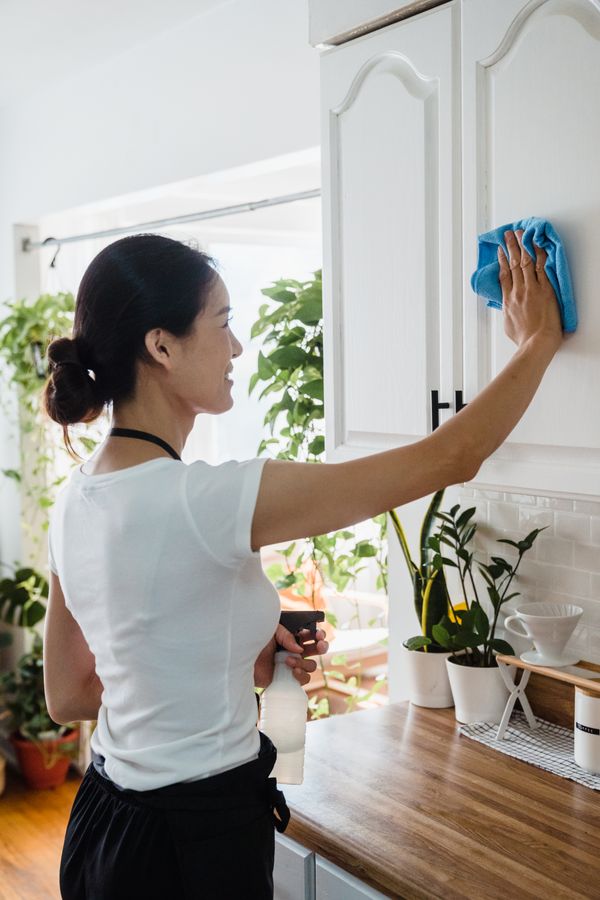
Microfiber\’s split fibers create millions of tiny edges that trap dust, grease, and moisture far better than cotton — a single cloth can absorb several times its weight in water. A 12-pack lets you color-code: blue for glass, yellow for counters, green for appliances, so you never wipe a toilet-adjacent surface and then a cutting board. Look for cloths with a GSM (grams per square meter) of 300 or higher for serious absorbency, and wash them without fabric softener, which clogs the fibers and ruins their performance. A quality microfiber cleaning cloths 12-pack runs $12 to $18 and replaces hundreds of paper towels a year.
6. Best for Stovetops: Glass Stovetop Scraper with Razor Blades
Baked-on spills on a glass or ceramic stovetop laugh at sponges. A dedicated stovetop scraper holding a single-edge razor blade shaves burnt residue flat off the glass without scratching — when used correctly, at a low angle, on a cooled stovetop with a little cooktop cream as lubricant. This is the tool professional appliance cleaners actually use. Buy a scraper with a retractable blade guard for safe drawer storage and a pack of replacement blades, since a dull blade drags instead of gliding. A glass stovetop scraper kit with blades costs $8 to $12 and makes a five-year-old stovetop look nearly new in one session.
7. Best for Bottles and Vases: Long-Handle Bottle Brush Set
Water bottles, baby bottles, vases, and blender jars develop biofilm in spots your hand cannot reach — that slimy layer is a bacterial playground. A set of long-handle brushes in multiple diameters (typically a large bottle brush, a straw brush, and a detail brush) reaches every interior. Look for stiff nylon bristles that will not shed, a twisted wire core that holds its shape, and a hanging loop. Silicone-tipped versions are gentler on delicate glass. A bottle brush cleaning set costs $8 to $12 and eliminates the mysterious smell from \”clean\” water bottles.
8. Best for the Sink Area: Over-Sink Dish Drying Rack (Roll-Up or Expandable)
Counter space is precious, and a traditional dish rack eats a square foot of it permanently. Roll-up over-sink racks (silicone-coated steel rods) unroll across the sink for drying and roll away into a drawer when done; expandable models adjust to your sink width. Dishes drip directly into the sink, so there is no stagnant tray water growing a science experiment. Choose rust-resistant materials — 304 stainless steel or silicone-coated steel — and check your sink\’s inner dimensions before ordering. Expect $15 to $25 for a sturdy roll-up over-sink dish drying rack that reclaims your counter.
9. Best Odor Fighter: Garbage Disposal Cleaning Pods
That sour smell from the disposal is decomposing food trapped in the splash guard and grinding chamber. Disposal cleaning pods use foaming agents and degreasers that expand to reach the hidden crevices a brush cannot, then rinse away with the water flow. They are far more effective than the old ice-and-lemon trick, which mostly just sharpens nothing and perfumes the problem temporarily. Use one weekly as maintenance, not as a rescue for a disposal that is already fully clogged — that needs mechanical attention. A bag of garbage disposal cleaner pods costs around $8 to $12 and keeps the sink area smelling neutral.
10. Best Under-Sink Organizer: Expandable Under-Sink Shelf Organizer
Cleaning tools you cannot find do not get used. An expandable under-sink organizer with two tiers works around plumbing to double your storage, keeping sprays upright, cloths accessible, and trash bags visible. Look for rust-proof coated steel, adjustable width (most expand from about 38 to 60cm), and a top shelf tall enough for standard spray bottles. Pair it with a small caddy for the daily-use items so you can carry everything to the job in one trip. A solid expandable under-sink organizer runs $20 to $35 and ends the avalanche of bottles every time you open the cabinet.
Quick Comparison Table
| Tool | Best For | Price Range | Key Feature |
|---|---|---|---|
| Electric spin scrubber | Stovetops, grout, tubs | $30–$50 | Powered agitation, extension handle |
| Handheld steam cleaner | Chemical-free degreasing | $40–$80 | Sanitizing steam, no chemicals |
| Soap-dispensing dish brush | Daily dishes | $10–$15 | Replaceable heads, hygienic bristles |
| Silicone scrubbers | Nonstick, glassware | Under $10 | Non-porous, dishwasher safe |
| Microfiber cloths (12-pack) | All surfaces | $12–$18 | Color-coded, ultra-absorbent |
| Stovetop scraper kit | Glass cooktops | $8–$12 | Razor-sharp burnt-residue removal |
| Bottle brush set | Bottles, jars, straws | $8–$12 | Reaches where hands cannot |
| Over-sink drying rack | Small kitchens | $15–$25 | Reclaims counter space |
| Disposal cleaning pods | Sink odors | $8–$12 | Foaming deep clean |
| Under-sink organizer | Storage chaos | $20–$35 | Doubles cabinet capacity |
Build Your Kit by Budget
Starter kit (under $40): soap-dispensing dish brush, silicone scrubbers, microfiber 12-pack, and a stovetop scraper if you have a glass cooktop. This covers 90 percent of daily kitchen cleaning and immediately upgrades you from the sponge-and-paper-towel cycle.
Complete kit (under $100): add the electric spin scrubber and the bottle brush set. Now deep-cleaning jobs like grout, ovens, and range hoods take minutes instead of weekends.
Full arsenal (under $180): add the handheld steam cleaner, over-sink rack, disposal pods, and under-sink organizer. At this point your kitchen has a professional-grade cleaning system with a place for everything.
Care Tips That Extend Tool Life
- Rinse brushes and scrubbers after every use and store them upright or hanging so they dry completely. Tools that stay damp grow bacteria and wear out faster.
- Sanitize silicone scrubbers and microfiber cloths in the dishwasher weekly. Wash microfiber separately from cotton (lint transfer) and never use fabric softener.
- Replace dish brush heads every 2 to 3 months, or sooner if bristles splay. A worn brush cleans half as well and you will compensate with extra chemicals.
- Descale your steam cleaner per the manufacturer\’s schedule if you have hard water; mineral buildup kills heating elements faster than anything else.
- Store razor scraper blades with the guard on, away from children. A dedicated drawer spot prevents both injuries and dings that dull the edge.
Frequently Asked Questions
Are kitchen sponges really that unhygienic?
Yes, according to multiple microbiology studies. Sponges\’ warm, moist, porous structure with trapped food particles makes them ideal bacterial incubators, and microwaving or boiling only partially sanitizes them. Dish brushes and silicone scrubbers dry quickly and do not trap food the same way, making them measurably more hygienic daily drivers for most dishwashing tasks.
Can a steam cleaner replace chemical cleaners entirely?
For grease and grime on hard, heat-safe surfaces, largely yes — pressurized steam above 100°C melts grease and sanitizes effectively. But steam cannot polish, deodorize fabrics deeply, or handle mineral-heavy limescale as well as targeted products, and it is unsafe for wood, unsealed stone, and electronics. Think of it as replacing most chemical cleaners, not all.
What is the best way to clean a glass stovetop without scratching it?
Let the cooktop cool completely, apply a dedicated cooktop cream, and use a razor scraper held at a low angle to shave off burnt residue, then buff with microfiber. The razor sounds aggressive but is the manufacturer-recommended method because it shears residue flat instead of grinding abrasives across the glass. Never use the scraper on a hot surface.
How often should I replace my dish brush head?
Every two to three months with daily use, or as soon as bristles splay outward and lose stiffness. A worn head cleans poorly no matter how much soap you use, which leads to rewashing and extra chemical use. Mark your calendar when you install a new head; at a few dollars per replacement, there is no reason to stretch it.
Do garbage disposal cleaning pods actually work?
For maintenance odor control, yes. The foaming action expands into the splash guard baffles and upper grinding chamber where brushes cannot reach, breaking down the grease and food film that cause smells. They are preventive maintenance, though — a disposal that is already jammed or fully clogged needs mechanical clearing first, and pods will not fix plumbing problems.
Is an electric spin scrubber worth it for a small kitchen?
Often more so than for a large one, because small kitchens concentrate grime into fewer surfaces you stare at constantly. The extension handle also reaches behind faucets and into tight corners that are awkward in compact layouts. If your most-hated jobs are stovetop grease and grout lines, it pays for itself in saved weekends quickly.
