
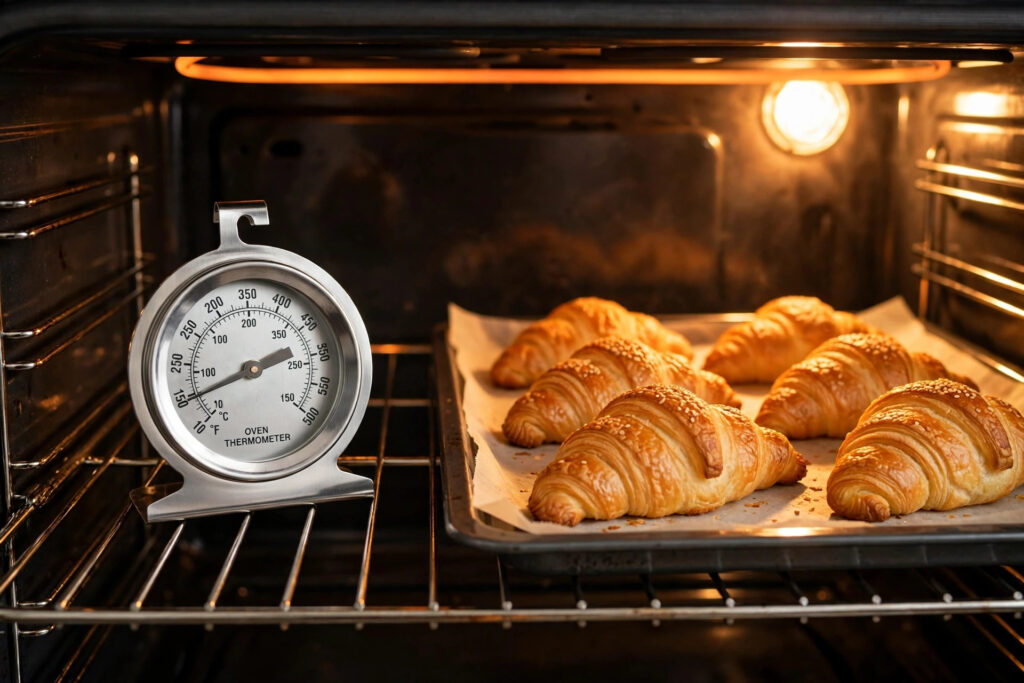
Intro
Most ovens lie. It is common for a home oven to run 15 to 25 degrees hotter or cooler than the number on its dial, and that gap is the difference between a cake that rises properly and one that sinks, or a pie crust that browns instead of staying pale. An oven thermometer tells you the real temperature inside your oven, so you can adjust the dial and bake with confidence.
This is a research-based comparison of top-rated oven thermometers — no inflated claims, no invented specs. Here are six of the best oven thermometers for baking in 2026, from a classic dial model to precision digital probes.
Our Top Picks
- Best Overall: Taylor Precision Products Large Dial Oven Thermometer
- Best Everyday Analog: OXO Good Grips Oven Thermometer
- Best Digital Probe: ThermoWorks ChefAlarm
- Best Simple Digital Alarm: ThermoWorks DOT
- Best Budget Analog: Taylor Classic Series Oven Thermometer
- Best Pro-Style Analog: CDN ProAccurate Oven Thermometer
1. Taylor Precision Products Large Dial Oven Thermometer
Best overall — the most readable dial you can buy
The Taylor Large Dial is the thermometer reviewers consistently recommend for home bakers: a 3.25-inch dial you can read from across the kitchen, a 100 to 600°F range that covers everything from slow roasting to high-heat baking, NSF certification, and a hook or stand so it hangs from a rack or stands on one. In independent comparisons it has held within about 5°F of a reference thermometer — plenty accurate for baking.
Pros:
- Extra-large 3.25-inch dial is easy to read through the oven window
- NSF certified for food safety standards
- Accurate to within about 5°F in independent comparisons
- Hangs from a rack or stands on its own base
- Affordable
Cons:
- Analog dials are slower to respond than digital probes
- No alarm — you have to check it yourself
- Dial markings are in 25-degree increments, so fine readings require estimation
2. OXO Good Grips Oven Thermometer
Best everyday analog — simple, clear, and hard to break
OXO’s oven thermometer is the set-it-and-forget-it option: a clear, easy-to-read dial with temperature zones marked for warming, baking, roasting and broiling, a sturdy stainless body, and a hook that hangs securely from a rack. Baking guides frequently cite it as the top-tested analog model for reliable, quick readings. It will not beep at you, but it also never needs a battery.
Pros:
- Clear dial with marked zones for baking, roasting and broiling
- Hangs securely from an oven rack
- No batteries needed, nothing to fail
- Durable stainless construction
Cons:
- No alarm or digital readout
- Smaller dial than the Taylor Large Dial
- Analog accuracy is good, not laboratory-grade
3. ThermoWorks ChefAlarm
Best digital probe — laboratory-level accuracy with alarms
The ChefAlarm is the tool for bakers who want certainty: a probe that sits in the oven while the display stays outside, so you can monitor the real oven temperature without opening the door and losing heat. It is accurate to within a degree or two, offers high and low alarms, and can also monitor food temperature with a second probe mode. Reviewers have called it the most accurate oven thermometer they tested.
Pros:
- Exceptional accuracy — matches professional reference instruments
- Probe stays in the oven; display stays outside, so no heat loss from opening the door
- High and low temperature alarms
- Doubles as a food thermometer with the probe
Cons:
- Significantly more expensive than analog models
- Needs batteries and has more parts to keep track of
- Overkill if you just want a quick oven check
4. ThermoWorks DOT
Best simple digital alarm — one job, done brilliantly
The DOT is ThermoWorks’ stripped-down digital alarm thermometer: a probe on a cable, a big display, and two buttons. Set your target temperature and it beeps when the oven reaches it. Allrecipes’ testers praised its accuracy and readability, and its range runs past 700°F, so it handles broiling and high-heat roasting as well as baking. If the ChefAlarm feels like too much, the DOT is the sweet spot.
Pros:
- Dead simple: two buttons, one clear display
- Audible alarm when the oven hits your target
- Very wide temperature range, past 700°F
- Probe cable keeps the display outside the oven
Cons:
- No high/low alarm range like the ChefAlarm
- Probe cable can kink in storage
- Costs more than any analog thermometer
5. Taylor Classic Series Oven Thermometer
Best budget analog — the same brand, smaller dial, lower price
Taylor’s Classic Series is the budget sibling of the Large Dial: the same 100 to 600°F range and stainless construction in a smaller, simpler package. It is the thermometer to buy if you want a second one for a toaster oven, or if you simply want the cheapest reliable way to find out whether your oven runs hot.
Pros:
- Very affordable
- Same trusted Taylor accuracy and 100 to 600°F range
- Compact — fits easily in small ovens and toaster ovens
Cons:
- Smaller dial is harder to read from a distance
- No stand; rack-hook only
- Analog response is slower than digital
6. CDN ProAccurate Oven Thermometer
Best pro-style analog — a commercial-kitchen look and feel
CDN’s ProAccurate thermometer is the analog pick with a professional bent: a stainless steel body, a clear dial, and a design made to live permanently in a busy oven. It hangs from a rack and reads across the standard baking range. It is a solid choice if you prefer a no-frills, commercial-style tool over consumer brands.
Pros:
- Sturdy stainless construction built for daily use
- Clear, easy-to-read dial
- Hangs from a rack and stays put
- Affordable
Cons:
- No alarm or digital features
- Dial is smaller than the Taylor Large Dial
- Less widely reviewed than the Taylor and OXO models
Buying Guide: How to Choose an Oven Thermometer for Baking
Analog or digital? Analog dial thermometers are cheap, need no batteries, and live in the oven permanently — perfect for a quick check before baking. Digital probe thermometers are far more accurate and can alarm, but they cost more and need batteries. For most bakers, a good analog dial is enough; for bread bakers and perfectionists, a digital probe is worth it.
Readability matters. You will read this through an oven window, often in dim light. A large dial with bold markings (like the Taylor Large Dial) or a backlit digital display makes the difference between a glance and a squint.
Range and accuracy. Any thermometer covering 100 to 600°F handles all baking. For accuracy, expect analog models to be within about 5 to 10°F of true temperature and digital probes within 1 to 2°F. Either is a huge improvement over trusting your oven dial alone.
Placement. Hang the thermometer from the center rack, where your food actually bakes — not near the walls or the heating element, which read hotter. If your oven has hot spots, move the thermometer around to map them.
Alarms are a bonus, not a necessity. An alarm is handy for preheating, but you can get the same result by glancing at the dial. Do not pay for features you will not use.
Frequently Asked Questions
Why does my oven need a thermometer? Most home ovens run 15 to 25°F hotter or cooler than the dial setting, and the error can change with age. A thermometer shows the real temperature so you can compensate.
Where should I put an oven thermometer? Hang it from the center rack, in the middle of the oven, away from walls and heating elements. That is where your food bakes, so it is the temperature that matters.
How do I calibrate my oven with a thermometer? Set the oven to 350°F, wait until it is fully preheated, and read the thermometer. If it reads 325°F, your oven runs 25° cool — set the dial 25° higher for recipes, or have the oven serviced if the gap is large.
Are digital oven thermometers more accurate than analog? Yes, generally. Digital probes are typically accurate within 1 to 2°F, while analog dials are within about 5 to 10°F. Both are far better than no thermometer at all.
Can an oven thermometer stay in the oven all the time? Analog dial thermometers are designed to live in the oven permanently. For digital probes, the probe and cable can stay inside, but the display unit itself must stay outside the oven.
