
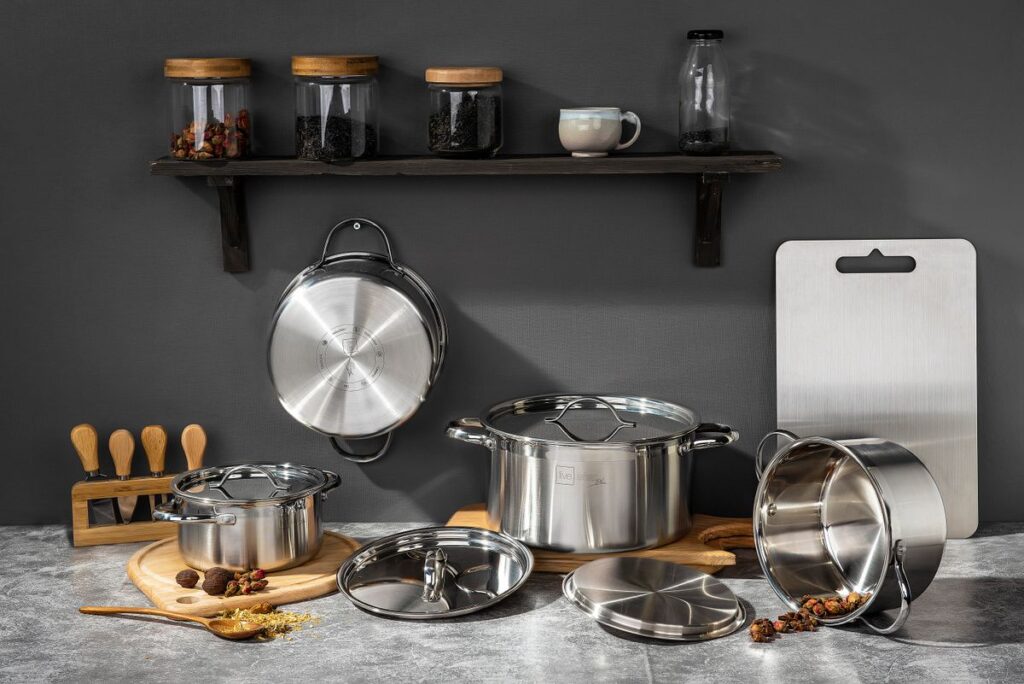
Cookware trends 2026 reflect a kitchen culture that has grown more sophisticated, more health-conscious, and more demanding all at once. PFAS regulations are reshaping nonstick, induction is redesigning pan bases, and manufacturers are finally making cast iron lighter. Whether you are upgrading a single pan or planning a full kitchen refresh, these nine shifts explain where cookware is headed — and which trends are worth your money versus passing hype.
1. The PFAS-Free Reckoning in Nonstick
The biggest of the cookware trends 2026 is regulatory: expanding PFAS restrictions across US states and the EU have forced a genuine transformation in nonstick coatings. Manufacturers are racing to launch demonstrably PFAS-free formulations — advanced ceramics, new-generation sol-gels, and hybrid surfaces — with third-party testing to prove the claims. This is not just marketing: the chemistry is actually changing, and shoppers are reading labels with new scrutiny.
What it means for you: if you have been avoiding nonstick over chemical concerns, 2026\’s PFAS-free options deserve a fresh look — but verify claims through independent certifications rather than packaging slogans. If you already own quality PFOA-free PTFE, there is no safety reason to discard it; the new coatings compete on longevity and marketing more than on safety.
2. Hybrid Surfaces Go Mainstream
Raised stainless-steel hexagon and dot patterns over nonstick coatings — the hybrid approach — have moved from premium novelty to mainstream offering. The concept is sound: the raised steel protects the slick coating from metal utensils while contributing a hint of searing capability that pure nonstick lacks. In 2026, hybrids appear at mid-range prices from multiple brands, making them the default recommendation for cooks who want nonstick convenience with fewer fragility anxieties.
The honest assessment: hybrids are genuinely more durable than traditional nonstick and slightly better at browning, but they still cannot build fond like bare steel or survive the abuse of uncoated pans. They are the best nonstick choice for most buyers, not a replacement for stainless or cast iron.
3. Induction-First Pan Design
As induction cooktops capture a growing share of new kitchens, pan design is following. Thicker magnetic base layers, perfectly flat machining for maximum glass contact, and base geometries tuned for induction\’s rapid cycling are now standard talking points. Some brands design explicitly for induction first, with gas compatibility as the secondary concern — a reversal from a decade ago.
What it means for you: if you cook on induction or plan to switch, prioritize pans marketed as induction-optimized rather than merely induction-compatible. The difference shows up in evenness and noise reduction (thinner pans can buzz on induction). Check that any aluminum or copper pan has a proper magnetic base — plain versions remain induction-incompatible.
4. Lighter-Weight Cast Iron
Cast iron\’s eternal complaint — weight — is finally getting engineering attention. New designs use thinner, more precisely cast walls, optimized handle geometry, and strategic weight distribution to shave 15 to 30 percent off traditional heft without sacrificing the heat retention that defines the material. Enameled dutch ovens and skillets lead this shift, and the difference is immediately noticeable when lifting.
This trend matters because weight is the top reason cast iron sits unused in cabinets. A dutch oven you will actually lift beats a heavier one with marginally better thermal mass every time. When shopping, compare actual weights rather than assuming all cast iron is equally heavy — the spread between brands has widened significantly.
5. Carbon Steel\’s Continued Rise
Carbon steel keeps gaining converts, and 2026\’s cookware trends show it moving from chef-secret to mainstream recommendation. Better factory pre-seasoning has shortened the break-in period that used to intimidate beginners; improved handle designs address the traditional bare-steel heat issue; and the material\’s lightness, responsiveness, and lifetime durability hit every note modern buyers care about. Expect carbon steel skillets and woks to keep displacing nonstick in enthusiast kitchens.
6. Sustainability as a Purchase Driver
Buy-it-for-life messaging has hardened into a genuine sustainability trend: shoppers increasingly evaluate cookware on lifespan, repairability, and end-of-life impact. Brands respond with lifetime warranties, replaceable handles and knobs, and take-back recycling programs. The most sustainable pan remains the one you never replace — which quietly favors cast iron, carbon steel, and clad stainless over any coated option.
Watch for greenwashing: \”eco-friendly\” coatings with short lifespans are less sustainable than a plain steel pan that lasts decades, regardless of packaging claims. Judge sustainability by expected years of service, not by marketing language.
7. Smarter, Not \”Smart,\” Cookware
The much-hyped era of Bluetooth-connected pans has largely fizzled — cooks did not want apps with their skillets. What survived is subtler intelligence: temperature-indicating handles and rims, pans engineered with specific heat-zone behavior, and precision-machined bases for induction. This is smart design rather than smart technology, and it is more useful: a pan that tells you when it is preheated correctly solves a real problem that an app never did.
8. The Minimalist Cookware Edit
Counter to decades of 15-piece set marketing, the dominant buying pattern in 2026 is curation: three to five excellent pieces chosen for actual cooking habits rather than a boxed set of compromises. Open-stock purchasing, modular systems with shared lids, and \”build your set\” configurators all serve this shift. The trend reflects a maturing market — cooks who know that a great skillet plus a great saucepan outperforms a mediocre twelve-piece set at the same price.
What it means for you: audit what you actually cook before buying. Most households thrive on a 12-inch skillet, a 3-quart saucepan, a dutch oven or stockpot, and a sheet pan — everything else is specialization. Buy the best versions of those four before adding anything.
9. Aesthetics: Cookware as Kitchen Decor
With open shelving and social-media kitchens, cookware appearance drives purchases more than ever. Enameled cast iron in saturated colors, hammered copper and stainless finishes, matte black everything, and Japanese-inspired minimalism all trend simultaneously — there is no single dominant look, which means buyers choose finishes that match their kitchens. The practical note: dark and matte finishes hide wear better than polished ones, and light-colored enamel interiors show staining fastest.
Which Trends Deserve Your Money?
- Worth it now: PFAS-free nonstick from certified brands, induction-optimized bases if you cook on induction, lighter-weight cast iron designs, and the curated minimal set approach.
- Worth watching: hybrid nonstick surfaces (improving yearly), advanced ceramic coatings with better longevity data, and modular cookware systems.
- Mostly hype: connected/app-enabled pans, extreme ply-count marketing (beyond tri-ply), and \”revolutionary\” coatings without independent test data.
How These Trends Affect What You Already Own
Good news: none of these cookware trends 2026 obsolete quality cookware you already own. Clad stainless, cast iron, and carbon steel are trend-proof — their physics does not expire. The trends most relevant to existing kitchens are the minimalist edit (consider decluttering unused pieces) and the PFAS-free shift (relevant only when replacing worn nonstick). The best response to most trends is informed patience: let early adopters validate the claims, then buy the proven winners.
How to Future-Proof Your Cookware Purchases
Trends come and go, but a few buying principles make any purchase resilient to whatever cookware trends 2026 bring next. First, default to induction-compatible everything — even if you cook on gas today, your next stove or your next home may not, and magnetic compatibility costs nothing extra on quality pieces. Second, favor uncoated materials (cast iron, carbon steel, clad stainless) for the core of your collection: their performance does not depend on coating chemistry, so they are immune to every reformulation cycle.
Third, buy repairable designs: riveted handles over welded where serviceability matters, standard lid sizes shared across pieces, and brands with published parts availability. Fourth, ignore ply-count and coating-brand hype in favor of verifiable specs — base thickness, actual weight, flatness, and warranty terms. Finally, time nonstick purchases to need rather than novelty: replace a dead pan with the current best-in-class rather than chasing each year\’s launch. Future-proofing is less about predicting trends than about buying the things trends cannot obsolete.
The Secondhand Advantage
One trend the industry rarely promotes: the thriving secondhand market for quality cookware. Vintage cast iron (often smoother and better-machined than modern production), used clad stainless, and estate-sale copper offer lifetime performance at fraction prices — and buying used is the single most sustainable purchase possible, since the manufacturing impact is already spent. Inspect carefully: check cast iron for cracks and warping (not surface rust, which restores easily), verify stainless is not deeply pitted, and avoid used nonstick entirely.
Where to look: estate sales and flea markets for cast iron, restaurant supply stores for sheet pans and stainless workhorses, and reputable online resale for clad pieces. A $15 vintage skillet, cleaned and re-seasoned, routinely outperforms a $60 new one — the old iron was cast thinner and machined smoother. The cookware trends 2026 conversation focuses on what is new, but the smartest money often buys what is old and proven.
Frequently Asked Questions
Should I replace my nonstick pans because of PFAS concerns?
Not necessarily. Quality PFOA-free PTFE pans used at normal temperatures are considered safe; the PFAS concern centers on manufacturing and environmental persistence, plus overheating. Replace worn nonstick with certified PFAS-free options when the coating degrades — there is no need to discard functional pans prematurely.
Is induction really the future of cooktops?
All indicators point that way: efficiency regulations, gas-phase-out discussions in some regions, and rapidly improving induction technology. When buying long-lived cookware now, induction compatibility is cheap insurance regardless of your current stove.
Are hybrid pans better than traditional nonstick?
For most buyers, yes — the raised steel pattern meaningfully improves durability against utensils and adds slight searing capability. They cost more but last longer, improving the lifetime economics. They remain coated pans with finite lifespans, not lifetime tools.
What does \”PFAS-free\” actually guarantee?
It should mean the product contains no per- and polyfluoroalkyl substances — but the term is not uniformly regulated, so look for third-party testing or certification rather than taking packaging at face value. Reputable brands publish test results; vague claims deserve skepticism.
Is lighter cast iron as good as traditional?
Well-engineered lighter designs retain the vast majority of traditional heat performance while being meaningfully easier to handle. Extremely thin cheap cast iron is a different story — it loses the thermal mass that defines the material. Compare weights and wall thickness, not just marketing claims.
How many pans do I actually need?
Four covers most home cooking: a 12-inch skillet, a 2–3 quart saucepan, a 5–6 quart dutch oven or stockpot, and a half-sheet pan. Add a nonstick egg pan and a carbon steel wok or second skillet as your cooking justifies. Everything beyond that is specialization, not necessity.
Will copper make a comeback?
Copper enjoys steady enthusiast interest and photographs beautifully, but its cost, weight, and maintenance keep it a luxury niche. Induction-compatible copper has removed one barrier, yet clad stainless remains the rational choice for nearly every buyer. Expect admiration, not mass adoption.
Will nonstick cookware be banned?
No outright consumer ban is on the horizon — regulations target PFAS manufacturing, specific applications, and labeling rather than existing pans. The practical effect is reformulation toward PFAS-free coatings, not confiscation. Your current PFOA-free pans remain legal and safe to use normally.
Are expensive cookware brands worth it over mid-range?
Up to a point: the jump from bargain to reputable mid-range buys real construction quality (thicker bases, better bonding, flatter machining). The jump from mid-range to luxury mostly buys finishing, branding, and marginal gains. The value sweet spot sits firmly in the quality mid-range for nearly every category.
Should I wait for next year\’s cookware innovations?
Rarely worth it — cookware evolves incrementally, and a good pan bought today cooks identically in five years. Buy when you need the tool; the \’next generation\’ of a skillet is never transformative. The exception is replacing dead nonstick, where waiting a few months for certified PFAS-free options can make sense.
Which cookware trend will matter most in five years?
Induction-first design, most likely — as induction adoption accelerates, pans engineered for magnetic heating will simply perform better for a growing share of cooks, while non-magnetic holdouts become legacy items. PFAS-free chemistry will be settled science by then. Bet on magnetism and lifetime materials; they compound.
