
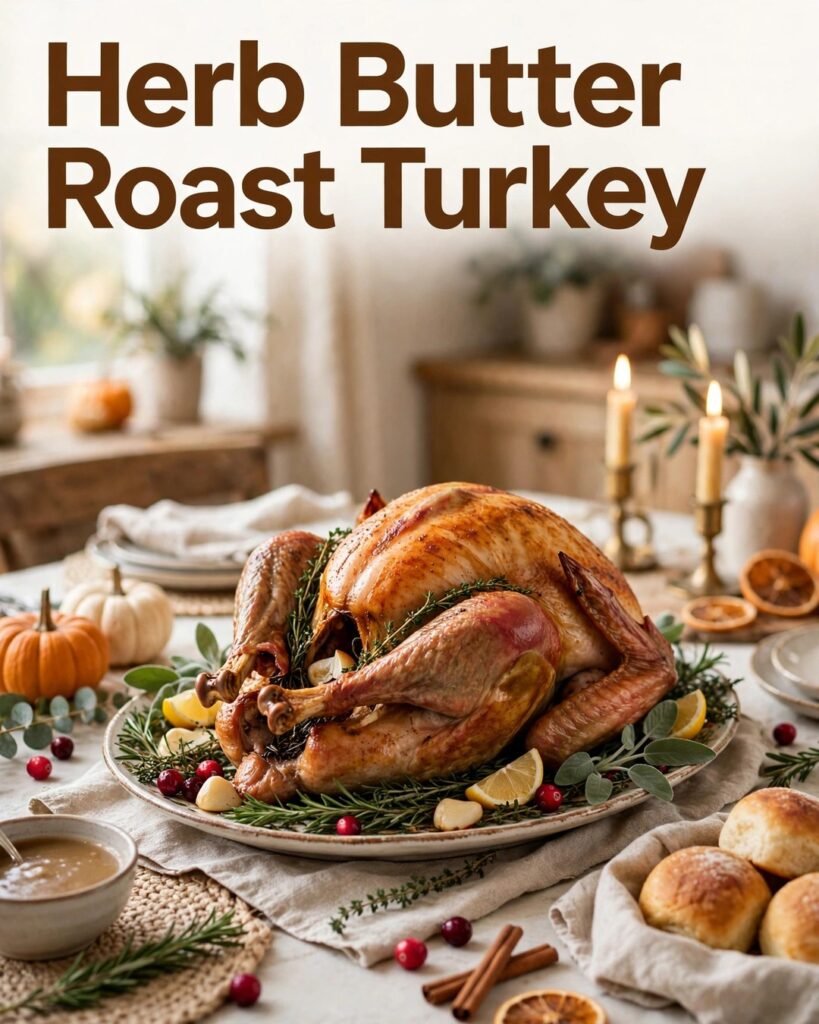
Easy Herb Butter Roast Turkey
This herb butter roast turkey is the Thanksgiving centerpiece that takes the stress out of the holiday. Softened butter whipped with fresh herbs, garlic, and lemon zest goes under the skin, basting the breast from the inside as it roasts so the meat stays juicy while the skin turns crisp and golden. There’s no brining, no special equipment, and no last-minute panic — just a straightforward roast, a proper rest, and a carving method that gets beautiful slices onto the platter.
The herb butter does double duty: it flavors the meat directly, and as it melts it keeps the breast — the part most likely to dry out — moist through a long roast. A hot oven start crisps the skin, then a moderate temperature finishes the bird gently. Give it a full rest before carving, and you’ll have a turkey that slices cleanly and tastes like you spent all day on it.
This recipe is part of our Thanksgiving collection — the turkey, every classic side, the pies, and a day-by-day plan for getting it all to the table.
If you do want to brine first, start with our classic turkey brine recipe — 12 to 24 hours in brine the day before, then go easy on extra salt in the herb butter.
Prep time: 30 minutes Cook time: 3 hours 15 minutes Total time: 3 hours 45 minutes, plus 30 minutes resting Servings: 10–12
What You’ll Need
- Large roasting pan with a rack
- Instant-read meat thermometer (the single most important tool for a juicy turkey)
- Kitchen twine for trussing the legs
- Sharp carving knife and a sturdy cutting board
- Aluminum foil for tenting during the rest
For the right gear, see our best roasting pans for turkey guide, our best electric knives for carving turkey guide, and our best gravy separators for Thanksgiving guide.
Ingredients
- 1 whole turkey, 12–14 pounds, thawed, giblets and neck removed
- 1 cup (2 sticks) unsalted butter, softened to room temperature
- 2 tablespoons chopped fresh thyme leaves
- 2 tablespoons chopped fresh sage leaves
- 2 tablespoons chopped fresh rosemary leaves
- 2 tablespoons chopped fresh flat-leaf parsley
- 4 cloves garlic, minced
- 1 tablespoon lemon zest (from about 1 lemon)
- 2 teaspoons fine sea salt
- 1 teaspoon freshly ground black pepper
- 1 large onion, quartered
- 1 head garlic, halved crosswise
- 2 carrots, cut into large chunks
- 2 celery stalks, cut into large chunks
- 1 lemon, quartered
- A few extra sprigs of thyme, sage, and rosemary, for the cavity
- 2 tablespoons olive oil
- 1 cup low-sodium chicken or turkey broth
Instructions
1. Bring the turkey to room temperature. Remove the turkey from the refrigerator 1 hour before roasting. Pat it very dry inside and out with paper towels — dry skin is what turns crisp and golden. Set it breast-side up on the rack in the roasting pan.
2. Make the herb butter. In a medium bowl, mash the softened butter with the thyme, sage, rosemary, parsley, minced garlic, lemon zest, salt, and pepper until evenly mixed. It should be soft and spreadable, not melted.
3. Butter under the skin. Starting at the neck end, gently slide your fingers between the breast meat and the skin to loosen it, taking care not to tear the skin. Push about three-quarters of the herb butter under the skin, spreading it evenly over both breasts by massaging from the outside. Rub the remaining butter all over the outside of the bird.
4. Fill the cavity. Stuff the cavity with the quartered onion, halved garlic head, carrots, celery, quartered lemon, and the extra herb sprigs. These aromatics steam gently as the bird roasts and perfume the meat. Tie the legs together with kitchen twine and tuck the wing tips under the body so they don’t burn.
5. Start hot for crisp skin. Drizzle the olive oil over the bird and pour the broth into the bottom of the pan. Roast in a preheated 450°F (230°C) oven for 30 minutes, until the skin begins to brown.
6. Finish at a moderate temperature. Reduce the oven to 325°F (165°C). Tent the breast loosely with foil if it browns too quickly, and roast for 2 hours 30 minutes to 2 hours 45 minutes more, basting with the pan juices every 45 minutes. The turkey is done when an instant-read thermometer inserted into the thickest part of the thigh (without touching bone) reads 165°F (74°C), and the breast reads at least 160°F — it will climb a few degrees as it rests.
7. Rest before carving. Transfer the turkey to a cutting board, tent loosely with foil, and rest for 30 minutes. This is non-negotiable: resting lets the juices redistribute, so the meat stays moist instead of running out onto the board. Meanwhile, strain the pan juices for gravy.
8. Carve the turkey. Remove the twine. Cut off each leg at the joint, then slice the drumstick meat away from the bone. Slice the thigh meat across the grain. For the breast, cut along the breastbone down one side, then slice the whole breast lobe off the carcass and cut it crosswise into even slices. Arrange on a warm platter and garnish with fresh herb sprigs.
Tips for the Best Herb Butter Roast Turkey
- Trust the thermometer, not the clock. Turkeys vary, and ovens lie. A thermometer in the thickest part of the thigh is the only reliable way to know it’s done — pull it at 165°F in the thigh and you won’t get a dry bird.
- Dry skin = crisp skin. Pat the turkey thoroughly dry before buttering, and don’t cover it while it roasts (except for a loose foil tent if the breast browns early). Moisture on the surface steams instead of crisps.
- Don’t skip the rest. Carving too soon is the most common reason a well-roasted turkey tastes dry. Thirty minutes of resting keeps the juices in the meat, and the turkey will still be warm when you serve it — tented foil holds the heat well. Use the resting window to make homemade turkey gravy from the hot drippings.
Golden, juicy, and carved with confidence — this is the turkey that makes the whole Thanksgiving table feel like a celebration. Save the carcass for stock, and don’t forget the pan drippings: they make the best gravy of the year.
Frequently Asked Questions
How do I know the turkey is done?
A thermometer, not the clock. The thickest part of the thigh should read 165°F (74°C), and the juices should run clear. Start checking 30 minutes before the recipe’s estimated finish — ovens and birds vary, and an overcooked turkey cannot be rescued, only sauced.
How long should the turkey rest before carving?
30 to 45 minutes, loosely tented with foil. Resting lets the juices settle back into the meat; carve too soon and they run onto the board instead. Use the resting window to make the gravy and reheat the sides.
Should I brine the turkey first?
It is optional but worth it if you have the fridge space and 12–24 hours: brining seasons the bird all the way through and gives you a wider margin against dry breast meat. Our classic turkey brine recipe has the ratios. If you brine, go easy on additional salt in the herb butter.
