
Learning how to dice an onion without crying comes down to two things: a sharp knife with correct technique, which ruptures fewer cells and releases less irritant gas, and a few simple tricks like chilling the onion for 15 minutes before cutting. With the method below, you can produce a fast, even dice with minimal tears.
Onions make us cry because cutting them releases a gas called syn-propanethial-S-oxide, which drifts up and irritates the eyes. The good news is that chemistry can be managed. This guide covers how to dice an onion without crying through proper knife skills first, then layers on nine proven anti-tear strategies, from chilling and ventilation to cutting technique adjustments that professionals actually use.
Why Onions Make You Cry: The Chemistry
An onion is a layered defense system. Its cells store sulfur compounds separately from the enzymes that transform them. When your knife crushes through cell walls, those components mix and produce volatile sulfur compounds, including syn-propanethial-S-oxide, a lachrymatory (tear-producing) gas. The gas rises, dissolves in the tear film covering your eyes, and forms a mild sulfuric acid that stings.
Your eyes respond by producing tears to flush the irritant away. This is a protective reflex, not an allergy, and the effect is temporary. Two variables control how much you suffer: how many cells you rupture and how much of the gas reaches your eyes. A dull knife crushes a wide path of cells like a bulldozer, while a sharp knife slices cleanly through a narrow line. That single difference explains why a sharp knife is the most effective anti-tear tool in the kitchen.
The onion\’s root end deserves special mention. The basal plate, the flat root end where the layers join, contains the highest concentration of sulfur compounds. Professional cooks leave the root end intact while dicing, using it as a handle that holds the layers together, and many report noticeably fewer tears with this approach.
The Foundation: A Sharp Knife and Correct Dice Technique
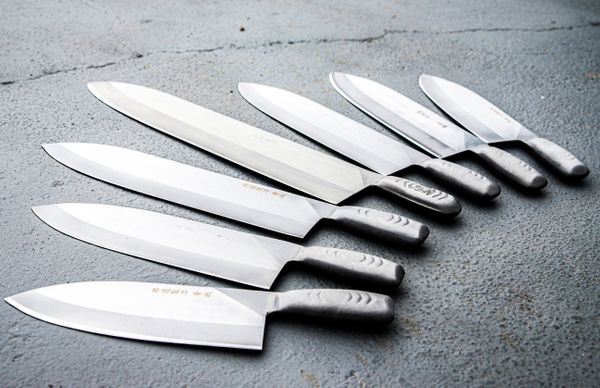
Before any tricks, get the fundamentals right. Use an 8-inch chef\’s knife that has been recently honed or sharpened. A sharp edge glides through the onion with minimal downward force, rupturing far fewer cells than a dull edge that must be muscled through.
Set up a stable cutting board on a damp kitchen towel so it cannot slip. Cut the onion in half through the root end, peel each half, and place it flat-side down. Make horizontal cuts toward the root end without cutting through it, then vertical cuts the same way, then slice crosswise to release an even dice. The intact root holds everything together until the final cuts.
Use a smooth rocking or gliding motion rather than chopping straight down. Guide the food with curled fingertips in the classic \”claw grip,\” keeping knuckles forward so the knife blade rides against them. Smooth, confident strokes rupture fewer cells than hesitant sawing, which is one reason speed, built on practice, genuinely reduces tears.
9 Proven Ways to Dice an Onion Without Crying
1. Chill the Onion for 15 to 30 Minutes
Refrigerating the onion before cutting slows the enzymatic reactions and reduces the volatility of the tear gas, so less of it reaches your eyes. Fifteen to thirty minutes in the fridge is the sweet spot. Do not freeze the onion; freezing damages the cell structure and makes the texture mushy when it thaws.
2. Use Your Sharpest Knife
This bears repeating because it matters more than every other trick combined. Hone your chef\’s knife with a honing steel before onion duty, and keep your knives professionally sharpened or learn whetstone sharpening. Clean cuts mean fewer ruptured cells and dramatically less gas.
3. Leave the Root End Intact
Cut around the root rather than through it until the final slices. The root end holds the highest concentration of sulfur compounds, so minimizing cuts through it directly reduces gas release. It also keeps the onion half stable, making your dice faster and more even.
4. Cut Near Running Water or a Fan
The tear gas is water-soluble, so cutting beside a gently running tap or with a small fan blowing across the board disperses the gas before it reaches your eyes. Position the fan to blow from behind you toward the onion, pushing the gas away from your face. A range hood running on high above the stove works similarly.
5. Breathe Through Your Mouth
Breathing through your mouth instead of your nose reduces the amount of gas drawn up toward your eyes through the nasal passages. It sounds too simple to matter, but many cooks find it takes the edge off, especially combined with a sharp knife and good ventilation.
6. Wear Glasses, Goggles, or Contact Lenses
Any physical barrier between the gas and your eyes helps. Regular eyeglasses offer partial protection; snug-fitting swim goggles or onion goggles block far more. Interestingly, contact lens wearers often report fewer tears because the lens shields part of the eye\’s surface from the gas.
7. Cut the Onion Under a Vent or Outdoors
If you are dicing a large batch for meal prep, move the cutting board near an open window or even outdoors. Moving air is the enemy of tear gas concentration. Food bloggers who prep ten pounds of onions for freezer batches swear by this approach.
8. Try the Bread or Candle Tricks With Realistic Expectations
Holding bread in your mouth or lighting a candle near the board are folk remedies with weak scientific support. The candle may burn off a small fraction of nearby gas, and the bread does nothing chemically. They are harmless to try, but invest your effort in the proven methods above first.
9. Choose Sweet Onions for Raw Prep
Sweet varieties like Vidalia, Walla Walla, and Maui contain fewer sulfur compounds than yellow storage onions, so they release less tear gas. They are not tear-free, but for salads and salsas where raw onion is the star, the variety choice makes a noticeable difference in both tears and harshness.
Dice Sizes and When to Use Each
| Dice Name | Size | Best Uses |
|---|---|---|
| Fine dice / brunoise | 1/8 inch (3 mm) | Sauces, dressings, garnishes where onion should melt in |
| Small dice | 1/4 inch (6 mm) | Salsas, relishes, tacos, omelets |
| Medium dice | 1/2 inch (12 mm) | Soups, stews, curries, mirepoix |
| Large dice / chunks | 3/4 inch (20 mm) | Kebabs, roasting, stir-fries |
Uniformity matters more than speed. Evenly sized pieces cook at the same rate, so your soup does not end up with some onion bits raw and others dissolved. For mirepoix, the classic French base of onion, carrot, and celery, a medium dice is standard. For a fine salsa or pico de gallo, drop down to a small dice so no single piece overwhelms a bite.
Storing Diced Onion Safely
Diced onion keeps in an airtight container in the refrigerator for 7 to 10 days. Use glass or a well-sealed container, since onion odor penetrates thin plastic and can perfume your fridge. For longer storage, spread the dice on a sheet pan, freeze until solid, then transfer to a freezer bag; frozen diced onion keeps for 3 to 6 months and can go straight from freezer to hot pan.
Never store cut onion at room temperature for more than 2 hours. Like all cut produce, it is perishable once the protective skin is removed. And skip the old myth that a cut onion left out \”absorbs bacteria\” from the air; that claim has no scientific basis, though proper refrigeration is still essential for food safety.
Onion Varieties and Their Best Uses
Not all onions behave the same on the cutting board or in the pan. Yellow onions are the all-purpose workhorse: pungent when raw, sweet and complex when cooked, and the best choice for caramelizing, braising, and long-cooked sauces. They also produce the most tear gas, so they benefit most from the chilling and sharp-knife strategies above.
Sweet onions such as Vidalia, Walla Walla, and Maui are milder and higher in sugar. They make you cry less, taste wonderful raw in salads and sandwiches, and caramelize faster because of their sugar content, though they can burn more easily for the same reason. Red onions are sharp and colorful raw, ideal for pickling, salsas, and burgers, but their color turns an unappetizing gray-blue when cooked for a long time.
White onions are sharper and crisper than yellow, popular in Mexican cooking for salsas, tacos, and ceviche where a clean, assertive bite is wanted. Shallots are smaller, milder, and more delicate, with a subtle garlic note; they dice finely for vinaigrettes and pan sauces where regular onion would dominate. Leeks are the mildest of all, excellent in soups and braises, but they trap grit between layers and must be washed thoroughly after slicing.
For dicing practice, start with large yellow onions: they are cheap, easy to grip, and their size makes the claw grip and rocking motion easier to learn. Save shallots and precise brunoise cuts for after the basic dice feels automatic.
Frequently Asked Questions
Does chilling an onion really stop the tears?
Chilling reduces tears but does not eliminate them completely. Fifteen to thirty minutes in the refrigerator slows the enzymes that create tear gas and makes the gas less volatile, so measurably less reaches your eyes. Combined with a sharp knife, chilling is one of the two most effective strategies available to home cooks.
Why do sweet onions make you cry less?
Sweet onions like Vidalia and Walla Walla are grown in low-sulfur soils and bred for mildness, so they contain fewer of the sulfur compounds that become tear gas when cells are cut. They still produce some irritant, but noticeably less than pungent yellow storage onions. Red onions fall somewhere in the middle for tear production.
Is it safe to cut onions with goggles on?
Yes, completely safe, and it is one of the most effective barriers available. Snug-fitting goggles, even swim goggles, prevent the gas from reaching the tear film on your eyes. Onion-specific goggles with foam seals and anti-fog lenses are sold for this purpose and are popular with people who are especially sensitive.
Should I cut the root end off the onion first?
No. Leave the root end attached while you dice. It holds the onion layers together like a handle, giving you a more stable, even dice, and it contains the highest concentration of sulfur compounds, so cutting through it last minimizes gas release. Trim it off only after dicing is complete.
Does a dull knife really make crying worse?
Yes, significantly. A dull knife crushes and tears through a wide band of cells, mixing far more sulfur compounds with enzymes and releasing much more tear gas. A sharp knife slices cleanly through a narrow line of cells. Keeping your chef\’s knife sharp is the single highest-impact change for reducing tears.
Can I dice onions in a food processor instead?
You can, but the results differ. A food processor ruptures cells aggressively and unevenly, producing watery, harsh-tasting onion pieces with an inconsistent texture. It works for large batches destined for long-cooked sauces where texture does not matter, but for salsas, salads, and sautés, hand dicing gives far superior flavor and appearance.
How do I dice an onion quickly for meal prep?
Work in an assembly line: halve and peel all onions first, then make all horizontal cuts, then vertical cuts, then the final crosswise slices. Keep your knife honed, use a large stable board, and chill the onions beforehand to reduce tearing slowdowns. An experienced cook dices an onion in under a minute; speed comes from repetition, not rushing.
What is the difference between dicing and chopping an onion?
Dicing produces uniform cubes of a specified size through the three-cut method (horizontal, vertical, crosswise), while chopping is a rougher, irregular cut made with simple crosswise slices. Dicing matters when even cooking is important, as in soups and sautés; chopping is fine for rustic dishes and long-cooked sauces where pieces break down anyway. Mastering both cuts gives you full control over texture in any recipe.
