
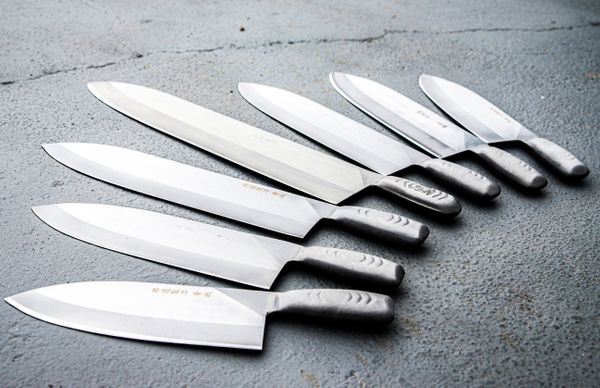
To store kitchen knives safely, keep every blade covered or separated: use a magnetic wall strip, an in-drawer knife organizer, individual blade guards, or a slotted knife block — and never toss unprotected knives loose into a drawer. The right storage protects your fingers from cuts, your edges from chipping, and your knives from moisture damage.
Knife storage is where safety and edge care intersect: a loose drawer knife dulls itself against other utensils and ambushes the next person who reaches in. This guide covers six smart ways to store kitchen knives safely, which method suits your kitchen, child-safety considerations, and the storage mistakes that ruin good blades.
Why Proper Knife Storage Matters
Three things happen to poorly stored knives. First, edges collide with other metal — drawer dividers, utensils, other blades — rolling or chipping the fine cutting edge you worked to create. A knife stored loose dulls itself without ever cutting food. Second, unprotected blades cause cuts: reaching into a jumbled drawer is one of the most common kitchen injury scenarios. Third, trapped moisture in sheaths or blocks breeds rust and handle damage.
Good storage solves all three: blades stay separated and covered, edges never touch anything harder than wood or plastic, and air circulates so moisture evaporates. It\’s the cheapest edge-maintenance you\’ll ever do.
6 Smart Methods to Store Kitchen Knives Safely
1. Magnetic Wall Strip (Best Overall)
A wall-mounted magnetic strip holds knives visible, accessible, and completely separated — blades never touch anything but air. Mount it at a comfortable height away from the stove\’s heat and out of children\’s reach. Use a wood-covered magnetic strip rather than bare metal to protect edges, and place knives spine-first onto the magnet, rolling the edge away last when removing.
Pros: saves counter and drawer space, excellent air circulation, edges stay pristine. Cons: requires wall space and mounting, not ideal in rentals that forbid drilling (adhesive options exist but verify weight ratings).
2. In-Drawer Knife Organizer (Best for Clean Counters)
A slotted tray or cork-lined organizer inside a deep drawer keeps knives hidden yet perfectly separated. Choose one sized to your drawer with slots angled so blades slide in spine-down. Cork and bamboo models cushion edges; avoid organizers where blades rattle against hard plastic dividers.
Pros: child-safe when the drawer has a lock or is out of reach, keeps counters clear, protects edges well. Cons: consumes a full drawer, requires the drawer to be deep enough for your longest knife.
3. Individual Blade Guards / Sheaths (Most Flexible)
Plastic or felt-lined blade guards slip over individual knives, making any drawer or bag safe. They\’re inexpensive, so you can outfit a whole set, and they\’re essential for transporting knives (to a cooking class, vacation rental, or sharpening service). Ensure the guard fits snugly — a loose guard that slides off defeats the purpose.
Critical: knives must be completely dry before sheathing. Trapping moisture inside a guard is a fast track to rust spots. Pros: cheapest option, portable, works with any storage setup. Cons: fiddly for daily use on many knives, moisture risk if you\’re careless.
4. Traditional Slotted Knife Block (Classic and Simple)
The countertop block everyone knows: vertical slots hold each knife separated and sheathed. It works fine, with two caveats — slide knives in spine-down (edge-up insertion drags the edge along the slot with every use, dulling it) and clean the slots periodically, since crumbs and moisture collect inside.
Universal blocks with bristle inserts accommodate odd shapes but trap more debris; clean them by shaking out over a trash can and occasional compressed air. Pros: no installation, stable, familiar. Cons: bulky on the counter, slots collect grime, fixed slots may not fit your set.
5. Knife Dock / Under-Cabinet Mount (Space Saver)
Under-cabinet magnetic or slot mounts free both counter and drawer space, keeping knives accessible but tucked away. They\’re excellent for small kitchens. Ensure the mount is rated for your heaviest knife and installed into solid cabinet material — a falling knife block is a hazard, not a solution.
6. Knife Roll or Case (For Transport and Small Sets)
Canvas or leather knife rolls with individual slots are the chef\’s choice for transport and a legitimate home option for small collections. Each knife gets its own pocket, edges stay protected, and the roll stores in a drawer or hangs on a hook. Not ideal for large sets, but perfect for 3–5 essential knives.
Which Storage Method Should You Choose?
| Your Situation | Best Choice |
|---|---|
| Plenty of wall space, easy access priority | Magnetic wall strip |
| Small children in the home | Locked drawer with in-drawer organizer |
| Tiny kitchen, minimal counter | Under-cabinet mount or magnetic strip |
| Rental, no drilling allowed | In-drawer organizer or countertop block |
| Transporting knives regularly | Blade guards + knife roll |
| Large existing set with block | Keep the block; add guards for overflow |
Child and Pet Safety Considerations
In homes with curious children, storage must be not just organized but inaccessible: a locked drawer, a high-mounted magnetic strip (above counter height plus reach), or a latched cabinet. Countertop blocks at the back of the counter are not child-proof — determined toddlers climb. Teach older children that knives are tools, not toys, and establish the rule that only adults retrieve them.
For pets, the concern is knocked-off counters: ensure magnetic strips hold firmly (test with your heaviest cleaver) and blocks sit stable and back from the counter edge. A knife knocked to the floor endangers both paws and bare feet.
Knife Storage Mistakes That Ruin Blades
- Loose in a drawer: The cardinal sin — dulls edges and causes cuts. Never.
- Edge-down in a block slot: Drags the edge along wood with every insertion. Go spine-down.
- Sheathing damp knives: Trapped moisture rusts blades. Dry completely first.
- Storing near heat: Above the stove, handles dry out and adhesives weaken. Choose a cool spot.
- Overloading a magnetic strip: Overcrowded knives knock each other; leave space between blades.
- Never cleaning the block: Crumbs and moisture in slots breed odors and mold. Shake out and air-dry periodically.
- Storing in the original cardboard sleeve long-term: Cardboard holds moisture against the blade. Fine for shipping, bad for storage.
Traveling with Kitchen Knives: Cases, Rolls & Rules
Whether you\’re heading to a cooking class, a vacation rental with terrible knives, or a friend\’s holiday dinner, transporting knives safely takes a bit of planning.
Blade Guards Are Non-Negotiable
Every traveling knife gets a snug-fitting blade guard — no exceptions, even inside a roll. Guards prevent the edge from cutting through the roll\’s fabric and protect the edge from rattling against its neighbors. For knives without dedicated guards, a folded cardboard sheath taped securely works as a field expedient, but fitted plastic guards are cheap enough to own for every knife you travel with.
Choosing a Knife Roll
A proper knife roll has individual slots or pockets that keep blades separated, a flap that folds over the handles, and ties or buckles that keep it closed. Canvas rolls are durable and washable; leather looks beautiful but needs conditioning. Size it to your kit — a roll for 5 knives that you load with 3 is fine, but cramming 8 into a 5-slot roll defeats the separation. Include a small honing rod in the roll\’s dedicated pocket if it has one.
Packing for Car Travel
Place the loaded roll flat in the trunk or footwell — never loose on a seat where sudden braking turns it into a projectile. If you don\’t have a roll, wrap each guarded knife in a kitchen towel and pack them flat in a rigid box or baking sheet with a towel cushion. Keep knives out of reach of children in the vehicle, just as at home.
Flying with Knives: Checked Baggage Only
Knives of any kind are prohibited in carry-on luggage — this is universal across airlines and security agencies. Pack guarded knives in a hard-sided checked bag, ideally inside a roll, with the roll positioned away from the bag\’s outer walls. Consider a TSA-friendly approach: there\’s nothing prohibited about properly packed kitchen knives in checked baggage, but keep the roll clearly identifiable as culinary tools to avoid confusion during inspection.
At Your Destination
Unpack promptly and store as you would at home — guarded in a drawer, or ask your host where knives can live safely during your stay. Never leave sheathed knives where children or unfamiliar guests might encounter them unexpectedly. And when cooking in someone else\’s kitchen, a quick hone before you start compensates for whatever the journey did to your edges.
FAQs: Storing Kitchen Knives Safely
Is it safe to store knives in a drawer?
Yes, if each blade is protected — use an in-drawer slotted organizer or individual blade guards so edges never touch other utensils or fingers. What\’s unsafe is tossing unprotected knives loose into a drawer, which dulls edges and causes cuts when reaching in.
Are magnetic knife strips safe?
Yes, when mounted securely at an appropriate height. Use a strong strip rated for your heaviest knife, mount into studs or solid anchors, and place/removed knives spine-first. Keep strips out of children\’s reach and away from stove heat. Wood-faced strips protect edges better than bare metal.
Should knives be stored blade up or down in a block?
Spine-down (edge facing up) is best for traditional slotted blocks — sliding a knife in edge-down drags the cutting edge along the slot every time, dulling it. Either orientation is safe from a cut-prevention standpoint since the blade is enclosed; edge longevity is the deciding factor.
How do you store knives with kids in the house?
Use a locked drawer with an in-drawer organizer, or mount a magnetic strip high out of reach. Countertop blocks are not child-proof. Combine inaccessible storage with clear rules: knives are adult tools, and children never retrieve them unsupervised.
Can you store knives in their sheaths long-term?
Yes, provided the knife is bone-dry before sheathing. Trapped moisture causes rust, especially on carbon steel. For long-term storage, add a light coat of food-safe mineral oil to carbon steel blades and store sheathed knives in a dry place with air circulation.
How do you clean a wooden knife block?
Turn it upside down and shake out debris, then use compressed air or a thin bottle brush in the slots. Wipe the exterior with a damp cloth and mild soap, then dry. Never submerge a wooden block or run it through the dishwasher — it will swell, crack, and harbor mold.
Organizing the Knife Drawer: Layout Tips
If the in-drawer organizer is your storage method, a thoughtful layout makes daily cooking smoother and safer.
Order by Frequency
Place your chef\’s knife and paring knife — the two you reach for constantly — in the front slots, closest to your dominant hand\’s approach. Specialty knives (boning, bread, santoku) go behind. This minimizes rummaging, which is when accidents happen: every extra second with your hand in the drawer is unnecessary risk.
One Slot Per Knife, Always
Never double up slots, even \”temporarily.\” Two blades in one slot nick each other\’s edges and make withdrawal unpredictable — the exact scenarios good storage exists to prevent. If your collection outgrows the organizer, that\’s the signal to add blade guards for overflow or upgrade to a larger organizer, not to cram.
Keep the Drawer Dedicated
The knife drawer should contain knives and nothing else — no utensils, no gadgets, no \”just this one peeler.\” Foreign objects slide into blade slots, chip edges, and turn a safe organized drawer into a hazard. If drawer space is tight, relocate less-used tools elsewhere rather than compromising the knife drawer.
Label the Slots
For households with multiple cooks, small labels on each slot (\”chef\’s,\” \”bread,\” \”paring\”) keep knives returning to their homes instead of migrating. It sounds fussy, but mis-shelved knives are how the bread knife ends up loose in the utensil drawer. A label maker and two minutes solve it permanently.
Final Thoughts
Knowing how to store kitchen knives safely is simple: every blade covered or separated, edges touching nothing hard, moisture kept away, and storage matched to your household. Pick one of these six methods, commit to it, and your knives will stay sharper, your fingers safer, and your kitchen calmer.
