
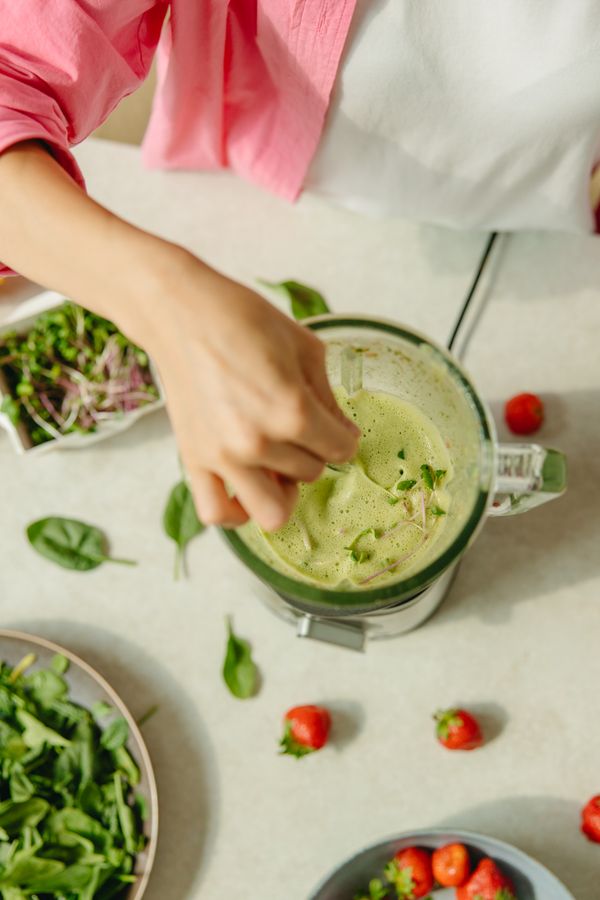
The immersion blender vs countertop blender debate is really about convenience versus power. Quick answer: an immersion (stick) blender wins for soups, sauces, and quick jobs with near-zero cleanup; a countertop blender wins for smoothies, frozen drinks, and crushing ice. Small kitchens often do fine with just the stick; smoothie lovers need the jar.
Both puree, but their designs create very different experiences. This guide compares them task by task, covering power, texture quality, cleanup, storage, and cost, with 2026 buying tips for each style.
Design Differences That Drive Everything
An immersion blender is a motorized wand, typically 200 to 600 watts, with blades inside a bell-shaped guard at the tip. You plunge it directly into a pot, beaker, or jar and blend where the food already is. Quality models like the Breville Control Grip or KitchenAid Variable Speed include whisk and chopper attachments that expand their range.
A countertop blender is the classic jar-on-a-base design, 1,000 to 1,800 watts in full-size models, engineered around a vortex that pulls ingredients through high-speed blades. It needs its own vessel and enough liquid to circulate, but it generates far more shear force, producing silkier textures and crushing ice effortlessly.
Head-to-Head Comparison
| Category | Immersion Blender | Countertop Blender |
|---|---|---|
| Hot soups in the pot | Excellent — blend where it cooks | Good — batch transfers, splatter risk |
| Smoothies | Okay — single servings, some texture | Excellent — silky, fast |
| Crushing ice | Poor — strains motor | Excellent |
| Sauces & emulsions | Excellent — mayo, dressings, pesto | Good, but overkill for small amounts |
| Whipped cream | Good with whisk attachment | Overkill, awkward |
| Cleanup time | Under 30 seconds | 1–3 minutes |
| Storage | Drawer — tiny footprint | Counter or tall cabinet |
| Batch size | Unlimited pot size, one spot at a time | Limited by jar, but uniform |
| Average price 2026 | $30–$120 | $80–$500 |
Soups and hot liquids: immersion wins
Blending soup directly in the pot is the immersion blender\’s signature move. No ladling scalding liquid into a jar, no batches, no extra dishes, no steam-explosion risk from a sealed lid. You get a smooth-enough puree in a minute and rinse the wand in seconds. Countertop blenders make technically silkier soup but demand careful batching: fill halfway, vent the lid, hold a towel over it. For weeknight soup makers, the stick blender is transformative.
Smoothies and frozen drinks: countertop wins
The vortex is unbeatable for drinks. Frozen fruit, ice, and leafy greens circulate through high-speed blades into a uniform, creamy texture in under a minute. An immersion blender can make a single smoothie in a tall beaker, but results are thinner and slightly textured, and ice is genuinely hard on its small motor. Daily smoothie drinkers should not compromise here.
Sauces, mayo, and small jobs: immersion dominates
Mayonnaise, salad dressings, pesto, chimichurri, and pan sauces are immersion-blender territory. The small blending bell works in the very jar or cup you will store the sauce in, and the controlled, low-splash action gives perfect emulsions. A countertop blender\’s large jar wastes small batches on its walls. This category alone justifies owning a stick blender even if you have a full-size model.
- Immersion excels at: soups, sauces, mayo, baby food, milkshakes for one, whipping small cream portions.
- Countertop excels at: smoothies, frozen cocktails, nut butters (high-end), crushed ice, large-batch purees.
- Overlap zone: both handle simple purees and soft-fruit blends adequately.
Texture quality: power matters
Watt for watt, countertop blenders produce finer purees. Fibrous vegetables like celery and kale disappear completely in a 1,400-watt blender; an immersion blender may leave faint fibers. For most soups and sauces the difference is negligible, but green smoothies and silky bisques reveal it. If velvet-smooth texture is your standard, the countertop blender earns its keep.
Cleanup and storage: immersion wins easily
Rinse the wand under the tap or pulse it in soapy water: done in 20 seconds, with one small part to dry. Countertop blenders require washing a large jar, lid, and blade assembly, though self-cleaning cycles help. Storage is equally lopsided: the stick lives in a drawer while the jar blender demands counter space or a tall cabinet. In small kitchens, this convenience gap is decisive.
Noise and safety
Immersion blenders are quieter and feel safer for quick jobs, though the exposed-blade design demands respect: keep it submerged while running and unplug before cleaning. Countertop blenders are louder, especially high-performance models, but their enclosed jars contain everything. Neither is dangerous with basic care.
Which Should You Buy? Buying Tips for 2026
- Buy the immersion blender if you make soup, sauces, or baby food regularly, have a small kitchen, or hate washing up. Look for at least 300 watts, variable speed, a stainless (not plastic) blending shaft for hot soups, and useful attachments like a whisk and mini-chopper.
- Buy the countertop blender if smoothies, frozen drinks, or ice-crushing are weekly events. Prioritize 1,000-plus watts, a tamper for thick blends, and a jar that fits under your cabinets.
- The budget power combo: a $50 immersion blender plus a $40 personal smoothie blender covers nearly everything for under $100.
- Check shaft material: plastic shafts can stain, warp, or melt in very hot pots; stainless steel is worth the upgrade.
- Attachment value: a stick blender with whisk and chopper attachments effectively replaces three gadgets, making it 2026\’s best value pick for minimalists.
2026 Trends
Immersion blenders are gaining cordless models with swappable batteries, finally cutting the cord for pot-side blending. Variable-speed triggers and quieter motors are now standard even at mid-range prices. Countertop blenders are trending toward sound shields, single-serve cup compatibility, and compact 64-ounce footprints that fit under cabinets.
The minimalist-kitchen movement favors the immersion blender as the one-blender solution, while the high-performance smoothie crowd keeps driving countertop blender sales. Both categories are adding recycled materials and longer warranties in response to sustainability demand.
Common Blending Mistakes to Avoid
Blending errors are universal across both styles. Fix these and every puree improves immediately.
Mistake 1: Blending boiling-hot liquid in a sealed jar. Steam expands violently and can blow the lid off a countertop blender, spraying scalding soup. Always vent the lid, cover with a towel, start on low, and fill only halfway. This is the single most dangerous blending mistake; the immersion blender avoids it entirely by working in the open pot.
Mistake 2: Adding all the liquid at once. Both blenders work better when you add liquid gradually: start with less, blend, and thin to the desired consistency. Too much liquid up front reduces the blades\’ grip on solids, leaving chunks swimming in thin soup. You can always add more; you cannot take it back.
Mistake 3: Over-blending starchy foods. Potatoes and other starchy vegetables turn gluey when overworked by blades, as ruptured starch granules create paste. Blend potato soups briefly and gently, or better yet, mash by hand and thin with broth. This mistake ruins more soups than any equipment choice.
Mistake 4: Running the motor beyond its duty cycle. Immersion blenders especially need rest: most are rated for one minute of continuous use before overheating. Thick nut butters and frozen blends demand pulsing with breaks. A burnt-motor smell means stop immediately and let it cool; repeated overheating kills motors permanently.
Mistake 5: Neglecting the blade assembly. Countertop blender gaskets trap food and odors; disassemble and wash the blade unit regularly rather than just rinsing the jar. Immersion blender bell guards collect residue around the blades; a soft brush reaches what rinsing misses. Clean blades cut better and last longer.
Pro Techniques for Better Blending
Layer for the vortex: In a countertop blender, load liquids first, then soft ingredients, then hard and frozen items on top. This order feeds the vortex efficiently instead of air-locking the blades. For immersion blenders, start at the bottom of the pot and tilt slightly to create circulation, moving slowly through the mixture.
Emulsify like a pro: Mayonnaise, aioli, and vinaigrettes need oil added slowly to a running blender so droplets disperse finely. With an immersion blender in a narrow jar, the oil incorporates almost automatically as you raise the wand. Room-temperature eggs emulsify far more reliably than cold ones.
Control texture deliberately: Pulse for chunky salsas and textured soups; blend continuously for silk. With immersion blenders, short bursts in different spots of the pot create rustic texture, while sustained blending in one area produces smoothness. Decide the texture before you start, because you cannot un-blend.
Freeze smart: Freeze soups and sauces in portions before blending-day; thawed bases blend faster and more evenly. Freeze herbs in oil in ice-cube trays for instant flavor bombs that blend into any sauce. Your future self will thank you.
Five Recipes That Show Off Each Blender
Theory is useful, but specific dishes reveal each blender\’s character. Try these to learn your machine\’s strengths.
Immersion blender showcases: Start with a roasted tomato soup, blended directly in the pot until silky, finished with cream stirred in off the heat. The no-transfer convenience converts skeptics instantly. Next, make real mayonnaise in a jar: egg, oil, mustard, and lemon transformed in sixty seconds with almost no cleanup. Finally, try a quick hollandaise: melted butter streamed into egg yolks and lemon while the wand runs, ready in two minutes for eggs Benedict that tastes like a restaurant.
Countertop blender showcases: Begin with a green smoothie: frozen mango, spinach, banana, and coconut water blended to complete silkiness that no wand can match. The vortex difference is immediately obvious. Next, make a silky butternut squash soup, blending in careful vented batches for a velvet texture that defines the genre. Finally, try homemade almond butter in a high-powered model: ten minutes of patient blending with the tamper yields drippy, luxurious butter at a fraction of store prices.
Notice the pattern: the immersion blender owns convenience and small-batch finesse, while the countertop blender owns texture and frozen power. Cooking both lists teaches you which machine your kitchen actually needs.
Extending Blender Life: Care by Type
Immersion blender care: Never immerse past the marked line on the shaft; liquid in the motor housing kills the tool. Detach the blending shaft for thorough washing rather than rinsing it attached, and dry completely before storage to prevent odors in the coupling. Store the chopper blade in its bowl with the lid on, protected from drawer damage. If the shaft develops play or wobble at the coupling, replacement shafts are often available for far less than a new unit.
Countertop blender care: The gasket and blade assembly need disassembly and deep cleaning monthly, not just jar rinsing; trapped residue is the main source of blender odors. Check the drive socket where the jar meets the base annually: worn sockets slip and grind, and replacements are cheap. Never run the blender empty, which overheats bearings rapidly, and avoid blending extremely hot liquids beyond the manufacturer\’s rating, which warps jars and degrades seals.
Both types benefit from the same golden rule: clean immediately after use. Dried food stresses motors on the next run and breeds odors that transfer to future blends. Thirty seconds now saves thirty minutes of scrubbing later.
Frequently Asked Questions
Can an immersion blender replace a countertop blender?
For soups, sauces, and small jobs, absolutely, and with far less cleanup. But it cannot match a countertop blender for silky smoothies, crushed ice, or frozen drinks. If you rarely blend frozen ingredients, the immersion blender alone is genuinely enough.
Can you crush ice with an immersion blender?
Not safely or effectively. Ice cubes strain the small motor and can damage the blades or the bell guard. Manufacturers specifically warn against it. Use a countertop blender, a Lewis bag and mallet, or buy crushed ice for drinks.
Is it safe to use an immersion blender in a hot pot?
Yes, provided the blending shaft is stainless steel and the pot is not nonstick-coated (the blades can scratch coatings). Keep the blender submerged while running to avoid splatter, and never lift it out while the motor is on. Plastic shafts may warp in boiling liquids.
How do you clean an immersion blender?
Unplug it, then pulse the wand in a cup of warm soapy water for a few seconds and rinse. For stubborn residue, use a soft brush around the blade guard. Never submerge the motor housing. The whole process takes under a minute.
What wattage does an immersion blender need?
For soups and soft foods, 200–300 watts suffices. For thicker purees, nut-heavy sauces, and regular heavy use, 400–600 watts blends faster with less strain. More important than watts is build quality: a well-made 300-watt wand outlasts a cheap 600-watt one.
Can I make mayonnaise with an immersion blender?
Yes, and it is one of the easiest methods. Place an egg, oil, mustard, and lemon juice in a narrow jar, rest the blender head on the bottom, blend without moving for 20 seconds, then slowly raise it. Thick, glossy mayo in under a minute with almost no cleanup.
The Bottom Line
In the immersion blender vs countertop blender matchup, lifestyle decides. Soup makers, sauce lovers, and small-kitchen minimalists will use an immersion blender constantly and wonder how they lived without it. Smoothie devotees and frozen-drink fans need the countertop blender\’s power. At their 2026 prices, owning both costs less than one premium jar blender, and together they leave no blending task uncovered.
