
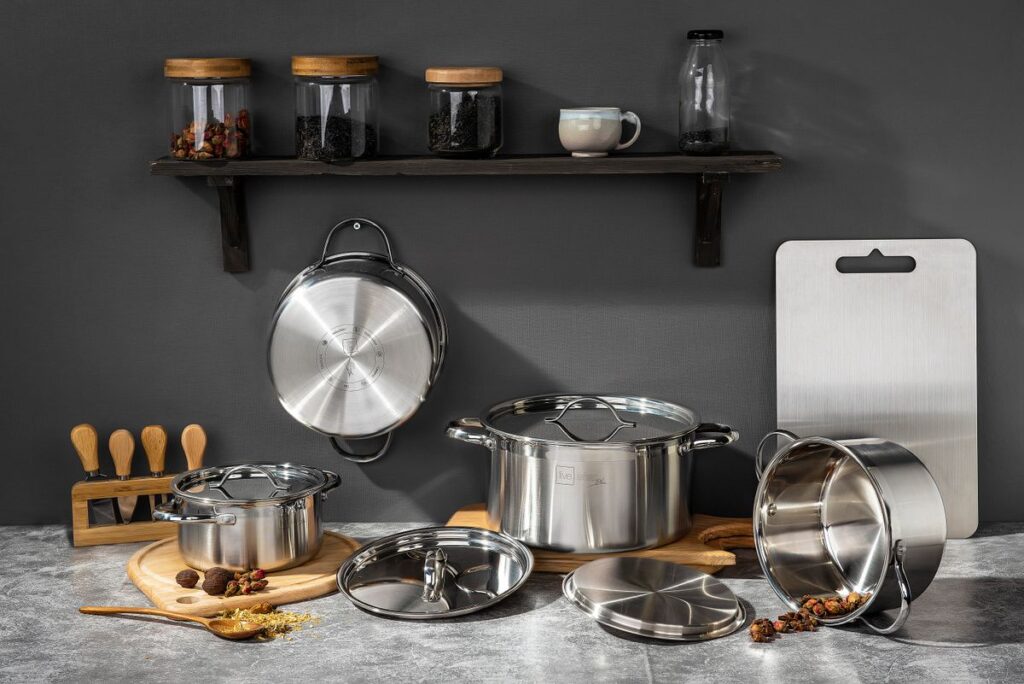
The sauté pan vs skillet confusion is understandable — they look similar, both fry and sear, and many kitchens own just one. But the side-wall geometry changes what each pan does best: a sauté pan\’s straight, tall sides contain splatter and hold sauces, while a skillet\’s sloped sides release moisture for better browning and make tossing effortless. This guide explains the design differences, the cooking implications, and which pan deserves your money first.
Sauté Pan vs Skillet: The Quick Verdict
Buy the skillet first — its sloped sides make it the more versatile everyday pan for searing, frying, and sautéing. Add a sauté pan when you regularly cook for crowds, make pan sauces, or braise: its straight sides hold more volume, contain splatter, and pair with a lid for covered cooking. Serious cooks eventually own both; casual cooks can thrive with just a good 12-inch skillet.
| Feature | Sauté Pan | Skillet (Fry Pan) |
|---|---|---|
| Side walls | Straight, tall (2.5–4 in) | Sloped, lower (1.5–2.5 in) |
| Capacity | Larger — holds more volume | Smaller usable volume |
| Searing | Good, but traps some steam | Excellent — moisture escapes |
| Pan sauces | Excellent — contains liquid | Good, but splatters more |
| Tossing food | Awkward — high walls block | Easy — flip with a flick |
| Lid use | Designed for lids | Lids less common |
| Price (12 in) | $70–$200 | $40–$150 |
The Geometry: Why Wall Shape Matters
A sauté pan is essentially a wide, shallow pot: straight vertical sides, a large flat cooking surface, and usually a lid. A skillet (often called a fry pan) has sides that flare outward, creating a wider opening at the top than at the base. This single design difference drives everything.
Sloped sides let steam escape. When you sear chicken breasts in a skillet, moisture evaporates freely instead of condensing on tall walls and dripping back — and that escaping moisture is the difference between browning and steaming. Tall straight sides do the opposite: they trap heat and moisture, contain splattering oil, and keep liquids from sloshing out. Neither is universally better; they optimize for opposite goals.
Searing and Browning: Skillet Territory
For hard sears — steaks, chops, scallops, mushrooms — the skillet wins. Its flared sides vent steam, its lower profile lets you maneuver a spatula freely, and food releases and flips easily. Professional kitchens sear almost exclusively in skillets (or their carbon steel cousins) for exactly these reasons.
Sauté pans sear respectably — the cooking surface is the same clad or cast material — but the tall walls trap enough steam to slightly inhibit crust formation, especially when the pan is crowded. If you sear in a sauté pan, work in smaller batches and give food room, and the results approach skillet quality.
Sauces, Braises, and One-Pan Meals: Sauté Pan Territory
Where the sauté pan shines is anything involving liquid. Its straight sides hold significantly more volume — a 12-inch sauté pan holds roughly 4–5 quarts versus 2–3 for a same-diameter skillet. Pan sauces reduce without sloshing over the edge; braised chicken thighs fit in a single layer with room for liquid; shallow-frying stays contained instead of spattering the stovetop.
The included lid transforms the sauté pan into a braising and steaming vessel: brown chicken, add liquid, cover, and finish — all in one pan. Skillets can braise in a pinch, but their open, flared design loses more moisture and makes a mess of anything beyond a quick simmer. For one-pan weeknight dinners, the sauté pan is the more capable tool.
Sautéing Technique: The Toss Factor
True sautéing — from the French sauter, \”to jump\” — means tossing food in the pan with a flick of the wrist. Skillets are built for this: the flared sides guide food back into the pan as you snap your wrist forward. It is satisfying, fast, and keeps small pieces moving for even cooking.
Sauté pans, ironically given the name, are worse at the tossing technique — the tall straight walls block the flipping motion. You stir instead of toss, which works fine but is slower and less even for small pieces. The naming is a historical quirk; the skillet is the better sautéing pan in the technical sense.
Capacity and Batch Cooking
Household size often decides the sauté pan vs skillet question. Cooking for four or more? The sauté pan\’s extra depth means you can brown a pound of meat without crowding, simmer sauce for the whole family, and cook pasta-adjacent one-pan meals with room to spare. Cooking for one or two? A skillet\’s smaller footprint heats faster, stores easier, and handles everyday portions perfectly.
Crowding deserves emphasis: it is the number one cause of gray, steamed \”seared\” meat in home kitchens. The sauté pan\’s larger usable cooking area is a practical antidote — you can fit more food in a single layer, which means better browning in fewer batches.
Oven Use and Versatility
Both pans go from stovetop to oven (with oven-safe handles), but they serve different oven roles. Skillets excel at stovetop-to-oven dishes: sear a steak, finish in the oven; start a frittata, finish under the broiler. Sauté pans handle covered oven braises and larger-format baking — think baked pasta or a big batch of shakshuka finished in the oven.
If you could only own one oven-going pan, the skillet\’s sear-then-finish versatility edges it out for most cooks. The sauté pan\’s oven strength matters more once you already own a skillet.
Material Considerations
Both pans come in the same materials — clad stainless, nonstick, cast iron, carbon steel — and material choice interacts with geometry. A cast iron skillet is the classic searing tool; a clad stainless sauté pan is the classic sauce-and-braise tool. Nonstick versions of both exist for egg and delicate-food duty. Match the material to your priority tasks first, then choose the shape.
Cost and Value
Skillets cost less at every quality tier — simpler shape, no lid, less material. A quality 12-inch skillet runs $40 to $150; a comparable sauté pan with lid runs $70 to $200. The skillet\’s lower price plus higher everyday versatility makes it the obvious first purchase. The sauté pan is the upgrade buy — worth it once you know you need the capacity and the lid.
Which Dishes Suit Each Pan?
- Reach for the skillet: seared steaks and chops, fried eggs, sautéed vegetables, stir-fry-style tossing, grilled sandwiches, frittatas, and anything you flip or toss.
- Reach for the sauté pan: pan sauces, braised chicken thighs, shallow-fried cutlets, one-pan pasta, big-batch sautés for a crowd, and anything with a lid.
- Either works: sautéed mushrooms, browned ground meat, reheated leftovers, and toasted nuts or spices.
The 2026 Angle: Hybrid Designs
Manufacturers have noticed the sauté pan vs skillet dilemma and responded with hybrids: skillets with slightly taller, straighter walls; sauté pans with gently flared rims for easier tossing. These \”everyday pans\” split the difference competently but master neither geometry — a hybrid sears slightly worse than a true skillet and holds slightly less than a true sauté pan. They are fine compromises for minimalists, but cooks who care about performance still benefit from owning the real shapes.
The One-Pan Weeknight Formula
The sauté pan vs skillet choice matters most on busy weeknights, when one pan must carry dinner. The formula works in either pan: brown a protein first and set it aside, sauté aromatics in the fond, deglaze with wine or stock, add vegetables and a starch, then return the protein to finish. In a skillet, keep quantities modest and embrace the toss; in a sauté pan, scale up confidently and use the lid to finish thick items through.
Three templates cover endless variation: (1) chicken thighs + mushrooms + white wine + cream over egg noodles; (2) sausage + peppers + onions + crushed tomatoes over polenta; (3) shrimp + garlic + cherry tomatoes + white wine + lemon over orzo. Each follows the same brown-sauté-deglaze-simmer sequence, each takes under 35 minutes, and each teaches the pan skills — fond development, deglazing, reduction — that separate good home cooks from great ones. Master the formula and the pan becomes almost incidental.
Choosing the Right Size
Pan diameter determines what you can cook without crowding, and crowding is the enemy of browning. For skillets, 12 inches is the versatile standard — big enough for four chicken breasts in a single layer. Ten inches suits couples and smaller burners; go smaller only for dedicated egg or single-serving duty. For sauté pans, 3 quarts (roughly 10–11 inches) handles family sauces, while 5-quart models suit batch cooking — but remember that a half-full large sauté pan is just an expensive skillet, so size to your typical batch.
One more consideration: match the pan to your largest burner. A 12-inch skillet on a small burner heats in a ring pattern with a cold perimeter, undermining the even searing you bought the pan for. On modest stoves, a 10-inch pan that sits fully over the burner outperforms a 12-inch pan that does not. Bigger is only better when the heat source can support it.
Final Verdict: Which Is Better?
Neither is better absolutely — they are complementary tools optimized for opposite jobs. Buy the skillet first: it is cheaper, more versatile for daily cooking, and the superior searing tool. Add the sauté pan second, when batch cooking, pan sauces, or covered braising enter your regular rotation. Together they cover nearly every stovetop task a home cook encounters; apart, the skillet covers more ground alone.
Frequently Asked Questions
Can I use a sauté pan as a skillet?
Yes, for most tasks — it fries, sears, and sautés capably. You will notice the difference in tossing (awkward), searing crowded food (more steam trapped), and flipping with a spatula (taller walls). For everyday cooking, a sauté pan substitutes for a skillet far better than the reverse.
Can I use a skillet as a sauté pan?
Only for small quantities. The flared sides and lower walls mean liquids slosh and spatter, and there is no lid for covered cooking. A skillet works for a quick pan sauce for two, but it cannot replace a sauté pan\’s capacity and containment.
What size sauté pan should I buy?
Three to four quarts (10–12 inches diameter) covers most households — large enough for family sauces and braises without becoming unwieldy. Five quarts and up suits batch cooking and entertaining but gets heavy when full.
Do I need a lid for my skillet?
Not essential, but useful — a lid turns a skillet into a steamer-finisher for thick burgers or a melter for cheese-topped dishes. Universal lids are inexpensive. Sauté pans, by contrast, essentially require their lids for braising and are always sold with one.
Why does food steam instead of sear in my pan?
Crowding is the usual cause — too much food drops the pan temperature and releases more moisture than can evaporate. Use a larger pan or cook in batches, preheat thoroughly, and pat food dry before it hits the heat. Skillets vent steam better than sauté pans, all else equal.
Is a chicken fryer the same as a sauté pan?
Closely related — a chicken fryer is a deep skillet with straight-ish sides and usually a lid, essentially a hybrid between the two. It shallow-fries beautifully and substitutes well for a sauté pan in many kitchens, particularly in cast iron.
Which pan is best for one-pan meals?
The sauté pan — its depth, capacity, and lid handle the brown-then-simmer-then-serve sequence that defines one-pan cooking. A deep 12-inch skillet with a lid is a close second for smaller portions.
What is the difference between a sauté pan and a frying pan?
Frying pan is simply another name for a skillet — the sloped-sided pan. So the comparison is really sauté pan (straight tall sides, with lid) versus frying pan/skillet (sloped sides, usually no lid). Retailers sometimes blur the terms, so check the wall geometry rather than trusting the label.
Can I braise in a skillet if I do not own a sauté pan?
For small braises, yes — brown the protein, add liquid, and cover with a lid or tight foil. The shallow depth means less liquid and faster evaporation, so reduce heat slightly and check liquid levels more often. It works for two portions; beyond that, the sauté pan\’s capacity becomes necessary.
