
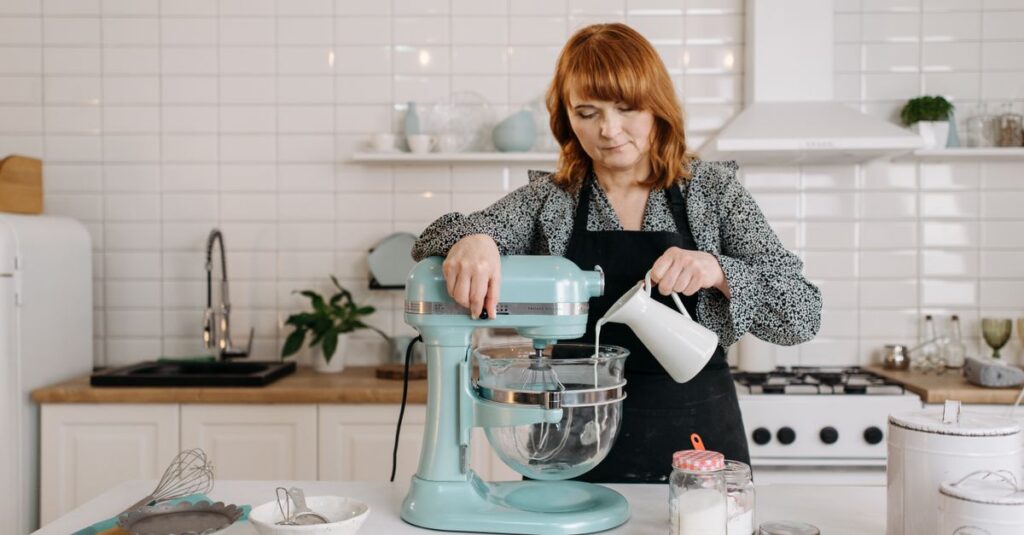
The stand mixer vs hand mixer decision is a rite of passage for every baker. The stand mixer sits on the counter like a trophy — heavy, powerful, beautiful, and expensive. The hand mixer hides in a drawer, costs a fraction of the price, and quietly handles most everyday mixing tasks. Marketing would have you believe every serious baker needs the stand mixer. Your wallet, your cabinet space, and your actual baking habits might disagree.
The real question is not which mixer is \”better\” in the abstract — it is which mixer matches the baking you actually do. A stand mixer is a transformative tool for bread dough, large-batch cookies, and whipped marathon sessions. A hand mixer is the pragmatic choice for weeknight brownies, whipped cream, and batters that take five minutes. Many bakers who buy the big machine discover they still reach for the small one most days.
In this stand mixer vs hand mixer comparison for 2026, we explain how each works, then compare them head-to-head on mixing power, dough handling, batter and whipping performance, attachments, ease of use, cleaning, storage, noise, durability, and price. A comparison table, a verdict for different bakers, and a full FAQ complete the guide.
Stand Mixer vs Hand Mixer: The Short Answer
Buy a stand mixer if you bake bread or stiff doughs regularly, make large batches, or want hands-free mixing plus attachments (pasta makers, meat grinders, grain mills). Its powerful motor, planetary mixing action, and heavy base handle jobs that would destroy a hand mixer.
Buy a hand mixer if you mostly make cakes, cookies, brownies, frostings, and whipped cream in normal batches. It is dramatically cheaper, stores in a drawer, and handles 90% of everyday baking tasks admirably. For the occasional baker, it is the smarter buy.
Bottom line: stand mixers win on power and heavy dough; hand mixers win on price, storage, and everyday convenience. Serious bakers often own both and use each constantly.
How a Stand Mixer Works
A stand mixer pairs a powerful motor (typically 300–800 watts in tilt-head and bowl-lift models) with planetary mixing action: the beater spins on its own axis while orbiting the bowl, touching dozens of points around the bowl\’s circumference. This thorough coverage means ingredients incorporate evenly without constant scraping.
The machine\’s weight — 20–30 pounds for full-size models — is a feature, not a bug. That mass keeps the mixer planted when kneading stiff bread dough that would walk a lighter machine across the counter. Bowl capacities run 4.5–8 quarts, handling double batches of cookies or two loaves of bread dough at once.
The attachment hub is the stand mixer\’s secret weapon. KitchenAid\’s power hub accepts dozens of attachments — pasta rollers, meat grinders, spiralizers, grain mills, ice cream makers — effectively turning the mixer into a multi-appliance platform. Brands like KitchenAid, Ankarsrum, and Breville dominate the 2026 market across price tiers.
How a Hand Mixer Works
A hand mixer is a motorized handle with two removable beaters (or whisk attachments) that you hold and move through the bowl yourself. Motors run 150–350 watts — far less than a stand mixer — but that is plenty for batters, frostings, egg whites, and whipped cream.
Because you guide the beaters, you control exactly where the mixing happens: scrape-down is built into the process, and you can use any bowl, pot, or measuring cup as your vessel. Modern hand mixers from KitchenAid, Cuisinart, and Breville include slow-start speeds to prevent flour explosions, snap-on storage cases, and dishwasher-safe beaters.
The limitations are physical. Your arm is the stand, so long mixing sessions tire you out. Stiff bread dough and thick cookie dough can overheat the motor or stall it entirely — most manufacturers explicitly warn against dough use. And because the beaters are small, large batches take longer and mix less evenly.
Head-to-Head: Stand Mixer vs Hand Mixer
Mixing Power and Motor Strength
Stand mixers operate in a different power class. A 500-watt KitchenAid Artisan or 800-watt Ankarsrum powers through stiff bread dough, triple-batch cookie dough, and dense fruitcake batter without breaking a sweat. The motor is geared for torque at low speeds — exactly what heavy dough demands.
Hand mixers top out around 250–350 watts and are geared for speed rather than torque. They fly through cake batter and whipped cream but labor visibly on thick doughs, and sustained heavy loads can overheat the motor. For light-to-medium tasks the power difference is invisible; for heavy dough it is everything.
- Stand mixer: 300–800W geared for torque; handles the heaviest doughs
- Hand mixer: 150–350W geared for speed; best for light-medium tasks
- Winner: stand mixer, decisively
Bread Dough and Heavy Dough Handling
This is the stand mixer\’s signature event. Ten minutes of hands-free kneading develops gluten beautifully while you prep other ingredients. Bowl-lift models handle 8+ cups of flour; even tilt-head models manage standard two-loaf recipes. The dough hook\’s pulling and folding action mimics hand kneading effectively.
Hand mixers should not knead bread dough — full stop. The motors are not designed for it, dough hooks for hand mixers are marginally effective at best, and you risk burning out the motor. If you bake bread more than occasionally, this single category justifies the stand mixer.
- Stand mixer: effortless hands-free kneading; the bread baker\’s essential tool
- Hand mixer: not designed for dough; risk of motor damage
- Winner: stand mixer, by a landslide
Cakes, Cookies, and Everyday Batters
For standard cake batter, brownie batter, and single-batch cookies, both mixers perform well — and the hand mixer is often more pleasant to use. It is lighter, quicker to set up, and you control the bowl. Creaming butter and sugar, the foundation of most baking, is easy for either machine.
The stand mixer pulls ahead on large batches: double or triple cookie dough mixes more evenly in the big bowl with planetary action, while a hand mixer requires longer mixing and more scraping for the same volume. For normal single batches, though, the results are indistinguishable.
- Stand mixer: better for large batches; planetary action mixes evenly
- Hand mixer: faster setup; identical results for single batches
- Winner: tie — hand mixer for everyday batches, stand mixer for big ones
Whipping Cream and Egg Whites
Both mixers whip cream and egg whites well, with a slight edge to the hand mixer for small quantities — you can whip a single cup of cream in a measuring cup in two minutes. Stand mixers need a minimum volume for the beater to reach the ingredients effectively, though the whisk attachment is superb for large meringue batches.
Speed control matters here: both types offer multiple speeds, and modern models include slow-start to avoid splattering. For meringues and angel food cake in quantity, the stand mixer\’s hands-free operation is a genuine advantage during the long whipping times.
- Stand mixer: best for large meringue and whipped cream batches
- Hand mixer: ideal for small quantities; usable in any container
- Winner: tie — depends on batch size
Attachments and Versatility
The stand mixer is a platform, not just a mixer. Pasta attachments roll fresh fettuccine, the meat grinder attachment handles burgers and sausage, grain mills produce fresh flour, and spiralizers, ice cream makers, and vegetable sheet cutters extend the machine into nearly every corner of cooking. No other countertop appliance offers this ecosystem.
Hand mixers sometimes include a whisk attachment and occasionally a dough-hook pair, but there is no attachment ecosystem. What you see is what you get — which, for many bakers, is exactly enough.
- Stand mixer: dozens of attachments; pasta, grinding, milling, and more
- Hand mixer: beaters and whisks only
- Winner: stand mixer, overwhelmingly
Ease of Use and Hands-Free Operation
The stand mixer\’s killer feature is walking away. Start the mixer, prep your next ingredients, answer the door — the machine keeps working. For recipes with long mixing times (meringue, kneading, creaming), hands-free operation is transformative.
The hand mixer demands your arm for the entire job. Short tasks are no burden, but a 10-minute knead-equivalent session is a workout. On the other hand, setup is instant — grab it from the drawer, click in the beaters, and go. The stand mixer requires counter space or hauling 25 pounds out of a cabinet.
- Stand mixer: fully hands-free; heavy to move and store
- Hand mixer: instant setup; your arm does the work
- Winner: tie — hands-free vs grab-and-go
Cleaning
Hand mixers are easier to clean. The beaters pop off and go in the dishwasher; the handle wipes clean. Total cleanup: one minute. Stand mixer bowls, beaters, and dough hooks are also dishwasher-safe, but they are large, and the mixer head and column collect flour dust that needs wiping.
Neither is difficult, but the hand mixer\’s smaller parts and simpler design make it the lower-friction choice for quick tasks.
- Stand mixer: large parts; head and column need wiping
- Hand mixer: beaters pop off; one-minute cleanup
- Winner: hand mixer
Storage and Counter Space
This is the hand mixer\’s home turf. It fits in a drawer with its beaters, disappearing completely. A stand mixer is a permanent countertop resident for most owners — it is too heavy to move regularly, and at roughly 14 inches tall it needs dedicated space. In small kitchens, the stand mixer\’s footprint is a serious commitment.
- Stand mixer: ~1.5 sq ft of counter; 20–30 lbs; lives on the counter
- Hand mixer: fits in a drawer; near-zero footprint
- Winner: hand mixer, decisively
Noise
Stand mixers produce a deep, steady hum that rises under load — noticeable but not piercing. Hand mixers run at higher RPM with a whinier pitch that many people find more irritating, though sessions are shorter. Neither is quiet; the stand mixer\’s lower tone is generally less annoying.
- Stand mixer: deep hum; longer sessions
- Hand mixer: higher-pitched whine; shorter sessions
- Winner: stand mixer, slightly
Durability and Lifespan
Quality stand mixers are heirloom appliances — all-metal-gear models from KitchenAid and Ankarsrum routinely run 15–25 years, and repair parts are widely available. Hand mixers last 3–8 years depending on brand and use; their plastic gears and smaller motors wear faster, though premium models from Breville and KitchenAid punch above their weight.
- Stand mixer: 15–25 years; repairable; heirloom build
- Hand mixer: 3–8 years; replace rather than repair
- Winner: stand mixer
Price
The gap is stark. Good hand mixers cost $30–$80, with premium models under $150. Stand mixers start around $250 for entry models and run $400–$600 for the popular KitchenAid Artisan and Professional tiers, with premium Ankarsrum and commercial models higher. Attachments add $50–$200 each.
Value depends on use: a $500 stand mixer used weekly for a decade costs under a dollar per week. A $50 hand mixer used monthly is equally good value. Buy for your real baking frequency, not your aspirational one.
- Stand mixer: $250–$600+; attachments extra
- Hand mixer: $30–$150; nothing else needed
- Winner: hand mixer on price
Stand Mixer vs Hand Mixer: Comparison Table
| Feature | Stand Mixer | Hand Mixer |
|---|---|---|
| Motor power | 300–800W, torque-geared | 150–350W, speed-geared |
| Bread dough | Excellent, hands-free kneading | Not recommended |
| Everyday batters | Excellent, best for big batches | Excellent for normal batches |
| Whipping | Best for large batches | Best for small quantities |
| Attachments | Dozens (pasta, grinder, mill) | Beaters and whisks only |
| Hands-free | Yes | No |
| Storage | Permanent counter space | Fits in a drawer |
| Durability | 15–25 years | 3–8 years |
| Typical price | $250–$600+ | $30–$150 |
Which Should You Buy? Our 2026 Verdict
Buy a stand mixer if: you bake bread or stiff doughs at least monthly, you batch-bake in quantity, you want the attachment ecosystem (fresh pasta alone justifies it for many), or you bake often enough that hands-free mixing meaningfully improves your life. It is an investment that pays off over decades.
Buy a hand mixer if: you bake occasionally to moderately — cakes, cookies, brownies, frostings, whipped cream — and have limited space or budget. It handles the vast majority of home baking tasks and asks for almost nothing in return.
Buy both if: you bake weekly or more. This is the setup serious home bakers converge on: the stand mixer for dough and big batches, the hand mixer for quick jobs where hauling out the big machine feels like overkill. They complement each other perfectly rather than competing.
Stand Mixer vs Hand Mixer FAQ
Can a hand mixer knead bread dough?
No — hand mixers are not designed for bread dough. The motors lack the torque, sustained kneading overheats them, and most manufacturers warn against it. Even models with dough hooks handle only very soft, small dough quantities. Bread bakers need a stand mixer.
Is a KitchenAid stand mixer worth the money?
For regular bakers, yes. KitchenAid mixers combine strong performance, a huge attachment ecosystem, excellent parts availability, and 15+ year lifespans. The value equation depends on use — weekly bakers get tremendous ROI; once-a-year bakers do not.
What can a stand mixer do that a hand mixer can\’t?
Knead bread dough hands-free, mix very large or stiff batches evenly, and power attachments for pasta, meat grinding, grain milling, and spiralizing. The attachment hub transforms it from a mixer into a multi-appliance platform.
Do I need a stand mixer for cookies?
Not for normal batches — a hand mixer creams butter and sugar and mixes cookie dough perfectly well. Stand mixers earn their keep on double or triple batches, where the big bowl and planetary action produce more even results with less scraping.
Which is better for meringue?
For large meringue batches (angel food cake, pavlova for a crowd), the stand mixer\’s whisk attachment and hands-free operation win. For small quantities, a hand mixer is faster to set up and easier to control. Both achieve proper stiff peaks.
How long do stand mixers last?
Quality models with metal gears routinely last 15–25 years with normal home use. KitchenAid and Ankarsrum both have strong reputations for longevity, and replacement parts remain available for decades-old models.
Tilt-head or bowl-lift stand mixer: which is better?
Tilt-head models (like the KitchenAid Artisan) offer easier bowl access and suit most home bakers. Bowl-lift models are sturdier for heavy dough and large batches, with higher capacities. Choose tilt-head for general baking, bowl-lift for bread-heavy or high-volume baking.
