
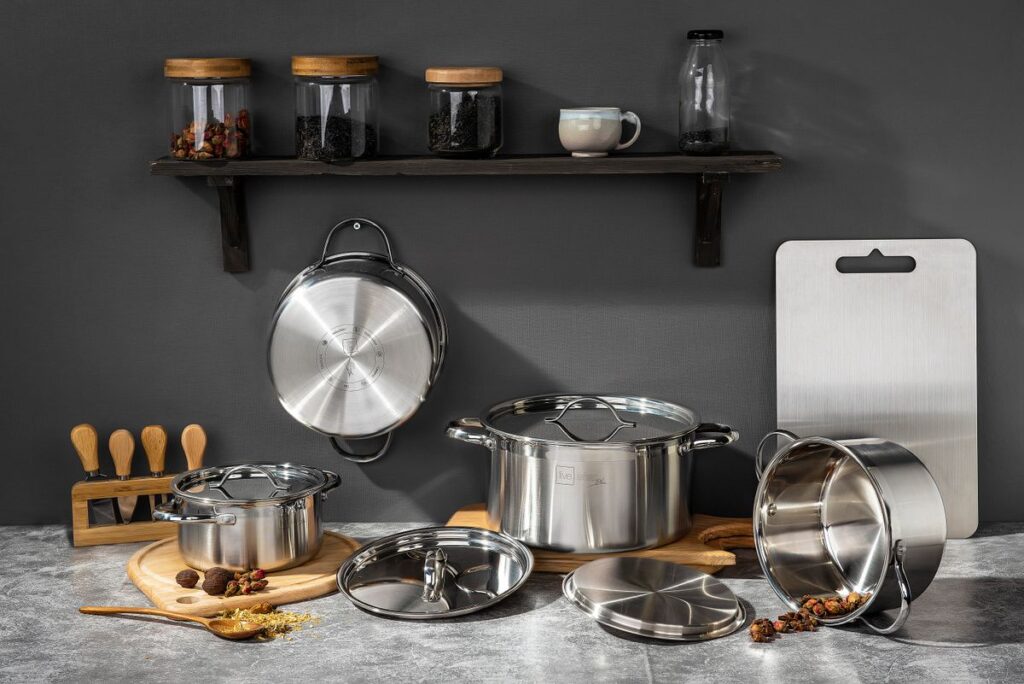
When shoppers compare tri-ply vs disc-bottom cookware, they are really comparing two philosophies of heat management. Tri-ply (fully clad) cookware bonds conductive metal through the entire pan — base and walls — while disc-bottom cookware sandwiches a conductive disc only into the base, with thinner single-ply walls. The practical difference shows up in searing, simmering, and sauces. This guide explains the construction, the cooking implications, and which design deserves your money.
Tri-Ply vs Disc-Bottom Cookware: The Quick Verdict
Tri-ply is the better all-around performer: heat spreads evenly up the walls, eliminating the hot-ring scorching that plagues disc-bottom pans during sears and simmers. Disc-bottom is the better budget choice: it delivers even base heating for boiling, steaming, and stock-making at a fraction of the price. If you sear meat or make sauces, buy tri-ply. If you mostly boil and steam, disc-bottom is excellent value.
| Feature | Tri-Ply (Fully Clad) | Disc-Bottom |
|---|---|---|
| Construction | 3+ layers through base and walls | Conductive disc in base only |
| Heat distribution | Even across entire pan | Even at base, hot ring at walls |
| Searing performance | Excellent, edge to edge | Good center, weaker at edges |
| Sauce and simmer control | Superior — no scorch spots | Fair — edges can scorch |
| Responsiveness | Fast heat changes | Slower, retains base heat |
| Weight | Heavier | Lighter |
| Price | $80–$300+ per piece | $30–$100 per piece |
How Tri-Ply Cookware Is Built
Tri-ply means three bonded layers: an outer layer of magnetic stainless steel (for induction compatibility and durability), a core of aluminum or copper (for heat conduction), and an inner cooking surface of 18/10 stainless steel. In quality fully-clad cookware, this sandwich extends from the base all the way up the walls to the rim. Five-ply and seven-ply versions add extra alloy layers for marginally better performance, though the jump from disc-bottom to tri-ply matters far more than the jump from tri-ply to five-ply.
The key engineering point is that heat travels sideways as well as upward. When a burner heats the base, the conductive core carries that energy up the walls, so the entire cooking surface — not just the bottom — participates in cooking. This eliminates the sharp temperature gradient where the hot base meets cool walls.
How Disc-Bottom Cookware Is Built
Disc-bottom (also called encapsulated-base) cookware takes a simpler approach: a thick disc of aluminum or copper, encapsulated in stainless steel, is bonded or impact-welded to the bottom of an otherwise single-layer stainless body. The walls are thin stainless with no conductive core. This design concentrates the engineering — and the cost — exactly where most stovetop heat enters the pan: the base.
For tasks where heat enters through the base and the contents distribute it — boiling pasta water, steaming vegetables, making stock — disc-bottom performs nearly as well as tri-ply. The thick base resists warping and spreads burner heat evenly across the bottom. The weakness appears when the walls matter: searing, where food contacts the sides, or simmering thick sauces, where the cool walls create scorch-prone temperature zones.
Heat Evenness: The Decisive Test
The classic demonstration is the flour test: dust flour across a dry heated pan and watch where it browns. A tri-ply pan browns evenly across the whole surface. A disc-bottom pan browns in a ring matching the disc, with pale zones beyond it. In real cooking, that ring pattern means pancake edges that never quite brown, sauces that catch at the perimeter, and sears that are perfect in the center but gray at the edges.
Tri-ply\’s wall heating also matters for oven use and for techniques like shallow-frying, where hot walls keep oil temperature stable as food is added. Disc-bottom pans lose more heat through their thin walls, making temperature recovery slower. For the tri-ply vs disc-bottom cookware decision, heat evenness is the single biggest performance gap.
Searing and Browning Compared
Searing is where fully clad construction earns its price. A tri-ply skillet holds a uniform high temperature edge to edge, so four chicken breasts brown identically whether they sit in the center or near the wall. The fond — those caramelized bits that become pan sauce — develops evenly, giving you a deeper, more uniform base for deglazing.
Disc-bottom skillets sear well in the center but fall off toward the edges, where the thin walls bleed heat. Cooks adapt by crowding food toward the middle, but that defeats the purpose of a large pan. If searing is central to your cooking — steaks, chops, scallops, mushrooms — tri-ply is meaningfully better, not just marginally.
Sauces, Simmers, and Delicate Work
Sauce-making exposes disc-bottom\’s weakness most clearly. A simmering tomato sauce or custard in a disc-bottom saucepan develops hot spots where the disc ends, and those spots scorch while the center merely simmers. Constant stirring compensates, but it is compensating for the pan. Tri-ply saucepans hold a gentle, uniform simmer with far less attention, which is why serious sauce cooks consider fully clad non-negotiable for saucepans specifically.
For boiling tasks — pasta, potatoes, blanching — the difference nearly vanishes. Water is an excellent heat distributor, so the base-only conduction of disc-bottom is plenty. This is why many cooks happily own disc-bottom stockpots alongside tri-ply skillets and saucepans.
Responsiveness: How Fast Pans React
Tri-ply\’s aluminum core running through the whole pan means faster response to burner adjustments — turn the heat down and the walls cool quickly, preventing overshoot. Disc-bottom pans, with their thick encapsulated base, retain heat longer and respond more sluggishly. Neither is objectively better in all cases: responsiveness helps delicate work, while heat retention helps searing recovery. But most cooks prefer the more predictable, linear response of tri-ply.
Durability and Longevity
Both constructions last decades — stainless steel does not wear out. The failure mode to watch is disc separation: on cheap impact-bonded disc-bottom pans, the disc can loosen or develop a gap after years of thermal cycling, creating a hot spot or a wobble. Fully encapsulated, welded discs from reputable brands rarely have this problem. Tri-ply has no disc to separate; delamination of clad layers is extremely rare in quality brands. On balance, tri-ply is the more failure-proof construction.
Weight and Handling
Tri-ply is heavier — a 12-inch fully clad skillet can weigh 3.5 to 4.5 pounds versus 2.5 to 3 for a disc-bottom equivalent. The extra mass is thermal mass, which aids searing, but it matters for tossing, pouring, and cooks with strength limitations. Disc-bottom\’s lighter build is genuinely more pleasant for everyday sautéing and one-handed maneuvers.
Cost and Value: Where Each Wins
Disc-bottom wins on price by a wide margin — often half the cost of comparable tri-ply. A disc-bottom stainless set can deliver 80 percent of real-world performance for boiling, steaming, and basic sautéing at 40 percent of the price. That is outstanding value for casual cooks.
Tri-ply wins on performance-per-dollar for cooks who sear, make sauces, or cook daily. The price premium buys measurably better results in exactly the techniques where pan quality matters most. A smart compromise many cooks land on: tri-ply skillet and saucepan (where walls matter), disc-bottom stockpot and steamer (where they do not).
The 2026 Market: What Has Changed
The tri-ply vs disc-bottom cookware price gap has narrowed as manufacturing improves — decent fully clad pans now appear at mid-range prices that were disc-bottom territory five years ago. Meanwhile, five-ply marketing has muddied the waters: extra layers sound impressive but deliver diminishing returns over good tri-ply. The savvy 2026 buyer ignores ply-count hype and focuses on the real question: does the conductive layer run up the walls or stop at the base?
How to Spot Quality Cladding When Shopping
The tri-ply vs disc-bottom cookware distinction is not always obvious on the shelf, because marketing language blurs it deliberately. Here is how to tell what you are actually buying. First, read the construction description precisely: \”fully clad,\” \”tri-ply throughout,\” or \”clad up the sides\” means tri-ply; \”encapsulated base,\” \”impact-bonded base,\” or \”aluminum disc bottom\” means disc-bottom — regardless of how premium the branding sounds. Second, look at the pan\’s rim: fully clad pans often show the layered sandwich edge at the rim, while disc-bottom pans show a visible seam or step where the disc meets the wall.
Third, check the weight and balance — quality tri-ply feels substantial and evenly weighted, while cheap disc-bottom feels light with a heavy base. Fourth, verify the base diameter matches your burners; an oversized disc-bottom pan on a small burner heats only the center, exaggerating the hot-ring problem. Finally, be skeptical of ply counts above three as a selling point: a well-made tri-ply pan from a reputable brand outperforms a sloppy five-ply pan every time. Construction quality beats layer quantity.
Care Tips That Protect Your Investment
Clad cookware lasts decades, but a few habits keep it performing like new. Avoid thermal shock — never plunge a hot pan into cold water — because rapid contraction stresses the bonded layers and can warp even quality pans. Preheat gradually over medium rather than blasting on high; clad pans heat evenly and do not need maximum burner output, which only risks discoloration and warping.
For cleaning, soak stuck food in hot water rather than attacking it with steel wool, which scratches the cooking surface over time. A paste of baking soda or a dedicated stainless cleaner removes the rainbow heat tint and browned-on oil that accumulate with use — cosmetic issues that do not affect performance but bother perfectionists. Dishwashers are technically safe for most clad stainless, but hand washing keeps the finish brighter longer and avoids the dulling that harsh detergents cause. None of this is onerous; it is simply the minimal respect that a decades-long tool deserves.
Final Verdict: Which Is Better?
Tri-ply is the better cookware for performance — more even heating, better searing, superior sauce control, and greater durability. Disc-bottom is the better value for boiling, steaming, and budget-conscious kitchens. The ideal setup mixes both strategically: invest in tri-ply where the walls do work (skillets, sauté pans, saucepans) and save with disc-bottom where they do not (stockpots, pasta pots). If buying one set for everything, tri-ply is worth the premium for anyone who cooks more than a few times a week.
Frequently Asked Questions
Is tri-ply always better than disc-bottom?
For searing, sauces, and overall evenness, yes. For boiling water, making stock, and steaming, the difference is negligible — water distributes heat so well that base-only conduction suffices. Match the construction to the task rather than assuming more expensive is always better.
What does 5-ply add over tri-ply?
Very little in practice. Extra layers of stainless alloys add marginal durability and slightly different heat characteristics, but the leap from single-ply walls to a fully clad aluminum core (disc-bottom to tri-ply) is the transformative one. Do not pay a large premium for ply count alone.
Can disc-bottom pans warp?
Quality disc-bottom pans resist warping well because the thick base is rigid. Cheap thin disc-bottom pans can warp, especially with thermal shock. Tri-ply\’s full cladding makes it inherently warp-resistant across the whole pan.
Do I need tri-ply for induction?
Both work on induction if the base is magnetic. Tri-ply\’s full cladding actually pairs beautifully with induction\’s precise control, giving fast, even response. Disc-bottom works fine too — induction heats the magnetic base directly regardless of wall construction.
Why do my sauces scorch in a disc-bottom pan?
The conductive disc ends before the walls, creating a temperature drop at the perimeter where thick sauces sit relatively still and catch. Stirring more frequently, using lower heat, and choosing a tri-ply saucepan for sauces all solve the problem.
Is fully clad worth it for a stockpot?
Rarely. Stockpots hold large volumes of liquid that distribute heat themselves, so disc-bottom or even good single-ply stainless performs fine. Save the clad premium for skillets, sauté pans, and saucepans where wall heating changes results.
How can I tell if a pan is truly fully clad?
Check the manufacturer\’s description for \”fully clad\” or \”tri-ply throughout,\” and look at the pan\’s profile — fully clad pans show the layered sandwich at the rim. If the description says \”encapsulated base\” or \”impact-bonded base,\” it is disc-bottom regardless of marketing language.
