
n
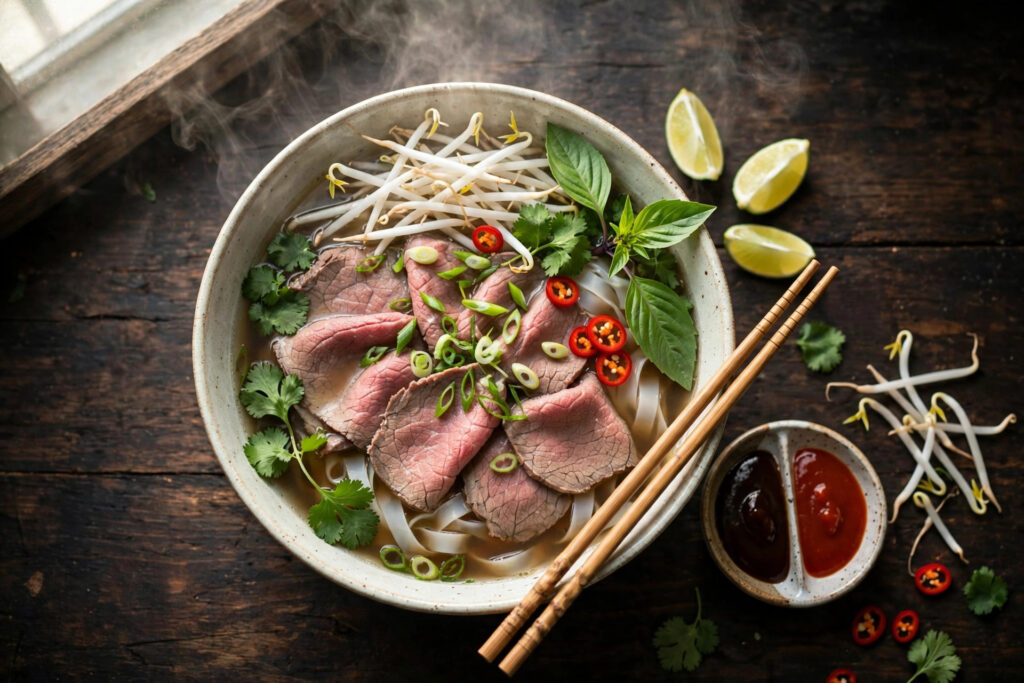
An authentic Vietnamese beef pho recipe builds its soul in the broth: beef bones simmered gently for 6–8 hours with charred onion and ginger and toasted spices (star anise, cinnamon, cloves, cardamom, coriander seed, fennel) — never boiled hard, so the broth stays crystal clear. Seasoned with fish sauce and a little sugar, it’s ladled over flat rice noodles and paper-thin slices of raw eye-of-round that cook in the hot broth, then finished at the table with bean sprouts, Thai basil, lime, and chilis. This guide covers the charring, the spice toasting, the clarity rules, and a pressure-cooker shortcut that gets you 90% there in 90 minutes.
Pho (pronounced “fuh”) is Vietnam’s national dish — a study in clarity and balance. A great bowl is aromatic but not muddy, rich but not heavy, with a broth so clear you can see the bottom of the bowl. That clarity isn’t luck; it’s technique: parboiling the bones, maintaining the barest simmer, and skimming diligently. Whether you commit to the full-day traditional method or the weeknight pressure-cooker version, the principles below are what separate pho from “beef noodle soup.”
What Makes Pho Taste Like Pho
Three flavor pillars, all in the broth:
- Charred aromatics: Onion and ginger blackened directly over flame (or under a broiler) until charred in spots. The char adds smoky sweetness and depth — raw onion and ginger taste sharp and one-dimensional by comparison.
- Toasted spices: Star anise (the dominant note — sweet, licorice-like), cinnamon or cassia, cloves, cardamom, coriander seed, and fennel seed, toasted until fragrant. These go in a spice sachet so the broth stays clear.
- Clean beefiness: A mix of marrow bones (richness), knuckle bones (gelatin/body), and brisket or chuck (meaty flavor + tender meat for the bowl). Parboiled first to purge impurities, then simmered — never boiled — for hours.
Ingredients (Makes about 4 liters; serves 8)
For the Broth
- 2 kg (4½ lb) beef marrow/knuckle bones
- 700 g (1½ lb) beef brisket or chuck
- 2 large yellow onions, halved
- 1 large hand of ginger (about 150 g), halved lengthwise
- 5 star anise
- 1 cinnamon stick (or cassia bark)
- 4 cloves
- 3 green cardamom pods, cracked
- 1 tablespoon coriander seeds
- 1 teaspoon fennel seeds
- 80 ml (⅓ cup) fish sauce, plus more to taste
- 2–3 tablespoons rock sugar or white sugar
- Salt to taste
- Water to cover (about 5 liters)
For the Bowls
- 500 g (1 lb) flat rice noodles (banh pho), 3–5 mm wide
- 400 g (14 oz) beef eye-of-round or sirloin, partially frozen and sliced paper-thin against the grain
- The cooked brisket from the broth, thinly sliced
- 1 onion, very thinly sliced
- 4 scallions, thinly sliced
For the Table (Non-Negotiable)
- Bean sprouts, Thai basil, lime wedges, sliced Thai chilis
- Hoisin sauce and sriracha (for dipping, not the broth — purists add them to a side dish, not the bowl)
Clarity tools: A large stockpot (8+ liters) and a fine-mesh skimmer make the long simmer manageable. 12-quart stainless steel stockpot Check Price on Amazon → A spice sachet or tea infuser keeps spices contained: muslin spice sachets Check Price on Amazon →
Step 1: Parboil the Bones (The Clarity Secret)
- Place the bones in the stockpot, cover with cold water, and bring to a rolling boil. Boil hard 10 minutes. The water will turn gray and scummy — that’s blood, impurities, and bone dust you want out. You will need a large stockpot for this — the bones, water and aromatics need headroom to simmer without boiling over; our guide to the best stockpots covers the sizes that suit broth-making.
- Drain, rinse the bones under running water, and scrub the pot clean. This single step is responsible for 80% of broth clarity. Skipping it gives you cloudy, muddy pho no amount of skimming can fix.
Step 2: Char the Aromatics
- Place the halved onions and ginger cut-side down directly on a gas burner flame, under a broiler, or in a dry cast-iron skillet over high heat. Char 10–15 minutes, turning, until blackened in spots and fragrant.
- Rinse off any loose flaky ash (keep the char — that’s flavor), and add to the pot.
Why char? The Maillard reaction and light caramelization transform raw allium sharpness into deep, sweet, smoky complexity. It’s the difference between a broth that tastes “beefy” and one that tastes like pho.
Step 3: Toast Spices and Simmer
- Toast the star anise, cinnamon, cloves, cardamom, coriander, and fennel in a dry skillet 2–3 minutes until fragrant. Tie in a spice sachet.
- Return the clean bones to the pot with the brisket. Add the charred aromatics, spice sachet, and 5 liters of cold water.
- Bring slowly to the barest simmer — a few lazy bubbles breaking the surface, around 90–95°C (195–200°F). Never let it boil. Boiling emulsifies fat and proteins into the liquid = cloudy broth.
- Simmer 6–8 hours, skimming foam and fat periodically. Add the brisket out at the 3-hour mark (it’s tender by then; longer turns it stringy) — cool, slice thin, and reserve for the bowls.
- Remove from heat. Fish out bones, aromatics, and sachet. Strain through a fine-mesh sieve (lined with cheesecloth for extra clarity).
- Season: Add fish sauce and sugar. Taste constantly — the broth should be savory-sweet-aromatic, with the spices present but not aggressive. It should taste slightly overseasoned: the noodles dilute it in the bowl.
Step 4: Assemble the Bowls
- Cook the rice noodles according to package directions (usually a brief soak + 1-minute boil); drain and portion into deep, warmed bowls.
- Arrange the raw beef slices and brisket slices over the noodles, plus thin onion and scallions.
- Bring the broth back to a rolling boil — it must be screaming hot to cook the raw beef. Ladle generously over each bowl; the beef will turn from red to pink-brown in seconds.
- Serve immediately with the full herb plate. Each diner customizes: bean sprouts for crunch, Thai basil torn over, lime squeezed in, chilis for heat.
The Pressure-Cooker Shortcut (90 Minutes)
Parboil and char as above. Pressure-cook bones, brisket, aromatics, and spices with water on high for 45 minutes; natural release 15 minutes. Strain, season, done. The broth is slightly less refined than the 8-hour version but genuinely excellent — about 90% of the way there for 20% of the time.
Pro Tips
- Slice beef partially frozen. 30–45 minutes in the freezer firms the eye-of-round enough to slice paper-thin with a sharp knife. Thin slices cook instantly in the broth; thick ones stay raw-centered.
- Warm the bowls. Pho cools fast, and lukewarm broth can’t cook the beef. Hot broth + warm bowls = perfect.
- Fish sauce in increments. Add, wait 2 minutes, taste. The difference between perfectly seasoned and too salty is about a tablespoon.
- Rock sugar > white sugar for a rounder, cleaner sweetness — but white sugar works fine.
- Don’t overcook the noodles. They continue softening in the hot broth. Pull them a touch early.
Variations
- Pho ga (chicken): Whole chicken + chicken carcasses, 2–3 hour simmer, shredded chicken in the bowl — lighter and faster.
- Pho chay (vegetarian): Charred aromatics + toasted spices in a mushroom-kombu vegetable broth; tofu and vegetables in the bowl.
- Pho tai nam gau: The classic combination — rare beef (tai), brisket (nam), and meatballs (bo vien).
- Spicy Hue-style (bun bo Hue): A different beast — lemongrass, shrimp paste, chili oil, thicker round noodles. Worth exploring next.
Storage
Broth keeps 5 days refrigerated (it’ll gel — that’s the gelatin, a good sign) or 3 months frozen. Freeze in portion-sized containers for quick pho nights. Store noodles, beef, and herbs separately; assemble fresh. Reheat broth to a full boil before ladling over.
Pho’s Story: From Hanoi Streets to Global Icon
Pho was born in northern Vietnam in the early 20th century, likely in Hanoi or Nam Dinh, during French colonial rule. Its parentage is debated but delicious: the French pot-au-feu (beef and vegetable stew) met Chinese-Vietnamese noodle soups, and Vietnamese cooks created something entirely new — a clear, spice-perfumed broth over rice noodles. The name itself may derive from pot-au-feu filtered through Vietnamese pronunciation.
After Vietnam’s 1954 partition, pho traveled south with northern refugees to Saigon, where southern cooks added the herb plate, bean sprouts, hoisin, and sriracha — the Saigon style most Westerners know. After 1975, the Vietnamese diaspora carried it worldwide, and pho became one of the planet’s great comfort foods — from Paris to Houston to Sydney. Northern (Hanoi) style remains purer: simpler garnishes, clearer broth, wider noodles. Try both; the debate over which is “real” pho is half the fun.
Broth Clarity: The Complete Rules
- Parboil and rinse. Non-negotiable — this removes 80% of cloudiness.
- Cold start, slow rise. Start bones in cold water and bring up gently; a violent initial boil emulsifies impurities.
- Bare simmer, always. Lazy bubbles at 90–95°C. If it boils, clarity is gone — you can’t un-boil it.
- Skim early and often in the first hour; later skimming matters less.
- Bag the spices. Loose spices shed sediment no sieve fully catches.
- Don’t stir the pot. Agitation suspends particles. Let it sit undisturbed.
- Strain through cheesecloth at the end for the final polish.
The Pho Toppings Bar: Hosting Pho Night
Pho is the ultimate dinner-party dish — the host makes the broth ahead, and guests customize at the table:
- Broth: Make 1–2 days ahead; refrigerate (it gels — that’s good). Reheat to a rolling boil before serving.
- Noodles: Cook just before serving; hold briefly in cold water, then portion.
- Proteins: Paper-thin raw eye-of-round (sliced ahead, kept cold), sliced brisket from the broth pot, beef meatballs warmed in the broth.
- The herb plate (per 4 guests): 2 cups bean sprouts, 1 large bunch Thai basil, 2 limes in wedges, 4 sliced Thai chilis, plus cilantro and thin-sliced onion.
- Condiments: Hoisin and sriracha in small dishes (for dipping, per northern tradition — not stirred into the broth), plus extra fish sauce.
- Setup: Keep the broth at a bare simmer in the pot on the stove; guests bring bowls to be filled, or ladle tableside for drama.
- How much: About 500 ml broth + 100 g noodles + 100 g beef per generous bowl; plan 1.5 bowls per hearty eater.
The 30-Minute Weeknight Pho
Craving pho on a Tuesday? This approximation is genuinely satisfying:
- Char an onion half and a 5-cm piece of ginger under the broiler (10 min).
- Simmer 1 liter of good beef stock with the charred aromatics and a sachet of toasted spices (2 star anise, 1 cinnamon stick, 3 cloves, 1 tsp coriander seed) for 20 minutes.
- Season boldly with fish sauce and a pinch of sugar.
- Strain over cooked rice noodles, thin-sliced beef, and scallions in warm bowls.
- Finish with the full herb plate — basil, sprouts, lime, chili.
It won’t match the 8-hour broth’s gelatinous depth, but the charred aromatics and toasted spices deliver the unmistakable pho signature. The herb plate does the rest.
More Asian Classics to Cook Next
If pho has you in a broth mood, keep going: our air fryer Thai red curry chicken takes the opposite route to the same flavour balance — rich and fiery instead of clear and aromatic — and it is on the table in 25 minutes. And if you are building a pantry of basics, the homemade beef stock behind this broth is worth making in its own right.
FAQs
How do you pronounce pho?
“Fuh” — one syllable, rhymes with “duh,” not “foe.” The tone in Vietnamese falls then rises, but “fuh” gets you understood everywhere.
Why is my pho broth cloudy?
Three usual causes: skipping the parboil, boiling instead of barely simmering, or adding the spices loose (they shed sediment). Parboil, keep it at lazy bubbles, and bag your spices.
Can I make pho in a slow cooker?
Yes — parboil and char as directed, then cook on low 10–12 hours. The gentle heat is actually ideal for clarity. It’s the most hands-off path to great pho.
Is the raw beef in pho safe to eat?
Yes, when handled properly: use a whole-muscle cut (eye-of-round) from a trusted source, slice thin, and ladle genuinely boiling broth over it — the thermal mass cooks it through in seconds. If concerned, briefly blanch the slices in the broth first.
What cut of beef is best for pho?
For the broth: marrow and knuckle bones plus brisket. For the bowl: eye-of-round or sirloin, sliced paper-thin. Brisket (from the broth pot) adds tender, fatty richness; meatballs (bo vien) are the classic third meat.
What is the difference between pho bo and pho ga?
Pho bo is this recipe — beef pho, built on beef bones with warm spices like star anise, cinnamon and clove. Pho ga is the chicken version: a lighter, clearer broth made from a whole chicken, usually with the same charred onion and ginger but a gentler spice hand. The noodles, herbs and table condiments are the same for both.
Can I use store-bought broth for pho?
You can approximate it: simmer good beef stock 30 minutes with charred onion/ginger and toasted spices in a sachet, then season with fish sauce and sugar. It won’t match the gelatinous depth of real pho broth, but it’s a respectable weeknight bowl.
What herbs go with pho?
The essential plate: Thai basil, bean sprouts, lime wedges, and sliced chilis. Nice additions: cilantro, culantro (sawtooth herb), and thin-sliced onion. Add them at the table, not during cooking — heat destroys their freshness.
