
Affiliate Disclosure: As an Amazon Associate I earn from qualifying purchases.
n
The best cookware for induction cooktops in 2026 is heavy, flat-bottomed, and fully magnetic — and the best overall value is a tri-ply stainless steel cookware set with magnetic exteriors, flat machined bases, and oven-safe handles. Induction doesn’t heat the pan; it is the heat, generated by magnetic fields exciting the iron in your cookware — which means the wrong pan simply won’t work, and the right pan performs better on induction than on any other heat source.
Our research team evaluated magnetic strength, base flatness, warp resistance, and owner reviews to rank the eight best induction-compatible options this year. You’ll also learn the 30-second magnet test, why some “induction-ready” pans disappoint, and the techniques that make induction cooking exceptional.
Quick Picks: Best Induction Cookware of 2026
- Best overall set: 10-piece tri-ply stainless set, fully magnetic — the induction foundation. Best Overall Tri-Ply Stainless Induction Cookware Set Check Price on Amazon →
- Best skillet: 12-inch tri-ply stainless skillet — flat, magnetic, warp-resistant. 12-Inch Tri-Ply Stainless Induction Skillet Check Price on Amazon →
- Best budget: hard-anodized set with bonded steel base — induction-ready value. Budget Induction-Ready Hard-Anodized Cookware Set Check Price on Amazon →
- Best cast iron: 12-inch pre-seasoned cast iron skillet — unbeatable searing on induction. Cast Iron Skillet for Induction Cooktops Check Price on Amazon →
- Best carbon steel: 12-inch flat-bottom carbon steel skillet — responsive, magnetic, light. Carbon Steel Skillet for Induction Check Price on Amazon →
- Best nonstick: 10-piece PFOA-free nonstick set with induction base — everyday ease. Induction-Compatible Nonstick Cookware Set Check Price on Amazon →
- Best Dutch oven: 5.5-quart enameled cast iron Dutch oven — perfect induction braising. Enameled Cast Iron Dutch Oven for Induction Check Price on Amazon →
- Best splurge: 5-ply clad set — maximum evenness on induction. Premium 5-Ply Induction Cookware Set Check Price on Amazon →
How Induction Works (And Why Your Pan Matters More)
An induction coil generates a rapidly alternating magnetic field. When ferromagnetic cookware sits in that field, the field induces electrical eddy currents in the pan’s iron — and the iron’s electrical resistance turns those currents into heat, inside the pan metal itself. The cooktop surface stays relatively cool; the pan becomes the heating element.
Three consequences for cookware choice. First, the pan must be ferromagnetic — iron or magnetic stainless. Aluminum, copper, and glass are invisible to induction unless bonded to a magnetic steel base. Second, flat contact is critical — the field strength drops rapidly with distance, so a warped base that rocks loses heating efficiency dramatically. Third, the field is localized — induction heats a defined coil zone intensely, so the pan’s own conductivity (tri-ply cladding, thick bases) determines how evenly that heat spreads. On induction, your cookware does more of the thermal work than on gas.
The Magnet Test: 30 Seconds to Certainty
Grab any fridge magnet and stick it to the pan’s base. Firm grip = works on induction. Weak or no grip = doesn’t. That’s the whole test, and it’s more reliable than packaging claims. Notes: test the base center (some pans have magnetic discs smaller than the base); a magnet that sticks weakly at the rim but firmly in the center will still work; and “induction-ready” labels are marketing — the magnet is physics. Test every piece you own before assuming.
What Works on Induction: Material Guide
Excellent: cast iron (bare and enameled)
Fully ferromagnetic, heavy, and flat-friendly — cast iron is superb on induction. The intense, controllable heat pairs beautifully with searing and braising. Caveats: lift, don’t slide, on glass tops (rough bases scratch); and the heavy mass means slower response than steel, though induction’s instant control compensates.
Excellent: carbon steel
Ferromagnetic, lighter than cast iron, and wonderfully responsive — carbon steel might be the single best induction skillet material. Its fast response matches induction’s precise power control. Requires a flat base (most quality skillets qualify) and the usual seasoning maintenance.
Excellent: tri-ply / multi-ply stainless with magnetic exterior
The induction default: magnetic stainless outside, aluminum core for evenness, non-reactive interior. Heavy, flat, warp-resistant, and compatible with everything. If you’re buying one set for induction, this is it.
Good: hard-anodized with bonded steel base
The aluminum body can’t couple with induction, but a bonded ferromagnetic steel disc in the base can. Performance depends on the disc: full-coverage bonded bases work well; small glued-on discs heat unevenly and can separate. Check that the base is genuinely flat and the magnet grips firmly across it.
Good: induction-base nonstick
Same principle as hard-anodized — a magnetic base layer under the nonstick coating. Fine for eggs and delicate foods. Keep heat moderate (high heat degrades coatings faster on induction’s intense field) and verify flatness.
Doesn’t work: pure aluminum, copper, glass, ceramic
Unless explicitly built with a magnetic base layer, these are invisible to induction. Traditional copper cookware — beloved on gas — is useless on induction without modification. Check specs; don’t assume.
The 8 Best Induction Cookware Picks of 2026
1. Best overall set: 10-piece tri-ply stainless
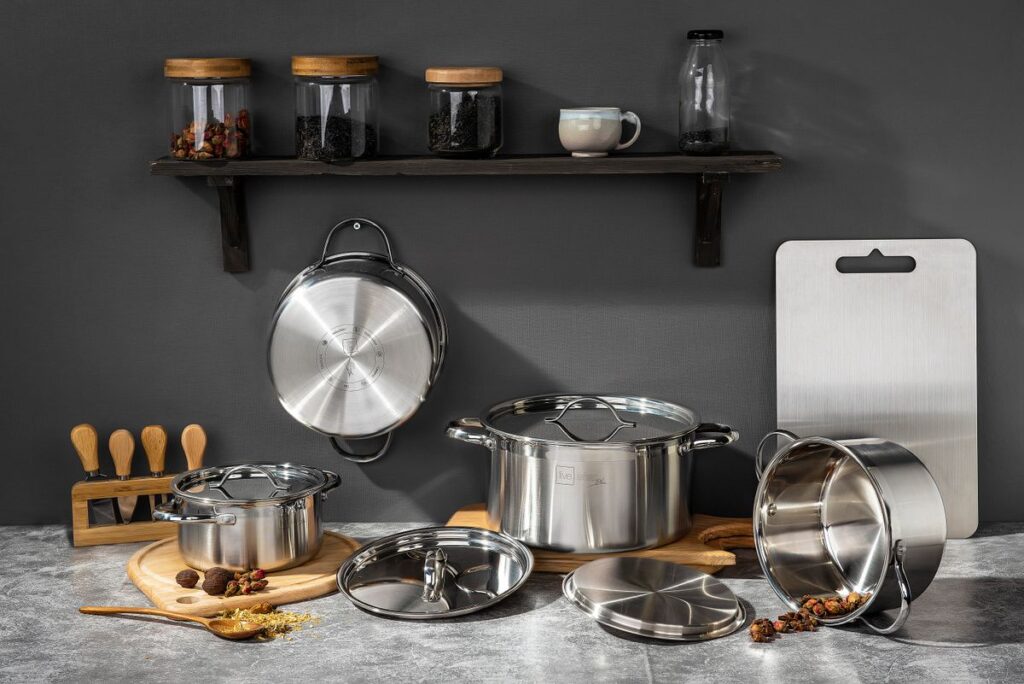
The induction foundation: fully magnetic exteriors, aluminum cores for even heat spread, flat machined bases, and oven-safe handles. Covers skillets, saucepans, sauté, and stockpot — every shape a kitchen needs, all optimized for the magnetic field. Tri-ply’s weight resists induction warping, and the set pricing beats buying pieces individually. Best Overall Tri-Ply Stainless Induction Cookware Set Check Price on Amazon →
2. Best skillet: 12-inch tri-ply stainless
If you buy one induction pan, make it this: a heavy 12-inch tri-ply skillet with a dead-flat magnetic base. It sears steaks, sautés vegetables, and deglazes pan sauces with the evenness that induction’s localized heating demands from its cookware. The helper handle manages the clad weight. 12-Inch Tri-Ply Stainless Induction Skillet Check Price on Amazon →
3. Best budget: hard-anodized set with steel base
Induction compatibility at a fraction of clad prices: hard-anodized aluminum bodies with genuinely bonded ferromagnetic bases. Lighter and easier to handle than tri-ply, with good nonstick-friendly interiors. Verify the base is full-coverage bonded (not a small disc) and flat — that’s what separates the good value sets from the disappointing ones. Budget Induction-Ready Hard-Anodized Cookware Set Check Price on Amazon →
4. Best cast iron: 12-inch pre-seasoned skillet
For searing on induction, nothing beats cast iron’s heat retention paired with induction’s instant, intense power. Preheat 5–8 minutes on medium (not boost — thermal shock is real), then sear harder than gas ever allowed. Lift to reposition; the rough base will scratch glass if dragged. Cast Iron Skillet for Induction Cooktops Check Price on Amazon →
5. Best carbon steel: 12-inch flat-bottom skillet
The responsiveness champion: carbon steel’s quick heating matches induction’s precise control beautifully, and it’s half the weight of cast iron. The flat magnetic base couples strongly; the seasoned surface goes naturally nonstick. For induction cooks who sauté and stir-fry, this is the daily driver. Carbon Steel Skillet for Induction Check Price on Amazon →
6. Best nonstick: induction-base nonstick set
Everyday ease on induction: PFOA-free nonstick interiors over magnetic base layers, covering the egg-and-fish duties where stainless frustrates. Keep to medium heat — induction’s intensity degrades coatings faster at high settings — hand wash, and expect the usual 3–5 year coating lifespan. Induction-Compatible Nonstick Cookware Set Check Price on Amazon →
7. Best Dutch oven: 5.5-quart enameled cast iron
Induction braising perfection: the ferromagnetic iron couples strongly, the heavy mass smooths induction’s power cycling into a steady simmer, and the enamel handles acidic braising liquids. Use lower settings than you expect — induction’s efficiency means medium-low holds a braise beautifully. Enameled Cast Iron Dutch Oven for Induction Check Price on Amazon →
8. Best splurge: 5-ply clad set
Maximum evenness for induction’s localized heating: five bonded layers spread the coil’s concentrated heat more uniformly than 3-ply, with superior warp resistance under boost-mode intensity. For the induction cook who notices — and is bothered by — any unevenness, this is the endgame set. Premium 5-Ply Induction Cookware Set Check Price on Amazon →
Induction Cooking Tips: Getting the Most from Your Pans
- Size-match the coil: use the burner zone closest to your pan’s base diameter. A small pan on a huge zone wastes energy and heats unevenly; most cooktops warn you with an error or weak heating.
- Start lower than on gas: induction is more efficient — heat transfers directly into the pan. Medium on induction often equals medium-high on gas. Overshooting scorches food and warps thin pans.
- Preheat briefly: 1–3 minutes for most pans; 5–8 for cast iron. Induction reaches temperature fast — the old gas preheat habits overdo it.
- Use boost sparingly: boost/power modes are for boiling water, not searing — sustained boost on empty or thin pans risks warping and coating damage.
- Lift, don’t slide: especially cast iron on glass tops. Sliding scratches; lifting preserves the surface.
- Expect buzzing: a faint hum or buzz, especially at high power with clad pans, is normal — it’s magnetostriction in the metal, not a defect. Heavier pans buzz less.
- Keep the surface clean: burnt-on residue between pan and glass reduces efficiency. Wipe the cooktop before cooking, not just after.
What to Avoid on Induction
- Warped pans: even slightly warped bases lose contact and heat poorly — the #1 cause of “my induction doesn’t work well” complaints.
- Undersized magnetic discs: cheap “induction-ready” aluminum pans with small glued discs heat in a ring pattern and can delaminate. Full-coverage bonded bases only.
- Round-bottom woks: only the tiny contact point couples — use flat-bottom woks with wide bases, or a dedicated induction wok hob.
- Dragging cast iron: scratches glass-ceramic surfaces permanently. Always lift.
- Empty boost heating: thin pans can warp in under a minute on maximum power with nothing in them.
Frequently Asked Questions
How do I know if my cookware works on induction?
Do the magnet test: if a fridge magnet sticks firmly to the pan’s base, it works on induction. Cast iron, carbon steel, and most modern stainless steel pass; pure aluminum, copper, glass, and ceramic don’t unless they have a bonded magnetic base.
Can I use cast iron on an induction cooktop?
Yes — cast iron is ideal for induction: fully ferromagnetic with excellent heat retention. Preheat on medium (not boost) to avoid thermal shock, lift rather than slide it on glass surfaces to prevent scratching, and enjoy some of the best searing any cooktop offers.
Why does my induction cooktop buzz with certain pans?
The faint buzzing is magnetostriction — the pan’s metal vibrating microscopically in the alternating magnetic field. It’s normal, harmless, and most noticeable at high power with multi-ply clad pans. Heavier pans and lower power settings reduce it.
Do I need special cookware for induction, or will any magnetic pan do?
Any flat, ferromagnetic pan works — but quality matters more on induction than gas. Heavy, flat, fully-clad pans heat far more evenly under induction’s localized field than thin magnetic pans, which develop intense hot spots. The magnet test says whether it works; construction quality says how well.
Can induction damage nonstick coatings?
Induction itself doesn’t damage coatings — excessive heat does, and induction reaches high heat fast. Keep nonstick on medium or below, never boost-heat an empty nonstick pan, and the coating lasts its normal lifespan. The speed of induction is the risk, not the technology.
What size pan should I use on each induction zone?
Match the pan’s base diameter to the marked cooking zone as closely as possible. Too small wastes the zone’s capacity; too large extends beyond the coil and heats unevenly. Most manufacturers print recommended diameter ranges — follow them for best efficiency.
Is cooking with induction safe?
Yes — induction is among the safest cooktop technologies. The surface stays relatively cool (only heated by contact with the hot pan), there’s no open flame or gas combustion, and most units auto-shutoff when pans are removed. The magnetic fields are non-ionizing and confined to centimeters above the surface.
Why won’t my induction cooktop recognize my pan?
Three usual causes: the pan isn’t ferromagnetic (fails the magnet test), the base is too small for the zone’s minimum diameter, or the base is warped and can’t make proper contact. Some cooktops also need the pan centered on the zone markings — off-center placement confuses the sensors.
Start with the magnet test on what you own — then fill the gaps with heavy, flat, magnetic pieces and induction becomes the best cooking you’ve ever done. Best Overall Tri-Ply Stainless Induction Cookware Set Check Price on Amazon →
