
Intro
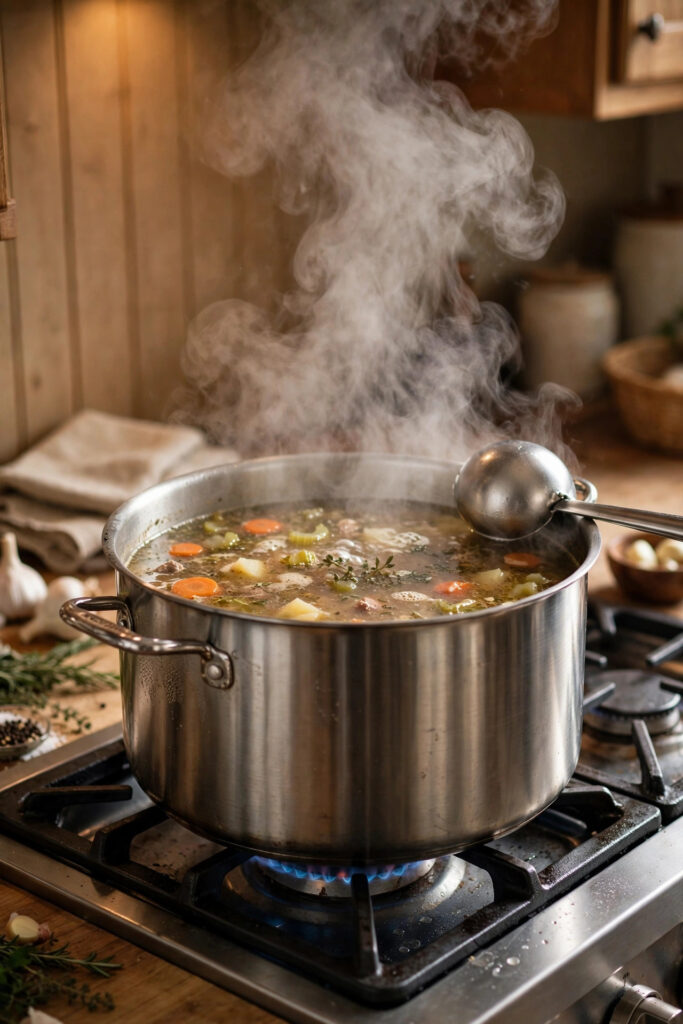
The best stock pot for soup is the one that simmers for hours without scorching, holds a whole chicken or a big batch of chili, and is still light enough to lift when it’s full. A good pot spreads heat evenly across the base and up the sides, so thick soups and tomato-based stocks don’t catch and burn on the bottom while the top stays lukewarm — and its wide opening makes stirring, skimming, and ladling easy.
Eight quarts is the sweet spot for most families: enough for a week’s worth of soup or a big pot of pasta, without taking over the stove. Below, we’ve researched the top-rated stock pots available right now, comparing them for heat distribution, capacity, weight, and durability, so you can pick the right pot for your winter soup season.
Our Top Picks
Cuisinart Chef’s Classic Stainless Steel Stockpot, 8-Quart
The Cuisinart Chef’s Classic Stainless Steel Stockpot is our best overall pick. Its aluminum-encapsulated base heats quickly and evenly, cutting down the hot spots that scorch long-simmering soups and tomato-based stocks, and the 8-quart size is big enough for a whole chicken, a large batch of chili, or a pound of pasta without being unwieldy. Reviewers consistently call it the reference pot for family-size soup batches, and the non-reactive stainless interior is safe for acidic ingredients like tomatoes, wine, and lemon.
Pros:
- Aluminum-encapsulated base heats quickly and evenly, reducing hot spots that scorch soups
- Non-reactive stainless interior is safe for acidic ingredients with no metallic taste
- Cool-grip riveted handles stay comfortable when the pot is full, with measurement markings inside
- Dishwasher-safe and oven-safe, with a long-established brand behind it
Cons:
- Disc-bottom construction, so heat doesn’t travel as evenly up the sidewalls as tri-ply pots
- 8 quarts can feel small for very large families or party-size batches
- Stainless surface shows water spots and heat tint over time
- Solid stainless lid means you can’t see the simmer without lifting it
All-Clad D3 Stainless Steel Stockpot with Lid, 8-Quart
The All-Clad D3 Stainless Steel Stockpot is our best premium pick. Its tri-ply bonded construction — an aluminum core sandwiched between two layers of 18/10 stainless steel, fully clad up the sides — spreads heat evenly across the base and walls, virtually eliminating the base hot spots that scorch thick soups during long, low simmers. It’s oven and broiler safe to 600°F, the most versatile temperature rating in this roundup, and reviewers rate it the premium benchmark for soups and stocks.
Pros:
- Fully clad tri-ply construction spreads heat evenly across base and walls, virtually eliminating scorching
- 18/10 stainless interior is non-reactive, so acidic soups and stocks cook cleanly
- Oven and broiler safe to 600°F — the most versatile rating here
- Riveted handles stay firm for years, and the snug lid retains steam well
Cons:
- Premium price — several times the cost of the Cuisinart or Amazon Basics equivalents
- No pouring lip, so pouring stock can drip down the side
- Food sticks if you skip the preheat step — there is a real learning curve for stainless cooking
- Heat tint and rainbow staining can appear with high heat
Tramontina Signature Tri-Ply Clad Stainless Steel Stock Pot, 8-Quart
The Tramontina Signature Tri-Ply Clad Stainless Steel Stock Pot is our best mid-range tri-ply pick. It uses the same fully clad construction philosophy as the All-Clad — stainless, aluminum, stainless — at a mid-range price, and it repeatedly tops 2026 best-stockpot lists as the value alternative to premium brands. The 8-quart capacity is sized for family soups, stocks, and pasta, and it works on all cooktops including induction.
Pros:
- Genuine tri-ply clad construction gives even heating with fewer hot spots, close to premium performance
- Works on all cooktops including induction; oven-safe to 500°F and dishwasher-safe
- Lifetime warranty and NSF certification add confidence for a mid-priced pot
- Relatively light for its size, making it easier to handle when full than heavier clad rivals
Cons:
- Smaller review base than Cuisinart or All-Clad, so long-term durability data is thinner
- Polished stainless finish shows fingerprints and water spots
- Still feels heavy once filled with 8 quarts of soup
- No glass lid option, so checking a simmer means lifting the lid and losing heat
Amazon Basics Stainless Steel Stock Pot with Glass Lid, 8-Quart
The Amazon Basics Stainless Steel Stock Pot is our best budget pick. It’s the best-selling budget option in multiple 2026 roundups: a heavy-gauge stainless 8-quart pot with an aluminum-encapsulated base and a tempered-glass lid with a steam vent. Reviewers call it proof that you don’t need to spend a fortune for a reliable everyday soup pot, and the glass lid lets you watch the simmer without lifting it.
Pros:
- Very affordable for an induction-compatible stainless pot — the lowest-risk entry point for a first stockpot
- Tempered-glass lid lets you watch the simmer without lifting it, and the steam vent helps control boil-overs
- Aluminum-encapsulated base heats quickly and evenly for everyday soups, stews, and pasta
- Oven-safe to 500°F without the lid and dishwasher-safe for easy cleanup
Cons:
- Only a 1-year limited warranty, versus lifetime coverage on the Tramontina and All-Clad
- The glass lid doesn’t seal as tightly as a steel lid, so it retains moisture less well on long reductions
- 8 quarts may feel small for big holiday batches or canning
- Thinner-feeling build than premium pots; reviewers note it doesn’t feel as substantial long-term
Le Creuset Signature Enameled Cast Iron Round Dutch Oven, 5.5-Quart
The Le Creuset Signature Enameled Cast Iron Round Dutch Oven is our best enameled pick for slow-simmered soups. Cast iron with a glass enamel coating delivers outstanding heat retention for slow, even simmers, and the light sand-colored interior lets you see browning clearly. It goes from stovetop to oven to table, needs no seasoning, and the enamel won’t react with acidic ingredients. At 5.5 quarts it’s smaller than the stainless pots here, so it suits family dinners rather than huge batch cooking.
Pros:
- Superb, even heat distribution and retention — ideal for slow-simmered soups, stews, and braises with no hot spots
- No seasoning required, and the enamel interior won’t react with acidic ingredients
- Tight-fitting lid locks in moisture, and the wide loop handles fit a hand in a thick oven mitt
- Heirloom durability backed by a lifetime limited warranty, with strong resale value
Cons:
- Very heavy — unwieldy to lift and wash once filled, especially for smaller or older cooks
- Premium price; only makes financial sense if you cook with it weekly
- Enamel can chip if dropped or overheated empty, and the light interior can stain over time
- 5.5 quarts is smaller than the 8-quart stainless pots; hand-washing is recommended
T-fal Specialty Nonstick Stockpot, 12-Quart
The T-fal Specialty Nonstick Stockpot is our best large-batch pick. Its 12-quart hard-anodized aluminum body is the draw: it handles family-sized soups, chili, and pasta water for a crowd, and food releases easily with minimal oil. It’s noticeably lighter than stainless or cast iron at the same size, and it’s an affordable way to get a genuinely large pot.
Pros:
- 12-quart capacity is ideal for big-batch soup-making, meal prep, and feeding a crowd
- Nonstick interior means soups and stews release easily and cleanup is fast, with less oil needed
- Strong aluminum construction conducts heat well and is lighter than stainless or cast iron
- Affordable for its size — a budget-friendly way to get a genuinely large pot
Cons:
- Nonstick coating wears over time and is not as durable as stainless; metal utensils and high heat shorten its life
- Not suitable for the high-heat searing you’d do in a stainless pot before adding liquid
- The large size makes it bulky to store and heavy to handle when full
- Not induction-compatible, so it won’t work on induction cooktops
Misen 8-Quart Stockpot
The Misen 8-Quart Stockpot is our most versatile pick. Its fully clad 5-ply construction heats exceptionally evenly and resists warping, with heat travelling up the sidewalls, and reviewers say its performance competes with brands costing two to three times as much. The wide, shorter profile makes it easier to stir, scrape the bottom, and ladle out soup than taller, narrower pots, and the 8-quart size is the sweet spot for families of 2–4.
Pros:
- Fully clad 5-ply construction heats exceptionally evenly and resists warping
- Wide, shorter profile makes it easier to stir, scrape the bottom, and ladle out soup
- Works on all cooktops including induction, and is dishwasher-safe
- Strong reviewer ratings for the price, well below All-Clad for comparable clad performance
Cons:
- Heavier than basic disc-bottom pots — the 5-ply build adds noticeable weight when lifting a full pot
- Premium-mid price is still a step up from budget picks like Amazon Basics or T-fal
- Smaller brand with a shorter track record, so long-term warranty and service history is less proven
- Stainless interior needs the same preheat technique as other stainless pots or food will stick
Buying Guide
Size — 8 quarts is the sweet spot: For most families, an 8-quart pot holds a whole chicken for stock, a double batch of soup, or a pound of pasta with room to spare. Go smaller (5–6 quarts) if you mostly cook for two or want a pot that doubles as a Dutch oven, and go bigger (12 quarts) only if you batch-cook or can. A pot that’s too big for your burner wastes heat and is miserable to lift when full.
Clad vs. disc-bottom — where the heat goes: Fully clad pots (All-Clad, Tramontina, Misen) bond aluminum up the sidewalls, so heat spreads evenly and thick soups don’t scorch on the bottom. Disc-bottom pots (Cuisinart, Amazon Basics) have an aluminum disc only on the base — they heat fast and cost far less, and they’re fine for most soups, but very thick or tomato-based stocks can catch if you don’t stir. If you simmer for hours, clad is worth the upgrade.
Material — stainless, enameled cast iron, or nonstick: Stainless steel is the workhorse — non-reactive, dishwasher-safe, and nearly indestructible, but it needs a preheat and a little oil or food will stick. Enameled cast iron (Le Creuset) holds heat beautifully for slow simmers and goes from stove to table, but it’s heavy and pricey. Nonstick (T-fal) is the easiest to clean and the lightest, but the coating wears out and can’t take high-heat searing.
Lid — glass or steel: A glass lid lets you watch the simmer without lifting it and losing heat, which is genuinely useful for soups. A solid steel lid seals tighter, retains moisture better on long reductions, and is oven-safe at higher temperatures. Neither is wrong — pick glass if you like to peek, steel if you reduce stocks for hours.
Weight and handles — the full-pot test: A stockpot is at its heaviest exactly when you need to move it. Before buying, check the weight and the handles: wide, riveted loop handles that fit a hand in an oven mitt are far easier to grip than small side tabs, and a wide, shorter pot is easier to lift and ladle from than a tall, narrow one.
FAQs
What size stock pot is best for soup? Eight quarts is the best all-around size for soup — it holds a whole chicken for stock, a double batch of soup, or a pound of pasta, with room for stirring. Smaller households can get by with 6 quarts, while batch cooks and canners should look at 12 quarts.
Is a stock pot the same as a Dutch oven? No, though they overlap. A stockpot is tall and narrow with a large capacity, built for liquids — stocks, soups, and pasta water. A Dutch oven is shorter and wider with heavy cast-iron walls, built for slow braising and baking. A Dutch oven works well for soup too, but it holds less and weighs much more.
Does a stock pot need to be fully clad? Not necessarily. Fully clad pots heat more evenly up the sides and are the best choice if you simmer thick or tomato-based soups for hours. But a good disc-bottom pot like the Cuisinart heats quickly and evenly enough for everyday soups at a fraction of the price — just stir occasionally and keep the heat moderate.
Can I use a stock pot on an induction cooktop? Only if it’s induction-compatible. Stainless steel pots with a magnetic base (Cuisinart, All-Clad, Tramontina, Amazon Basics, Misen) work on induction, but aluminum nonstick pots like the T-fal don’t. Check the product specs for “induction compatible” before buying.
Why does my soup scorch on the bottom of my stock pot? The usual causes are heat that’s too high, a thin-bottomed pot, or not stirring. Bring soup to a simmer over medium heat, then drop it to low and stir the bottom every 20–30 minutes. A clad pot with even heat distribution helps a lot, as does starting with a little oil or liquid in the pot before adding thick ingredients.
How do I clean a stainless steel stock pot? Let it cool, then wash with warm, soapy water and a non-abrasive sponge. For stuck-on bits, simmer water with a spoonful of baking soda for 10 minutes and scrape gently. Bar Keeper’s Friend removes heat tint and water spots; avoid steel wool, which scratches the finish.
