
Affiliate Disclosure: As an Amazon Associate I earn from qualifying purchases.
n
The best silicone spatulas for 2026 are made from food-grade, BPA-free silicone rated to at least 450°F (higher is better for stovetop work), with a sturdy core that won’t flex too much, a seamless one-piece design that’s easy to clean, and a head shape matched to the job. A good spatula costs $8–$15; a quality set of three to five runs $20–$35.
Silicone spatulas have quietly become the most-used utensil in many kitchens — they scrape bowls cleaner than any spoon, survive dishwasher cycles, won’t scratch any cookware, and handle both delicate egg work and stiff bread dough. But the market is flooded with floppy, chemical-smelling impostors. This research-based guide shows you how to spot quality silicone, which head shapes you need, and our top picks by use case.
What Separates Good Silicone from Bad
Food-grade silicone, verified
Look for “food-grade silicone,” “FDA-compliant,” or European LFGB certification on the packaging. Quality silicone is odorless — if a spatula smells strongly of chemicals out of the package, that’s a red flag for fillers. A common home check: twist or pinch the flat part of the head; if it turns white under stress, it likely contains fillers. Pure silicone keeps its color.
Heat rating
For baking and bowl-scraping, 450°F is plenty. For stovetop sautéing and candy-making, look for 500–600°F ratings — cheap spatulas rated to only 400°F can soften or deform when left resting in a hot pan. Note that heat ratings apply to the silicone head; if the handle is a different material, check its rating too.
Core construction
The best spatulas have a rigid internal core (often nylon or stainless) running through the handle into the head. Coreless all-silicone spatulas are wonderfully flexible for bowl-scraping but too floppy for heavy batters; conversely, an over-stiff spatula can’t squeegee a bowl clean. Match the flex to the job.
One-piece vs. two-piece
One-piece seamless spatulas have no crevice where the head meets the handle — nothing traps food, and they go straight in the dishwasher. Two-piece designs with removable heads allow thorough cleaning and handle replacement, but the joint can harbor gunk if not disassembled regularly. For most cooks, one-piece wins on hygiene.
The 5 Head Shapes Worth Owning
- Classic scraper/spatula: the rectangular-ish flexible head for folding batters, scraping bowls, and spreading frosting. The single most useful shape.
- Spoonula (spoon-spatula): a spoon-shaped head with flexible edges — scoops like a spoon, scrapes like a spatula. Ideal for sauces, jams, and serving.
- Slotted turner: for flipping eggs, pancakes, and fish; slots drain oil and liquids.
- Small jar spatula: long, narrow head for getting the last of the peanut butter, mayo, or jam out of deep jars.
- High-heat sauté spatula: a stiffer, heat-rated head (600°F) shaped for stirring and turning in hot pans.
Top Picks: Best Silicone Spatulas 2026
These picks are based on material specs, construction quality, and consistent long-term user feedback — the designs that keep earning praise year after year. We focus on verifiable quality markers rather than claiming exhaustive hands-on testing.
Best overall set: 4-piece food-grade silicone set
A set covering the classic scraper, spoonula, slotted turner, and small spatula in 600°F-rated, one-piece food-grade silicone is the best value for most kitchens. silicone spatula set 600F Check Price on Amazon → Prioritize sets where every piece is one-piece construction — some sets mix in two-piece designs that are harder to keep clean.
Best for baking: flexible bowl scrapers
Bakers need maximum flex to leave bowls nearly clean. Look for thin, pliable heads with a curved edge that hugs the bowl — the classic European-style dough scraper shape in silicone. flexible silicone bowl scraper Check Price on Amazon → A two-pack (one large, one small) covers mixing bowls and measuring cups alike.
Best for high-heat cooking: 600°F sauté spatula
For stovetop work — scrambling eggs, stirring risotto, flipping in cast iron — you want a stiffer head rated to 600°F that won’t soften when it kisses a hot pan edge. high heat silicone turner 600F Check Price on Amazon → Check that the rating covers the entire utensil, not just the head, if you’ll rest it on pan rims.
Best jar spatula: long narrow silicone spatula
The humble jar spatula pays for itself by rescuing the last tablespoon from every jar — over a year, that’s real money in nut butters and condiments. long silicone jar spatula Check Price on Amazon → Look for a head narrow enough for standard jars with enough length to reach the bottom.
Best budget: 5-piece value set
Decent food-grade silicone sets exist under $20 — the key checks are the pinch test (no whitening), a stated heat rating of at least 450°F, and one-piece construction. silicone cooking utensils set Check Price on Amazon → Avoid sets where the “silicone” heads are suspiciously rigid plastic-feeling or smell strongly out of the package.
Silicone vs. Other Utensil Materials
| Material | Max practical heat | Dishwasher | Best for |
|---|---|---|---|
| Silicone | 450–600°F | Yes | Scraping, folding, eggs, nonstick |
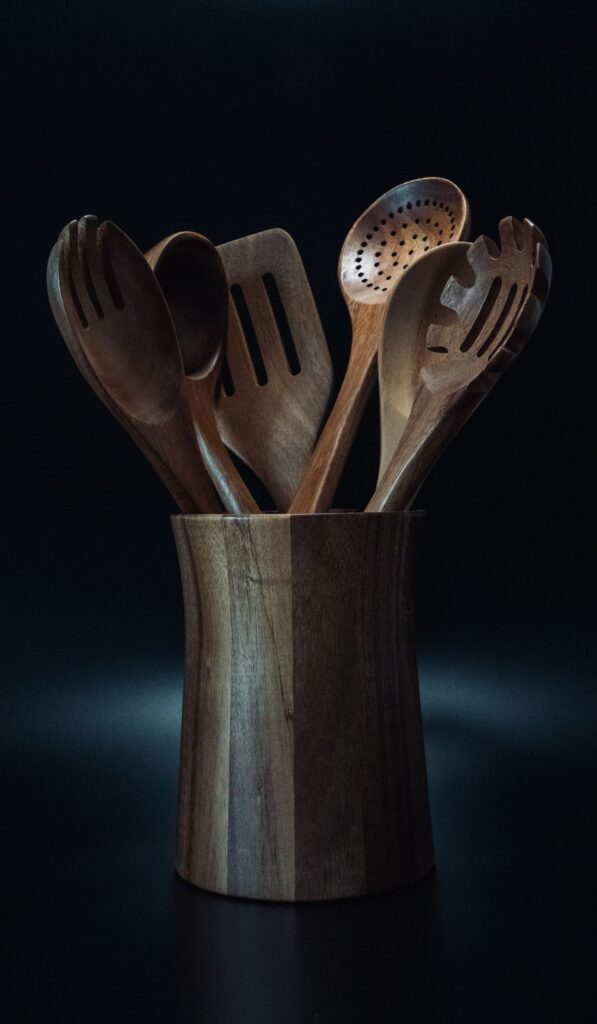
| Wood | High (doesn’t melt) | No — hand wash | High-heat stirring, rustic feel |
| Nylon | ~400°F | Yes | Budget nonstick-safe option |
| Stainless steel | Unlimited | Yes | Heavy-duty, but scratches coatings |
Silicone’s killer combination is heat resistance plus dishwasher safety plus zero scratch risk — no other material hits all three. Wood still wins for the sheer pleasure of stirring a risotto and for the highest-heat searing work; our wooden vs. silicone comparison breaks down when to reach for each.
Care and Longevity
- Dishwasher safe, but top rack is gentler — prolonged high heat can fade colors over years (cosmetic only).
- Remove odors: silicone can absorb garlic and turmeric smells. Soak in a baking soda solution, or bake the clean spatula at 250°F for 20 minutes — heat drives off absorbed volatile compounds.
- Remove stains: turmeric and tomato stains are cosmetic; a baking soda paste or hydrogen peroxide soak lightens them.
- Don’t cut on them — knives slice silicone, and the cuts then trap food.
- Retire when: the head tears, the core pokes through, pieces become permanently sticky/tacky (a sign of degradation), or two-piece joints no longer fit snugly.
Are Silicone Spatulas Safe?
Food-grade silicone is considered safe for cooking by the FDA and European food-safety authorities. It doesn’t contain BPA, phthalates, or lead, and it’s stable at normal cooking temperatures — it doesn’t melt or off-gas like nylon can at high heat. The caveats are quality-related, not material-related: buy certified food-grade silicone from reputable brands, respect the stated heat rating, and discard pieces that degrade. Cheap silicone with heavy fillers is where the (limited) concerns concentrate, which is why the pinch test and odor check matter.
How to Test Silicone Quality Before You Buy
Whether shopping in-store or evaluating a new purchase at home, these checks separate genuine food-grade silicone from filler-loaded imitations. The pinch test: pinch and twist the flat part of the head firmly — pure silicone keeps its color, while filler-heavy silicone turns white or pale where stressed. The smell test: quality silicone is odorless; a strong chemical or plastic smell out of the package is a red flag.
The flex test: bend the head — it should flex smoothly and spring back instantly with no cracking or permanent deformation. The label test: look for explicit “food-grade silicone,” “FDA compliant,” or “LFGB certified” markings plus a stated heat rating. Vague “silicone-like” or missing heat ratings suggest the maker has something to hide. The price test: a 5-piece “silicone” set for $8 is not food-grade silicone — material costs make that impossible. These five checks take a minute and prevent years of cooking with questionable tools.
Sets vs. Individual Spatulas
A 4–5 piece set ($20–$35) is the economical starting point, covering the scraper, spoonula, turner, and small spatula most kitchens need. The risk: some sets mix quality levels, with excellent scrapers bundled alongside flimsy turners. Check reviews for consistency across pieces, not just the star rating.
Buying individually ($8–$15 per piece) lets you get the best-in-class for each shape — the perfect flexible scraper from one maker, the ideal stiff turner from another. Serious bakers often end up here, since bowl-scraping demands a specific flex that generic sets rarely nail. The pragmatic path: start with a well-reviewed set, then upgrade individual pieces as you discover which shapes you reach for daily.
Beyond Spatulas: Other Silicone Tools Worth Owning
Once you trust the material, silicone’s advantages extend across the kitchen. Silicone baking mats (silicone baking mat set Check Price on Amazon →) replace parchment paper for most baking — nonstick, reusable thousands of times, and excellent for sticky doughs. Silicone lids and stretch covers replace disposable plastic wrap for bowls and half-cut produce.
Silicone oven mitts offer better grip on hot pans than cloth and rinse clean, though they conduct more heat over long holds — use them for quick grabs, not carrying a roast across the kitchen. Silicone muffin pans release baked goods beautifully but need a rigid baking sheet underneath for support. Each of these earns its place the same way spatulas did: the material’s heat resistance, nonstick nature, and easy cleaning solving a real annoyance.
Silicone Spatula Buying Checklist
Run through this list before any purchase and you’ll never buy a bad spatula again:
- ☐ Labeled food-grade silicone (FDA compliant or LFGB certified)
- ☐ Stated heat rating — 450°F minimum, 600°F for stovetop work
- ☐ Passes the pinch test (no whitening when twisted)
- ☐ Odorless out of the package
- ☐ One-piece seamless construction (no head-handle joint to trap food)
- ☐ Flex matched to task — pliable for scraping, stiffer for sautéing
- ☐ Comfortable handle with a hanging hole or rest notch
Keep this checklist on your phone for in-store shopping — it takes 60 seconds to run through and filters out the filler-loaded disappointments that dominate discount racks.
Frequently Asked Questions
What temperature can silicone spatulas withstand?
Quality silicone spatulas are typically rated from 450°F to 600°F. For baking and bowl work, 450°F is sufficient; for stovetop sautéing, choose 500°F or higher so the head doesn’t soften when it contacts hot pan edges. Always check whether the rating covers the whole utensil or just the head.
Are silicone spatulas better than wooden spoons?
They’re better at different jobs. Silicone wins for scraping bowls, folding delicate batters, dishwasher convenience, and guaranteed nonstick safety. Wood wins for high-heat stovetop stirring, rigidity with heavy doughs, and tactile feel. Most well-equipped kitchens keep both — see our wooden vs. silicone comparison for the full breakdown.
How do I get the smell out of silicone spatulas?
Soak in warm water with baking soda for an hour, or place the clean, dry spatula in a 250°F oven for 20 minutes — the heat drives absorbed odor compounds out of the silicone matrix. For prevention, wash promptly after cooking with pungent ingredients like garlic, curry, or tomato.
Why did my silicone spatula turn white?
Two causes: filler-heavy low-quality silicone whitens when pinched or twisted (a quality red flag), while quality silicone can develop a white mineral film from hard water or dishwasher detergent. The film wipes off with vinegar; filler whitening is permanent and means the spatula wasn’t pure silicone to begin with.
Can silicone spatulas melt?
Quality silicone doesn’t melt at cooking temperatures — it’s rated well above what stovetops and ovens produce in normal use. What can happen with cheap or misused spatulas: softening and deformation above their rated temperature, or scorching if left in direct contact with a burner or broiler element. Respect the rating and keep them out of direct flame.
How long do silicone spatulas last?
Quality silicone spatulas typically last 3–5 years of regular use, sometimes longer. Replace them when heads tear, the internal core becomes exposed, surfaces turn permanently tacky, or two-piece joints loosen. Discoloration and staining alone aren’t reasons to replace — they’re cosmetic.
What’s the difference between a spatula and a spoonula?
A classic spatula (scraper) has a flatter, rectangular-ish flexible head optimized for folding and scraping bowls. A spoonula has a spoon-shaped bowl with flexible edges — it scoops and serves like a spoon while scraping like a spatula. The spoonula is arguably the more versatile single tool for sauces, batters, and serving.
Are one-piece silicone spatulas better?
For hygiene and convenience, yes — with no joint between head and handle, there’s nowhere for food to hide, and they go straight in the dishwasher. Two-piece designs let you replace heads separately, but require disassembly for thorough cleaning. Most cooks are better served by one-piece construction.
