
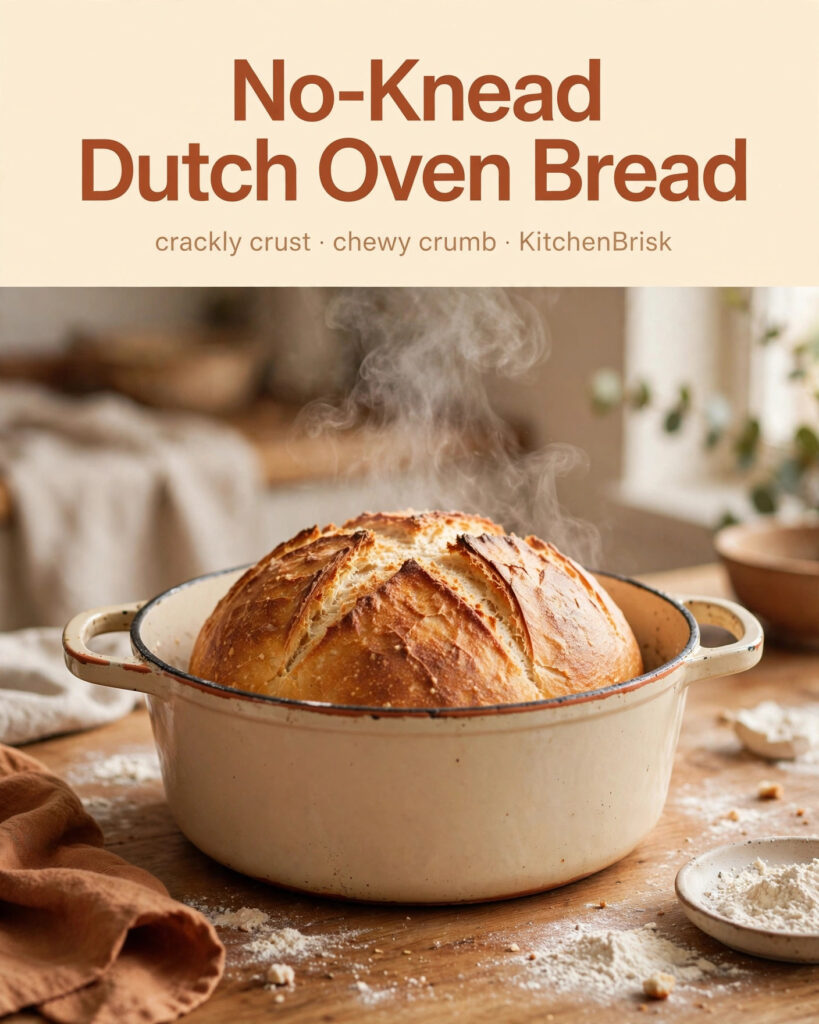
Easy No-Knead Dutch Oven Bread
There are few things more satisfying than pulling a crackling, golden loaf of no-knead dutch oven bread out of the oven and hearing it sing as the crust sets. This recipe is as simple as bread baking gets: four ingredients, no kneading, no stand mixer, no shaping skills required. You stir a shaggy dough together in five minutes, let time do the work overnight, and bake it in a ripping-hot Dutch oven for a loaf with a shattering crust and an open, chewy crumb that rivals any bakery.
The Dutch oven is the real hero here. Baking the loaf with the lid on traps steam escaping from the dough, which is exactly what professional bread ovens do — it lets the crust expand fully before it sets, giving you that dramatic oven spring and deep golden colour. Then you uncover the pot for the final stretch so the crust dries out and crackles. It is a genuinely foolproof method, and a perfect first loaf if you have never baked bread before.
What You’ll Need
A 5- to 6-quart Dutch oven with an oven-safe lid is what makes this recipe work — it goes into a 450°F oven empty, holds the heat, and traps the steam that builds the crust. If you don’t have one yet, see our guide to the best dutch ovens to pick the right one. A great, affordable choice is the Lodge 6-quart enameled Dutch oven, or the classic Lodge 5-quart pre-seasoned cast iron Dutch oven — both handle the high bake temperature with ease.
- 5- to 6-quart Dutch oven with an oven-safe lid
- Large mixing bowl and wooden spoon (or Danish dough whisk)
- Parchment paper (for the sling)
- Wire cooling rack
Ingredients
Serves 1 loaf, about 10 slices · Prep: 10 min (plus 12–18h rise) · Cook: 45 min · Total: about 19h
- 3 cups (375g) plain all-purpose flour (or bread flour), plus extra for dusting
- 1¾ tsp (10g) fine sea salt (or kosher salt)
- ½ tsp (2g) instant yeast (also called quick-rise or rapid-rise yeast)
- 1½ cups (360ml) lukewarm water
Instructions
1. Mix the dough. In a large bowl, whisk together the flour, salt, and instant yeast. Pour in the lukewarm water and stir with a wooden spoon until a shaggy, sticky dough forms and no dry flour remains. It will look rough and uneven — that is exactly right. No kneading needed. 2. Rise overnight. Cover the bowl with cling film or a damp tea towel and leave at room temperature for 12–18 hours. The dough is ready when it has more than doubled, the surface is dotted with bubbles, and it smells pleasantly tangy. (In a hurry? Put the covered bowl in a warm spot — around 75°F / 24°C — and it will be ready in about 4–5 hours.) 3. Shape loosely. Generously flour your worktop. Scrape the dough out — it will be loose and sticky — and, with floured hands, fold the edges into the centre a few times to form a rough ball. Place it seam-side down on a sheet of parchment paper. Rest 30 minutes while the oven heats. 4. Preheat the oven and the Dutch oven. Set the oven to 450°F (230°C) and place the empty Dutch oven with its lid inside. Let it heat for a full 30–45 minutes — the pot needs to be thoroughly screaming hot. Do not skip this step. 5. Bake covered. Using the parchment as a sling, lower the dough into the hot Dutch oven. Cover with the lid and bake for 30 minutes. Do not peek — the trapped steam is doing the work. 6. Bake uncovered. Remove the lid. The loaf will be pale and puffed. Bake 15–20 minutes more, until deeply golden and crackling, with a richly browned crust. It should sound hollow when tapped on the base. 7. Cool before slicing. Lift the loaf out by the parchment onto a wire rack and cool for at least 1 hour. Cutting too early releases the steam still inside and leaves the crumb gummy — patience is rewarded.
Tips for the Best No-Knead Dutch Oven Bread
- Use a parchment sling. Lowering raw dough into a 450°F cast iron pot with your bare hands is a burn waiting to happen. The parchment lets you drop the loaf in neatly and lift it out cleanly afterwards — no sticking, no scorched fingers.
- Steam is the crust secret. The lid-on bake traps steam around the loaf, which keeps the crust soft long enough for full oven spring, then the uncovered finish drives off the moisture for that shattering crust. Lifting the lid early to peek lets the steam escape and shortens the rise — leave it alone for the full 30 minutes.
- Don’t skip the preheat. A thoroughly heated Dutch oven hits the dough with instant, intense heat, which is what gives you the dramatic rise and the crisp, well-browned base. A 10-minute preheat is not enough — give it the full 30–45 minutes.
Variations
- Seeded loaf: fold ¼ cup of sunflower seeds, pumpkin seeds, or a mix into the dough when you shape it, and sprinkle more on top before baking.
- Garlic and rosemary: stir 1 tablespoon of chopped fresh rosemary and 2 minced garlic cloves into the flour before adding the water.
- Cheddar and jalapeño: fold 1 cup of shredded sharp cheddar and 1 finely diced jalapeño (seeds removed for less heat) into the dough at shaping time.
- Wholemeal version: swap 1 cup of the all-purpose flour for wholemeal flour, and add an extra 2 tablespoons of water — whole grains drink more liquid.
FAQs
Can I use active dry yeast instead of instant yeast? Yes. Dissolve it in the lukewarm water with a pinch of sugar first and let it sit for 5–10 minutes until foamy, then mix it into the flour as usual. The rise time stays the same.
Why is my dough so sticky? High-hydration dough is the whole point of this method — the wet dough is what produces the open, airy crumb. Resist the urge to add more flour during mixing; wet hands and a floured worktop at shaping time are all you need.
Can I bake it without a Dutch oven? A Dutch oven is strongly recommended for this recipe — the trapped steam is what makes it work. In a pinch, bake on a preheated baking tray with an oven-safe pot or a large metal bowl inverted over the loaf for the first 30 minutes to mimic the steam chamber.
How do I store the bread? Keep it cut-side down on a board or in a paper bag at room temperature for up to 3 days — never the fridge, which stales bread faster. For longer storage, slice the cooled loaf, wrap tightly, and freeze for up to 3 months; toast slices straight from frozen.
More from the Dutch oven: Serve warm slices alongside our dutch oven beef stew or dutch oven mac and cheese — and if you are new to the pot itself, our best dutch ovens guide will help you pick the right one.
