
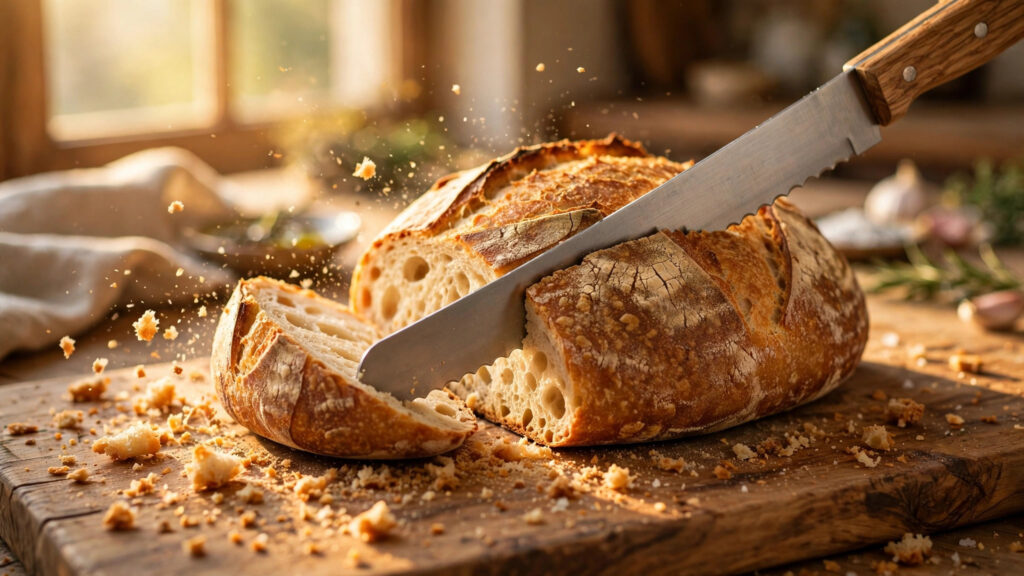
Slicing a beautiful sourdough loaf with the wrong knife is heartbreaking: the crust shatters, the crumb compresses, and the slice looks like an accident. The fix is a long serrated bread knife — one that saws through a hard crust with a light touch instead of mashing the soft interior. These five serrated knives are the ones bakers and reviewers keep coming back to for crusty sourdough.
Why a serrated edge matters for sourdough: a plain edge presses down and crushes the airy crumb before it cuts. Serrated teeth grip the hard crust and saw through it with minimal downward force, leaving the open crumb intact and producing clean, even slices.
1. Victorinox Fibrox Pro 10.25-Inch Bread Knife
Best overall for sourdough
The Victorinox 10.25-inch serrated bread knife is the default recommendation of professional bakeries and culinary schools for a reason. Its long blade crosses even a wide boule in a single stroke, the wavy serrations grip crusty exteriors without shredding, and the textured Fibrox handle stays secure even with floury hands. It’s light, balanced, and costs a fraction of premium German knives.
Pros:
- 10.25-inch blade slices wide boules and batards in single strokes
- Wavy serrations cut crusts cleanly without excessive crumbs
- Non-slip Fibrox handle stays secure with wet or floury hands
- Holds an edge well for the price; dishwasher safe
- Lifetime warranty against defects
Cons:
- Utilitarian look — no one buys it for beauty
- The long blade can feel unwieldy on small cutting boards
- Not an offset design, so knuckles ride closer to the board on very thick loaves
2. Mercer Culinary Millennia 10-Inch Wide Wavy Edge Bread Knife
Best budget pick
The Mercer Millennia is the budget bread knife that refuses to perform like one. Its 10-inch wide blade has a wavy edge with pointed teeth that bite eagerly into hard crusts, and the wide blade gives you knuckle clearance when slicing through thick loaves. The textured Santoprene handle is non-slip and comfortable for long slicing sessions.
Pros:
- Excellent cutting performance at a budget price
- Pointed wavy teeth bite into extra-hard crusts eagerly
- Wide blade keeps knuckles clear of the cutting board
- Comfortable non-slip Santoprene handle
Cons:
- Plain, utilitarian appearance
- Handle feels less refined than premium forged knives
- The pointed teeth can snag on softer breads if you use too much pressure
3. Tojiro F-737 Bread Slicer 270mm
Best Japanese pick
Tojiro’s 270mm (10.6-inch) bread slicer is the pick for bakers who love Japanese blade geometry. The long, thin blade glides through sourdough with almost no friction, and the fine serrations produce remarkably clean slices with minimal crumb. It’s noticeably lighter than German bread knives, which suits bakers who prefer a nimble, precise feel.
Pros:
- Long, thin blade cuts with minimal friction and crumb
- Light and nimble in hand — easy on the wrist
- Excellent value for Japanese-made steel
- Fine serrations give clean slices on crusty and soft breads alike
Cons:
- Western-style handle is basic compared to the blade
- Thin blade demands gentle technique — not a beater knife
- Hand wash recommended; the finish spots in dishwashers
4. MAC SB-105 10.5-Inch Superior Bread Knife
Best for precision slicing
MAC’s 10.5-inch Superior bread knife is the precision instrument of this list. MAC grinds its blades thinner than most competitors, so the knife moves through a loaf with very little resistance — slices come off even and thin, which is exactly what you want for sourdough toast. The pakkawood-style handle is comfortable and looks a cut above the plastic-handled budget picks.
Pros:
- Very thin blade grinds through loaves with minimal resistance
- Produces even, thin slices — ideal for sourdough toast
- Comfortable handle with a more premium look
- Holds a sharp edge well
Cons:
- Higher price than the Victorinox and Mercer picks
- Thin blade is less forgiving of rough handling
- Hand washing recommended
5. Wusthof Classic 10-Inch Bread Knife
Best premium pick
The Wusthof Classic bread knife is the traditional forged German choice: full-tang, triple-riveted, and built to last decades. Its serrations are moderately sized so it handles crusty sourdough and soft sandwich bread equally well, and the thin forged blade creates minimal friction as it cuts. Wusthof’s PEtec sharpening process gives it an edge that stays sharp significantly longer than budget blades.
Pros:
- Forged full-tang construction — extremely durable
- Moderately sized serrations handle crusty and soft breads equally well
- Edge holds significantly longer than budget knives
- Classic triple-riveted handle with excellent balance
Cons:
- Premium price — several times the cost of the Victorinox
- Heavier than Japanese and budget picks
- Many bakers will get equivalent results from the cheaper knives above
How to Choose a Bread Knife for Sourdough
Blade length: 9–10.5 inches. A long blade lets you saw through a wide boule in long, smooth strokes instead of sawing back and forth in place. Under 9 inches means multiple passes and ragged slices; 10+ inches is the sweet spot for sourdough.
Serration style matters. Pointed teeth bite aggressively into hard crusts. Rounded or wavy serrations glide more smoothly and tear delicate interiors less. For very hard-crusted sourdough, pointed teeth grab better.
Consider an offset or wide blade. A wide or offset blade gives your knuckles clearance when cutting down through a tall loaf — without it, your knuckles drag on the board on the last strokes.
Weight and balance. Heavier German knives do some of the work for you with gravity; lighter Japanese knives give more control but demand a steady hand.
Handle grip. You’ll be sawing with some pressure on hard crusts, so a textured, non-slip handle matters more here than on most knives. Flour-dusted hands are slippery.
Don’t overspend (probably). The price-performance curve on bread knives is flat: a $40–50 knife cuts sourdough as well as a $150 one in most home kitchens.
Frequently Asked Questions
Why do I need a serrated knife for sourdough? Can’t I use my chef’s knife? A chef’s knife presses down and crushes sourdough’s airy crumb before it cuts through the hard crust. A serrated edge’s teeth grip and saw through the crust with minimal downward force, keeping the crumb open and the slices clean.
What length bread knife is best for sourdough? 10 inches or more is ideal — it crosses a wide boule in a single stroke. Shorter blades force you to saw in place, which produces uneven slices and more crumbs.
How do you sharpen a serrated bread knife? Serrated knives need sharpening far less often than straight edges because the teeth protect the cutting surfaces. When one does dull, use a tapered ceramic sharpening rod in each gullet, or take it to a professional sharpener.
Should I cut sourdough warm or wait for it to cool? Wait. Cutting into a hot loaf releases steam and leaves the crumb gummy. Let sourdough cool for at least an hour (two is better) before slicing for the cleanest cuts and best texture.
