
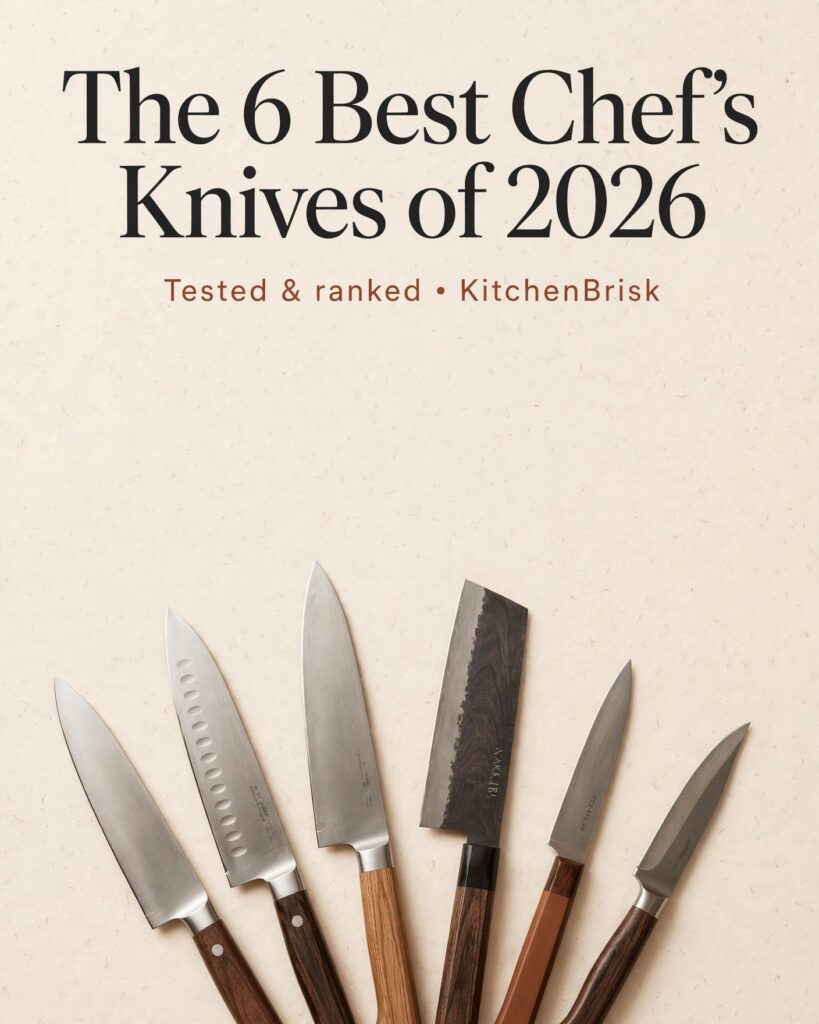
Intro
A chef’s knife is the single most-used tool in most kitchens — it does the slicing, dicing, mincing and chopping for nearly every recipe on this site. The right one feels like an extension of your hand; the wrong one makes prep feel like a chore.
We rounded up the six chef’s knives that appear most consistently across 2026 expert roundups, spanning budget, mid-range and premium tiers, Western and Japanese styles. Every pick below is a real, currently available product from a respected maker.
Our Top Picks at a Glance
| Pick | Knife | Best for |
|---|---|---|
| ⭐ Best Overall | MAC Professional MTH-80 8-Inch | The sweet spot of sharpness, comfort and price |
| 💰 Best Budget | Victorinox Fibrox Pro 8-Inch | Maximum value; the knife most kitchens could stop at |
| 🗾 Best Japanese Value | Tojiro DP F-808 8-Inch | Real VG-10 Japanese steel under a budget price |
| 🪶 Best Lightweight | Global G-2 8-Inch | One-piece nimble design, great for long sessions |
| 🇩🇪 Best German | Wüsthof Classic 8-Inch | Forged workhorse for heavy-duty prep |
| ✨ Best Premium Japanese | Shun Classic 8-Inch | Hardest edge here, stunning Damascus finish |
The Reviews
1. ⭐ MAC Professional MTH-80 8-Inch Chef’s Knife — Best Overall
Wirecutter’s overall best chef’s knife pick, and for good reason: the MTH-80 blends Japanese thinness with a Western-friendly profile. The molybdenum-vanadium steel takes a laser-like edge and cuts with minimal resistance, and the 8-inch blade suits both rocking and push-cutting styles.
Pros
- Exceptionally sharp out of the box; glides through onions and tomatoes
- Hybrid Japanese–German geometry works for many cutting styles
- Comfortable pakkawood handle, well balanced
Cons
- Edge needs regular honing to stay at its best
- Not as tough as a forged German blade for heavy-duty jobs like squash and bone work
Best for: cooks who want one do-everything knife at a fair mid-range price.
2. 💰 Victorinox Fibrox Pro 8-Inch Chef’s Knife — Best Budget
The perennial budget king. America’s Test Kitchen’s budget pick arrives razor sharp, is NSF-certified, and is genuinely dishwasher-safe. It’s the knife most home kitchens could happily stop at.
Pros
- Best value per dollar of any knife on this list
- Grippy Fibrox handle stays secure even with wet hands
- Easy to resharpen; forgiving for beginners
Cons
- Stamped, not forged — lighter and less heirloom-grade long-term
- Plain looks; won’t hold an edge as long as harder steels
Best for: first “real” chef’s knife, students, and shared kitchens.
3. 🗾 Tojiro DP F-808 8-Inch Chef’s Knife — Best Japanese Value
Genuine VG-10 Japanese steel — the same core alloy in knives costing three times more — with a Western gyuto profile. An affordable entry into Japanese knives.
Pros
- Remarkably sharp out of the box
- Thin blade that falls through vegetables
- Teaches you Japanese-knife technique cheaply
Cons
- Harder, thinner blade can chip if abused — no twisting or frozen food
- Fit and finish is rougher than pricier Japanese brands; needs whetstone sharpening, not a pull-through
Best for: cooks curious about Japanese knives without the premium price.
4. 🪶 Global G-2 8-Inch Chef’s Knife — Best Lightweight
Forged from a single piece of CROMOVA 18 stainless steel — no seams, no rivets. At roughly 5.5 oz it’s one of the lightest full-size chef’s knives here, with a “Goldilocks” balance reviewers keep reaching for.
Pros
- Lightweight and nimble; kind to wrists in long prep sessions
- Remarkably sharp; lifetime warranty
- Seamless one-piece construction is hygienic and easy to clean
Cons
- Smooth steel handle can feel slippery when wet
- Thin blade flexes on hard vegetables; modern look isn’t for traditionalists
Best for: smaller hands, long cooking sessions, and cooks who like a modern feel.
5. 🇩🇪 Wüsthof Classic 8-Inch Chef’s Knife — Best German
The 200-year-old reference standard for German forged knives: full tang, full bolster, ~58 HRC high-carbon stainless. A buy-it-for-life workhorse that powers through dense veg and heavy prep without flinching.
Pros
- Forged durability; forgiving to sharpen with a home honing rod
- Inspires confidence through the toughest ingredients
- Classic triple-riveted handle that suits a traditional grip
Cons
- Hefty weight can cause forearm fatigue in marathon sessions
- Edge retention trails harder Japanese steels; premium price
Best for: cooks who want one tank-like knife that lasts decades.
6. ✨ Shun Classic 8-Inch Chef’s Knife — Best Premium Japanese
VG-MAX core with 34-layer Damascus cladding at ~61 HRC — the hardest edge on this list. Hand-finished, beautiful, and Shun offers a free lifetime sharpening service.
Pros
- Sharpest, longest-holding edge here
- Superb fit and finish; a genuine showpiece
- Free lifetime sharpening from Shun
Cons
- D-shaped handle is biased toward right-handers
- Hard steel can chip and is harder to resharpen; hand-wash only — risky for a shared, dishwasher-going kitchen
Best for: knife enthusiasts willing to hand-wash and whetstone-sharpen.
Buying Guide: How to Choose a Chef’s Knife
Blade length. 8 inches is the sweet spot for most home cooks — versatile without feeling unwieldy. Go 6 inches only if you have very small hands or limited space.
Steel type. German-style forged knives (~56–58 HRC) are tougher and easier to maintain with a honing rod. Japanese-style blades (~60–61 HRC) stay sharper longer but can chip and need whetstone sharpening. Decide which trade-off fits your habits.
Stamped vs forged. Forged knives are heavier, sturdier and usually better balanced. Stamped knives are lighter, thinner and cheaper — the Victorinox proves stamped can be excellent.
Handle and grip. Pinch grip the blade between thumb and forefinger; if the handle digs into your palm or the knife feels tip-heavy, keep looking. D-shaped handles (like the Shun) favour right-handers.
Maintenance. Budget for a honing rod regardless of which knife you buy, and a whetstone if you go Japanese. A dull premium knife cuts worse than a sharp budget one.
Care. Hand-wash and dry immediately, store in a block or on a magnetic strip, and never use the blade to scrape food across the board — flip it and use the spine.
FAQs
What is the best chef’s knife for beginners?
The Victorinox Fibrox Pro 8-Inch. It’s sharp, forgiving, dishwasher-safe and costs a fraction of premium knives — the safe first “real” knife.
Are Japanese or German chef’s knives better?
Neither is objectively better. Japanese knives stay sharper longer but are more delicate; German knives are tougher and easier to maintain. Match the knife to how you’ll treat it.
How often should I sharpen my chef’s knife?
Hone with a rod every few uses; sharpen (whetstone or professional service) every 6–12 months depending on use.
Can I put my chef’s knife in the dishwasher?
Only the Victorinox on this list is genuinely dishwasher-safe. Hand-washing extends the edge and handle life of every knife here.
What size chef’s knife should I buy?
8 inches suits most adults. If you’re petite or mostly do small prep, a 6-inch chef’s knife is more controllable.
Keep it sharp: Put your knife skills to work with plenty of chopping practice in our Dutch Oven Beef Stew recipe.
