Intro
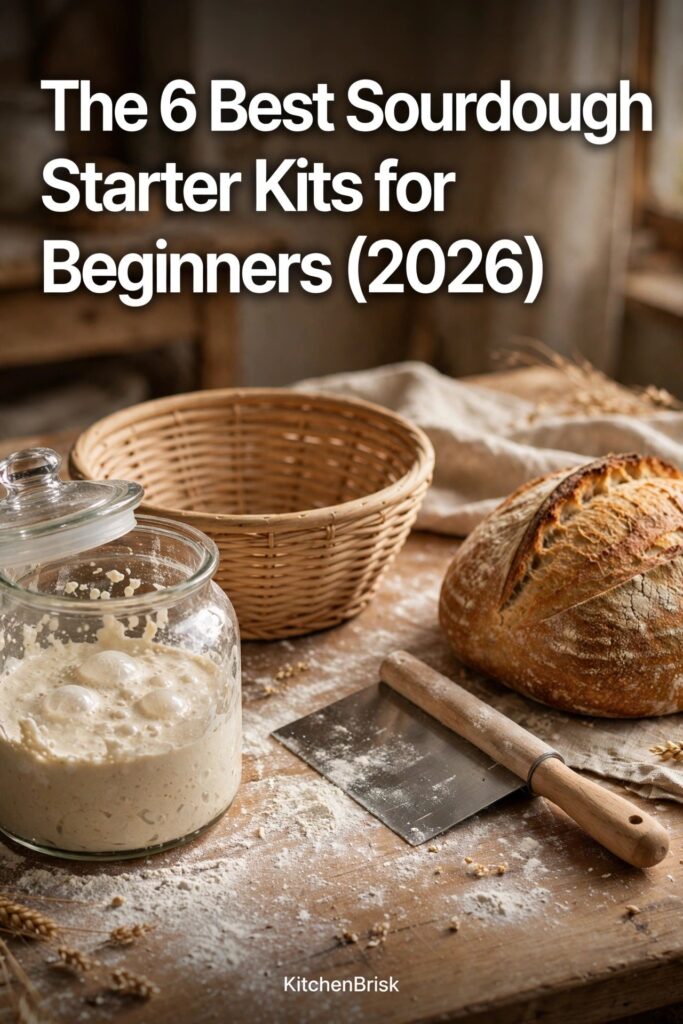
The best sourdough starter kits for beginners solve the two problems that stop most first loaves before they start: getting a living culture going, and having the right tools to feed, shape, and bake with it. A starter is a live culture of wild yeast and friendly bacteria that you keep alive with regular feedings of flour and water — and once it is active, it can leaven bread for years. The kit is supposed to make that first month easy. The catch is that most kits sold as “sourdough starter kits” are tool bundles, not cultures: a jar, a rattan banneton, a scraper, a cloth liner, and a scoring lame, with no living yeast anywhere in the box.
That distinction is the buying question here, and it matters more than any single tool. A kit that includes a live or dehydrated culture — Breadtopia, Cultures for Health, or King Arthur below — gives you something to feed on day one. A tools-only kit — Superbaking, KNEADACE, or BAVIFY — gives you excellent gear but leaves you to grow a culture from flour and water yourself (about a week or more of daily feedings) or to buy a culture separately. Neither route is wrong, but buying a tools-only kit while expecting a ready-to-bake starter is the most common beginner disappointment in the 2026 roundups. Below, we have compared six current kits, and we say plainly for each one whether it includes a live culture, a dehydrated culture, or no culture at all — alongside jar size, banneton quality, scoring tools, and how much hand-holding a beginner actually gets.
Our Top Picks
Breadtopia Sourdough Starter Kit
The Breadtopia Sourdough Starter Kit is our best all-in-one pick, and the only kit here that pairs a culture with a proper set of tools. The 2026 roundups name it the best all-in-one for beginners: it bundles a dried sourdough starter with a banneton, a scraper, and a lame, so a first-time baker can revive the culture and bake a first loaf without hunting for gear separately. The dried format is the practical middle ground — unlike a live starter, it does not need feeding the day it arrives, and unlike a tools-only kit, it actually contains the yeast. Breadtopia’s starter is made with organic, non-GMO ingredients and fed with organic bread flour, and the company backs it with detailed revival guides.
Pros:
- Includes a dried sourdough starter — the only tools-plus-culture kit here
- Banneton, scraper, and lame cover shaping and scoring from the first loaf
- Dried format ships safely and waits until you are ready to revive it
- Detailed Breadtopia guides walk a beginner through revival and feeding
Cons:
- A dried starter needs several days of rehydration and feeding before it is bake-ready
- The tool set is smaller than the big multi-piece bundles below
- No starter jar with volume markings for tracking the daily rise
Superbaking Sourdough Starter Kit
The Superbaking Sourdough Starter Kit is our best overall tool kit. It is the most-reviewed kit in the 2026 roundups, with roughly 7,500 Amazon reviews and a 4.7-star average, and it is the kit the roundups keep naming best overall for beginners. The centrepiece is a splinter-free 9-inch round rattan banneton, handcrafted from Indonesian rattan, that supports loaves up to 1.5 lb and leaves the classic spiral pattern on the crust. Around it sit a glass starter jar, a dough whisk, a lame with extra blades, a scraper, a linen liner, and a silicone bread sling that makes loading and removing a hot loaf safer. A printed guide covers starter care through scoring, and the Bakeside app adds starter photo analysis and bake scheduling for bakers who want digital coaching.
Pros:
- The most-reviewed kit here, with about 7,500 reviews and a 4.7-star average in 2026 roundups
- Splinter-free Indonesian rattan banneton supports loaves up to 1.5 lb
- Glass jar, whisk, lame, scraper, liner, and silicone sling cover every step
- Printed guide plus optional Bakeside app coaching for first-time bakers
Cons:
- Tools only — it includes no live or dehydrated culture, so you grow your own or buy one separately
- One 9-inch round banneton only, so no oval loaves and no second basket
- The 1.5 lb basket capacity will not suit bakers who regularly bake larger loaves
Cultures for Health San Francisco Sourdough Starter
The Cultures for Health San Francisco Sourdough Starter is our best starter-culture pick — and it is important to be clear about what it is: the actual living culture, not a tool kit. This is a dehydrated San Francisco-style starter, the format the 2026 roundups name the best starter culture, with more than 11,000 Amazon reviews and a #1 Best Seller badge in its category. There is no jar, no banneton, and no lame in the box. What you get is the yeast and bacteria themselves, dried for shipping, which you rehydrate and feed over several days until the culture is doubling reliably. It is the cheapest way to start with a proven culture, and the right buy for anyone who already owns the tools — or who is pairing it with one of the tools-only kits below.
Pros:
- A real dehydrated live culture — the one thing most tool kits leave out
- More than 11,000 Amazon reviews and a #1 Best Seller badge in 2026 roundups
- Dried format ships safely and keeps until you are ready to activate it
- The cheapest route to a proven, named San Francisco-style culture
Cons:
- Culture only — no jar, banneton, scraper, or lame included
- Needs several days of rehydration and feeding before it is ready to bake
- A lower review average (about 3.8 stars in roundups) than the tool kits, reflecting how many beginners struggle with activation
King Arthur Fresh Sourdough Starter and Petite Sourdough Crock Set
The King Arthur Fresh Sourdough Starter and Petite Sourdough Crock Set is our best live-culture pick. Where the other cultures here are dried, King Arthur ships a fresh, moist starter descended from a culture the company says it has maintained in New England for decades — the 2026 roundups name it the best live culture for bakers who want a proven, active starter. The set pairs that fresh starter with a petite glass crock, a mini version of King Arthur’s popular glass crock, sized for a small-batch starter so there is less discard to throw away, plus a spatula for mixing and stirring. King Arthur’s instructions say to feed the fresh starter within 24 hours of receiving it, and no more than 10 days should pass between dispatch and the first feeding, so plan the delivery for a day you will be home.
Pros:
- A fresh, live culture — the fastest route to an active, bake-ready starter here
- Descended from a culture King Arthur says it has maintained for decades
- Petite glass crock is sized for small batches, so less discard at each feeding
- Clear feeding directions and King Arthur’s baker support if activation goes wrong
Cons:
- Live culture only plus a crock — no banneton, lame, or baking tools included
- Must be fed within 24 hours of arrival, so it is a poor surprise gift
- Fresh starter ships within the US only, according to 2026 roundup coverage
KNEADACE Pro Sourdough Bread Starter Kit
The KNEADACE Pro Sourdough Bread Starter Kit is our best jar-focused pick. Instead of spreading the budget across a dozen tools, it concentrates on the one thing a beginner touches every day: the starter jar. The centrepiece is a thick 34 oz borosilicate glass jar with a funnel-shaped opening for controlled feeding, volume and feed-line markings on the glass, a stick-on thermometer strip, a cloth cover and a silicone cover, a spatula, and an elastic feeding-day tracking band that shows which day you last fed. The 2026 roundups score it highly for a complete single-jar kit, and reviewers praise the way the markings and the day band remove the guesswork — did it double, and did I feed it yesterday? The silicone cover doubles as a non-slip base during fermentation and a fridge seal overnight.
Pros:
- 34 oz thick borosilicate jar with a funnel opening and feed-line markings
- Thermometer strip, day-marked tracking band, cloth and silicone covers, and spatula included
- The markings make it easy to see when the starter has doubled after feeding
- The silicone cover doubles as a non-slip base and a fridge seal
Cons:
- Tools only — no live or dehydrated culture included, so you grow your own starter or buy one separately
- A single jar only, with no banneton, lame, or proofing basket for shaping loaves
- 34 oz may be more capacity than an occasional or small-batch baker needs
BAVIFY Sourdough Starter Kit
The BAVIFY Sourdough Starter Kit is our best value all-in-one tool kit. It tops the August 2026 roundup of 12 sourdough kits as the editor’s choice, with a 4.8-star average across more than 1,100 reviews, and it is the most complete bundle here for the money. The 16-piece set includes both a 9-inch round and a 10-inch oval banneton, a 24 oz starter jar, a dough whisk, scrapers, a scoring lame, a silicone sling, decorating stencils, and bread storage bags — genuinely covering the process from growing the starter through mixing, shaping, scoring, baking, and storing. The two basket shapes are the real advantage over the single-basket kits: round boules and oval batards without buying a second banneton later.
Pros:
- 16 pieces including round and oval bannetons, a 24 oz jar, whisk, scrapers, and lame
- The highest review average here, about 4.8 stars across 1,100+ reviews in 2026 roundups
- Two basket shapes cover both round boules and oval loaves in one box
- Stencils and storage bags included, so the kit covers baking and storing too
Cons:
- Tools only — no live or dehydrated culture included, so you grow your own or buy one separately
- A bigger box of pieces to store, wash, and keep track of than the focused kits
- More gear than a true beginner needs on day one, if you only want to try sourdough first
Buying Guide
Culture or tools-only — decide this first: Read the listing before you buy. Most kits called “sourdough starter kits” are tool bundles with no living culture in the box. If you want to bake within days, buy a kit that includes a culture (Breadtopia’s dried starter, Cultures for Health’s dehydrated starter, or King Arthur’s fresh starter) — or pair a tools-only kit with one of those cultures. If you are happy to grow a culture from flour and water, a tools-only kit is fine, but budget about a week or more of daily feedings first.
Live, dried, or from scratch: A live starter arrives active and should be fed within a day of delivery, so it is the fastest route to baking but the worst surprise gift. A dried starter ships safely and waits on the shelf, then needs several days of rehydration and feeding to wake up. Growing from scratch costs nothing but flour and water, takes roughly a week or more, and needs a jar with room to double — the KNEADACE jar’s markings help here.
Jar size and markings matter more than they look: Your starter lives in its jar, and it needs headroom to double after each feeding without overflowing. A 24 oz jar suits small batches; a 34 oz jar suits bakers who keep more starter on hand. Volume lines, feed lines, and a tracking band — like the KNEADACE set’s — turn “did it rise?” from a guess into a visible check, which is exactly what a beginner needs in the first two weeks.
Banneton quality decides your loaf shape: Look for natural rattan with a smooth, splinter-free finish and a linen liner, in the size that matches your loaves — 9-inch round for a boule, 10-inch oval for a batard. A banneton supports the dough during its final proof so it holds its shape instead of spreading flat, and it leaves the classic spiral pattern on the crust. One basket is enough to start; two shapes, as in the BAVIFY kit, are the upgrade once you bake both.
The small tools are not optional extras: A lame (scoring blade) controls how the loaf opens in the oven, a bench scraper moves sticky dough without tearing it, and a Danish whisk mixes high-hydration dough without clogging. A silicone sling makes loading a loaf into a hot Dutch oven safer. Check that the kit includes at least the lame and a scraper — buying them separately after the fact costs more than the difference between kits.
Feeding schedule is the real commitment: A starter needs regular feeding — daily on the counter, or weekly in the fridge once it is established — and every feeding produces discard. A small-batch setup like King Arthur’s petite crock keeps discard low, and a jar with clear markings keeps the routine honest. If you travel often or bake rarely, a dried culture you can activate when you are home beats a live one that needs feeding the day it arrives.
FAQs
Does a sourdough starter kit include the live culture? Usually not. Most kits sold as “sourdough starter kits” are tool bundles — jar, banneton, scraper, cloth, and lame — with no living culture in the box. In this guide, Breadtopia includes a dried starter, Cultures for Health sells the dehydrated culture itself, and King Arthur ships a fresh live starter; Superbaking, KNEADACE, and BAVIFY are tools-only, so you grow a culture from flour and water or buy one separately.
How long does it take for a new starter to be ready to bake? It depends on the format. A fresh live starter can be bake-ready within a couple of days of regular feeding. A dried starter needs several days of rehydration and feeding to wake up. Growing a starter from scratch takes roughly a week or more of daily feedings, and it is ready when repeated feedings make it reliably double in about 6 to 8 hours — not just when it first bubbles.
What do I actually need to start baking sourdough? A live or dehydrated culture (or flour and water to grow one), a jar with room for the starter to double, a banneton with a liner for the final proof, a lame for scoring, and a scraper for handling dough. A Dutch oven helps the crust but is not required for a first loaf — a baking sheet and a hot oven will do.
How often do I feed a sourdough starter? Daily if it lives on the counter at room temperature, usually once or twice a day. Once a starter is established, it can live in the fridge and be fed about once a week, with a couple of room-temperature feedings to wake it up before baking. Mark the level after each feeding so you can see whether it doubled.
What is a banneton, and do I need one? A banneton is a rattan proofing basket that supports shaped dough during its final rise so it keeps its shape instead of spreading flat, and it leaves the classic spiral pattern on the crust. A bowl lined with a floured tea towel works as a substitute, but a banneton gives more consistent shape and airflow, which is why every tool kit here includes one.
Can I keep a sourdough starter alive forever? Yes, with regular feeding. A healthy starter can be maintained for years — King Arthur’s culture is described as descended from one maintained for decades. Discard the whole culture if you see mould or pink or orange growth, and never taste raw starter.