
Affiliate Disclosure: As an Amazon Associate I earn from qualifying purchases.
n
The best wooden spoons for cooking in 2026 are made from dense hardwoods like beech, acacia, or olive wood, with a smooth food-safe finish, a comfortable long handle, and a shape matched to the task — flat-edge spoons for sautéing, deep-bowled spoons for stirring pots, and slotted spoons for serving. Expect to pay $8–$15 per quality spoon or $20–$35 for a well-made set.
Wooden spoons are the quiet workhorses of the kitchen: they won’t scratch nonstick or cast-iron seasoning, they don’t conduct heat into your hand, and they develop a beautiful patina with use. But not all wooden spoons are equal — soft, splintery, lacquered spoons from discount bins crack, warp, and shed finish into food. This research-based guide explains what separates a lifetime spoon from a landfill spoon, which shapes you actually need, and our top picks across budgets.
What Makes a Great Wooden Spoon
Wood type matters most
Dense hardwoods resist moisture, warping, and cracking; soft woods don’t. Here’s how the common options compare:
| Wood | Density/durability | Notes |
|---|---|---|
| Beech | Excellent | The European classic — hard, smooth-grained, affordable; the safest default choice |
| Acacia | Excellent | Beautiful grain, naturally oil-rich, resists water well; slightly pricier |
| Olive wood | Outstanding | Extremely dense and gorgeous; heavier and more expensive |
| Bamboo | Good | Technically a grass; hard and affordable but can splinter if poorly finished |
| Teak | Excellent | Superb water resistance; often pricier and sometimes over-harvested — check sourcing |
| Unknown softwood | Poor | Light, rough, splinter-prone — the hallmark of ultra-cheap spoons |
Finish: oil, not lacquer
The best wooden spoons are finished with food-safe mineral oil or left unfinished (you oil them yourself). Avoid thick lacquer or varnish finishes — they look glossy in the store but chip and flake into food over time, and you can’t re-oil through them. A quality spoon feels smooth but not plasticky.
Shape and size
A 12–14 inch handle keeps your hand clear of heat and steam over stockpots. Look for a handle thick enough to grip comfortably without flexing — thin handles snap under the leverage of thick doughs and stews. The bowl shape should match the task (see below).
The 5 Spoon Shapes Every Kitchen Needs
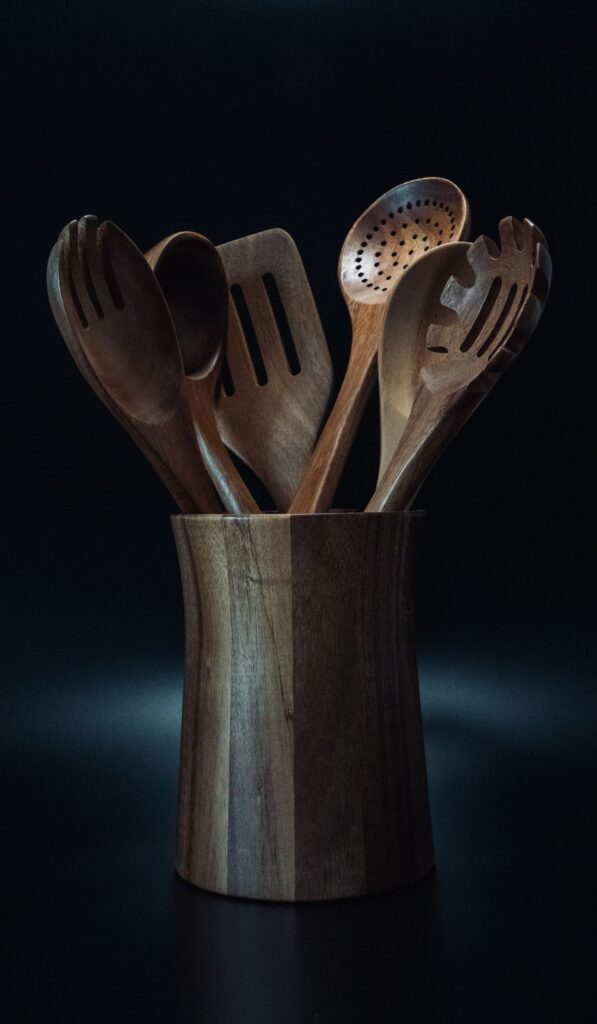
- Flat-edge turner spoon: a straight edge for scraping fond off pan bottoms while sautéing — the wooden equivalent of a spatula.
- Deep-bowled stirring spoon: for soups, stews, and sauces; moves serious volume without splashing.
- Slotted spoon: lifts solids out of liquids — blanched vegetables, poached eggs, fried foods draining.
- Long-handled tasting/mixing spoon: the 14-inch all-rounder for stockpots and deep Dutch ovens.
- Small spoon or spreader: for tasting, stirring small saucepans, and serving condiments.
You don’t need all five on day one — a flat-edge turner and a long stirring spoon cover 80% of wooden-spoon tasks. Build the collection as you notice gaps.
Top Picks: Best Wooden Spoons 2026
Our picks below are based on materials, construction quality, finish, and long-term user feedback patterns — what consistently earns praise for durability and what consistently gets returned. We haven’t lab-tested every spoon on the market; instead we’ve focused on the specs that predict longevity.
Best overall: solid beechwood spoon set
A set of five to six solid beechwood spoons — flat-edge, slotted, deep bowl, and turners — hits the sweet spot of quality and value. Beech is hard enough for daily use, takes oil beautifully, and quality sets stay smooth for years. beechwood wooden spoon set Check Price on Amazon → Look for one-piece construction (no glued joints) and spoons in the 12–13 inch range.
Best premium: olive wood spoons
Olive wood is the luxury tier — extraordinarily dense, naturally beautiful grain, and highly resistant to moisture and odors. Individual olive wood spoons cost more, but they last decades and age gorgeously. olive wood cooking spoons Check Price on Amazon → Choose makers who finish with food-safe oil rather than lacquer.
Best budget: bamboo spoon set
Well-finished bamboo spoons are hard, lightweight, and very affordable in sets of six or more. The key word is well-finished — run your thumb along the edges before committing; any roughness signals a spoon that will splinter. bamboo wooden spoon set Check Price on Amazon → Stick with reputable kitchen brands over no-name bulk packs.
Best for nonstick: smooth-edge beech turners
For nonstick and ceramic-coated pans, choose spoons with smoothly rounded, burr-free edges — beech excels here because its fine grain sands to a silky finish. Inspect the edge in good light; any ridge or rough spot will eventually mark delicate coatings.
Best single workhorse: 14-inch acacia stirring spoon
If you buy just one, make it a long acacia stirring spoon. Acacia’s natural oil content resists the staining and odor absorption that plague lesser woods in tomato sauces and curries, and 14 inches keeps your knuckles out of the steam over a stockpot. acacia wood stirring spoon Check Price on Amazon →
Wooden Spoons vs. Other Materials
| Material | Heat safety | Scratch risk | Maintenance |
|---|---|---|---|
| Wood | Excellent — doesn’t conduct heat | None | Hand wash, occasional oiling |
| Silicone | Excellent (up to ~450–600°F) | None | Dishwasher safe, minimal |
| Stainless steel | Poor — handles get hot | High on nonstick/cast iron | Dishwasher safe, minimal |
| Nylon/plastic | Moderate — melts above ~400°F | Low | Dishwasher safe; replace when warped |
For a full breakdown, see our wooden vs. silicone utensils comparison. The short version: wood wins on feel, tradition, and high-heat stovetop work; silicone wins on dishwasher convenience and baking.
Care: How to Make Wooden Spoons Last for Years
- Hand wash only — dishwashers’ prolonged heat and water cycles crack and warp wood. Wash promptly with hot soapy water and dry immediately.
- Never soak wooden spoons; standing water swells the grain and loosens fibers.
- Oil monthly (or when the wood looks dry or pale): rub in food-grade mineral oil, let it soak overnight, wipe off the excess. This is the single biggest longevity factor.
- Don’t leave them in hot pots resting against the rim for long periods — the heat dries and eventually chars the wood.
- Sand out roughness: if a spoon develops raised grain, a quick pass with fine sandpaper (220 grit) followed by oiling restores it.
- Deodorize as needed: rub with half a lemon and baking soda, or soak briefly in a vinegar-water solution, then wash and dry.
When to Retire a Wooden Spoon
Replace spoons with deep cracks (they harbor bacteria and can snap), blackened or charred areas that won’t sand out, persistent rancid smells after deodorizing, or splintering that sanding can’t fix. A well-cared-for hardwood spoon lasts years; a neglected softwood one lasts months. The oiling habit is what separates the two outcomes.
How to Spot a Quality Wooden Spoon in the Store
You can judge a wooden spoon in 30 seconds with your hands and eyes. First, check the weight — a quality hardwood spoon feels solid and substantial; a featherlight spoon is softwood that will warp. Run your thumb along every edge and the bowl: it should feel silky with no roughness, ridges, or splinters. Sight down the handle like a rifle barrel — it should be straight, since warped handles indicate poor drying or storage.
Look at the grain: tight, even grain signals hardwood; wide, coarse grain with visible pores suggests softwood. Check the finish — it should look like wood, not plastic. Thick glossy lacquer is a warning sign; a soft satin sheen from oil finishing is what you want. Finally, tap it lightly against your palm: hardwood gives a crisp, dense knock, while softwood sounds dull and hollow. These checks take seconds and reliably separate the $12 lifetime spoon from the $3 six-month spoon.
Sets vs. Individual Spoons: Which to Buy
Spoon sets offer better per-piece value and instant coverage of the main shapes — a good 5–6 piece beechwood set for $20–$35 is the most economical way to equip a kitchen. The downside: sets inevitably include shapes you’ll rarely use, and the quality is uniform, meaning you can’t upgrade just the workhorse pieces.
Buying individually costs more per spoon but lets you invest where it counts: a premium olive wood turner you’ll use daily, a basic beech slotted spoon for occasional serving. The smart hybrid approach is a mid-range set for coverage plus one or two premium individual pieces for your most-used shapes. Replace set pieces individually as they wear rather than rebuying whole sets — that’s how a collection improves over time instead of resetting.
Cooking Techniques That Shine with Wooden Spoons
Certain techniques are genuinely better with wood. Risotto: the flat-edge wooden spoon’s rigidity lets you stir the rice with the constant, firm motion that releases starch properly — silicone flexes and misses the pan bottom. Roux and gravies: wood’s thin-but-stiff edge scrapes the pan’s corners where lumps hide, and it won’t melt if the roux gets hotter than expected.
Caramel and candy: wooden spoons don’t conduct heat, so stirring 300°F sugar is comfortable, and there’s zero melt risk. Stir-frying in carbon steel or cast iron: a wooden turner scrapes fond aggressively without damaging seasoning — the exact task where silicone is too soft and metal too harsh. If you cook these dishes regularly, wooden spoons aren’t traditional affectation; they’re the right tool.
Wooden Spoon Care Cheat Sheet
- Daily: hand wash promptly with hot soapy water; dry immediately — never air-dry in a puddle or leave soaking.
- Monthly: rub in food-grade mineral oil, let soak overnight, wipe off excess. This one habit doubles spoon lifespan.
- As needed: sand rough spots with 220-grit sandpaper and re-oil; deodorize with lemon and baking soda.
- Never: dishwasher, prolonged soaking, or resting in a hot pan for extended periods.
- Replace when: deep cracks appear, charring won’t sand out, or persistent rancid smells survive deodorizing.
Tape this inside a cabinet door for the first few months — once the routine becomes habit, your spoons will outlast most of your other utensils.
Frequently Asked Questions
Are wooden spoons sanitary?
Yes, when properly cared for. Studies on wood cutting boards have found that wood’s porous structure can actually trap and neutralize bacteria as it dries, and the same principle applies to spoons. The key practices are prompt hand washing, thorough drying, and retiring cracked spoons — cracks are where sanitation fails, not the wood itself.
What is the best wood for cooking spoons?
Beech is the best all-around choice — hard, smooth, affordable, and widely available. Acacia and olive wood are premium upgrades with better natural moisture resistance and prettier grain. Avoid soft, unidentified woods in cheap sets; they splinter, warp, and absorb odors.
Can you put wooden spoons in the dishwasher?
You shouldn’t. The dishwasher’s prolonged hot water exposure and heated drying cycle cause wood to swell, crack, and warp, and can strip the oil finish. Hand washing takes 20 seconds and extends a spoon’s life from months to years.
How do you oil wooden spoons?
Rub food-grade mineral oil (not cooking oils like olive oil, which can go rancid) over the entire spoon with a cloth, let it soak in for several hours or overnight, then wipe off the excess. Repeat monthly for frequently used spoons, or whenever the wood looks pale and dry.
Why do wooden spoons get rough and fuzzy?
Raised grain from moisture exposure — usually soaking, dishwasher cycles, or being left wet. Fix it by letting the spoon dry completely, sanding lightly with 220-grit sandpaper, and re-oiling. Prevention is simple: wash promptly and dry immediately, never soak.
Are bamboo spoons better than wood spoons?
Neither is categorically better. Bamboo is hard, affordable, and renewable, but it’s a grass with a different fiber structure that can splinter if poorly finished. Hardwood spoons (beech, acacia) tend to have a smoother, more refined feel and take oil better. Choose based on finish quality rather than material loyalty.
How many wooden spoons do I need?
Three cover most kitchens: a flat-edge turner for sautéing, a long deep-bowled spoon for pots, and a slotted spoon for serving. Add a small tasting spoon and a second turner if you cook daily. Beyond five or six, you’re collecting rather than equipping.
Do wooden spoons stain?
Yes — tomato sauce, turmeric, and curries will tint light woods, especially beech. It’s cosmetic and harmless; acacia and olive wood resist staining better thanks to their natural oils. A baking soda paste or lemon rub lightens stains, but most cooks embrace the patina as character.
