
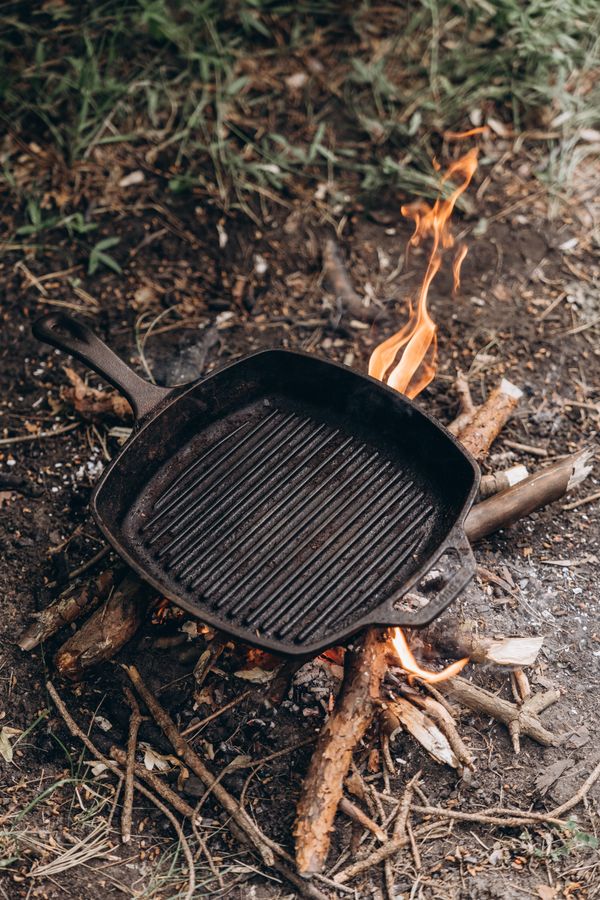
Every cast iron lover eventually faces the cast iron griddle vs skillet question: the flat, open griddle that turns your stovetop into a diner flat-top, or the deep-sided skillet that sears, fries, and bakes. Both are affordable, both last forever, and both earn their keep — but they serve different cooking styles. This comparison covers breakfast, searing, versatility, and handling to help you choose.
Cast Iron Griddle vs Skillet: The Quick Verdict
Buy the skillet first — its high sides make it the more versatile pan, handling searing, frying, sautéing, and baking. Add a griddle when breakfast cooking, smash burgers, or big-batch flat-top-style cooking become regular events. The griddle is the specialist that transforms specific meals; the skillet is the generalist that handles everything else.
| Feature | Cast Iron Griddle | Cast Iron Skillet |
|---|---|---|
| Cooking surface | Large, flat, open | Round, with high sides |
| Sides | Minimal — low rim or none | High — 2+ inches |
| Breakfast (pancakes, eggs) | Superb — cook for a crowd | Good — limited batches |
| Searing and frying | Good — but splatters freely | Excellent — contains splatter |
| Baking (cornbread, pizza) | Fair — shallow | Excellent — deep-dish capable |
| Two-burner models | Yes — spans burners | No |
| Storage | Awkward — large and flat | Easy — nests and stacks |
| Price | $25–$70 | $20–$60 |
What Each Piece Actually Is
A cast iron griddle is a flat cooking slab — round, square, or rectangular — with little to no sidewall. Some are double-burner rectangles that span two stovetop burners; others are round single-burner discs. Many are reversible, with a smooth side for pancakes and eggs and a ridged grill side for grill-marked meats. The defining trait is open, unobstructed cooking space.
A cast iron skillet is the familiar deep-sided frying pan: round, with flared sides two or more inches high, a pour spout or two, and a long handle (plus a helper handle on larger sizes). Those sides contain oil, hold shallow-fry depth, and make the skillet an oven-baking vessel. It is the most versatile single piece of cast iron ever made.
Breakfast: The Griddle\’s Home Turf
This is where griddles justify their existence. A double-burner griddle cooks six pancakes at once while eggs fry alongside — the diner flat-top experience at home. Bacon, sausage, hash browns, and French toast all share the expansive surface, and everything finishes at the same time. For family breakfasts or weekend brunch hosting, a griddle transforms the meal from sequential batches into a single orchestrated cook.
Skillets cook breakfast perfectly well — arguably better for individual portions, with superior heat concentration — but they work in batches. Two pancakes at a time in a 10-inch skillet versus six on a griddle is the difference between a 10-minute breakfast and a 30-minute one for a family of four. Volume cooking is the griddle\’s entire argument.
Searing and High-Heat Cooking
Skillets win the sear. Their high sides contain spattering oil, hold a depth of frying fat safely, and create a slightly enclosed environment that keeps heat focused on the food. Steaks, chops, fried chicken, and shallow-fried cutlets all belong in the skillet — the sides are functional safety equipment as much as design.
Griddles sear respectably — the flat iron gets screaming hot and builds great crusts — but open sides mean oil spatters freely across your stovetop, and there is no containing anything beyond a film of fat. Smash burgers are the griddle\’s signature sear application: maximum flat contact for maximum crust, with the spatula-smash technique that needs unobstructed space. For smash burgers specifically, the griddle beats the skillet.
Baking and Oven Work
The skillet is a baking vessel: deep-dish pizza with crispy fried edges, tall cornbread, Dutch baby pancakes that climb the sides, roasted chicken, and cobblers. Its sides shape and contain batters and doughs. The griddle\’s oven role is limited to flatbreads, pizza (excellent — the flat iron makes a superb pizza surface), and warming tortillas. For bakers, the skillet is far more useful.
Smash Burgers: The Deciding Dish?
Smash burgers deserve special mention because they have driven griddle sales for years. The technique — a ball of ground beef smashed paper-thin onto a ripping-hot flat surface — demands maximum contact and unobstructed smashing room. A griddle delivers this perfectly; a skillet\’s curved sides and smaller flat area make smashing awkward. If smash burgers are a regular craving, this single dish can justify the griddle. (A skillet still makes excellent thick pub-style burgers, so this only matters for the smash technique.)
Handling, Weight, and Storage
Skillets store easily — they nest inside each other and hang from hooks. Griddles, especially double-burner rectangles, are storage puzzles: too large for most cabinets, too flat to nest, too heavy to hang casually. Many griddle owners store theirs in the oven (removing it each time they bake) or on a dedicated rack. Before buying a double-burner griddle, measure your storage and your burners — it must span two burners evenly to heat properly.
Both are heavy, but griddles concentrate that weight in an unwieldy flat slab with small handles — harder to maneuver than a skillet with a proper long handle. Draining grease from a griddle is notably more awkward than pouring from a skillet\’s spouts.
Seasoning and Maintenance
Both season the same way and improve with use. Griddles arguably season faster — their constant contact with fatty breakfast foods builds patina quickly. But their large flat surfaces show uneven seasoning more visibly, and the ridged grill side (on reversible models) is harder to clean than smooth iron. Skillets\’ enclosed shape makes them slightly easier to maintain evenly. In practice, the difference is minor — cook often, dry on heat, oil lightly, and both thrive.
Two-Burner Griddles: Worth It?
Double-burner griddles promise the ultimate flat-top, but they have a known weakness: the middle, bridging two burners, often runs cooler than the areas directly over the flames, creating hot and cool zones. On gas this is manageable; on electric it can be pronounced. They also demand precise burner spacing — measure your stove before buying. For many cooks, a large round single-burner griddle heats more evenly and stores more easily, sacrificing only the maximum batch size.
Cost and Value
Both are among the cheapest quality cookware available: $20 to $60 for skillets, $25 to $70 for griddles. Price should not decide this comparison — buy based on cooking style. The combined cost of both is less than a single mid-range clad skillet, which is why so many cast iron enthusiasts simply own both and end the debate by acquisition.
The 2026 Angle: Flat-Top Fever
The cast iron griddle vs skillet debate has fresh energy from the outdoor flat-top griddle boom — cooks who fell in love with backyard griddle cooking want the same experience indoors. Stovetop cast iron griddles deliver a convincing approximation for breakfast and burgers. Meanwhile, enameled cast iron griddles have improved, offering easier maintenance for cooks who want griddle convenience without seasoning rituals. The skillet remains the default recommendation; the griddle is the lifestyle upgrade.
Seasoning a Griddle: Tips for Large Flat Surfaces
Seasoning a griddle follows the same chemistry as a skillet, but the cast iron griddle vs skillet size difference changes the technique. Work in zones: apply whisper-thin oil to one section at a time, heating each past the smoke point before moving on — trying to season a double-burner griddle all at once leads to uneven, gummy patches. The oven method shines here: coat the entire griddle thinly, place it upside down in a 450°F oven for an hour, and let the ambient heat do the work uniformly.
Griddles also benefit from a deliberate break-in menu: start with bacon, sausage, and grilled cheese — fatty foods that deposit seasoning aggressively across the broad surface. Avoid the temptation to cook delicate eggs on day one; give the griddle two weeks of regular fatty cooking first. The ridged grill side (on reversible models) seasons the same way but needs a stiff brush to work oil into the valleys. Patience pays: a well-seasoned griddle develops a nearly nonstick surface that makes the whole flat-top experience click.
The Griddle Breakfast Timeline
A double-burner griddle turns chaotic brunch into choreography. Here is the timeline for a family breakfast: minute 0 — griddle on medium heat, bacon down on the hotter zone. Minute 8 — bacon moved to the cooler edge to hold, sausage patties down. Minute 12 — sausages flipped, hash browns spread thin on the hot zone (maximum contact equals maximum crisp). Minute 18 — meats moved to a warm plate, pancakes down in two batches. Minute 26 — eggs fried in the residual butter while pancakes hold warm. Everything finishes within half an hour, all from one cooking surface, with one cleanup.
The key insight is zone management: learn which parts of your griddle run hot (directly over burners) and which run cooler (edges and middle on double-burner models), then assign foods accordingly — searing and crisping on hot zones, holding and gentle cooking on cool ones. This is the flat-top skill that makes griddle owners evangelical: the entire breakfast visible, manageable, and finishing simultaneously.
Final Verdict: Which Is Better?
The skillet is the better all-around piece — more versatile, easier to store, better for searing, frying, and baking. The griddle is the better specialist — unmatched for big breakfasts, smash burgers, and flat-top-style batch cooking. Buy the skillet first without hesitation. Buy the griddle when you find yourself thinking \”I wish I had more flat cooking space\” more than twice a month — that is the griddle telling you it has earned its place.
Frequently Asked Questions
Can I cook pancakes in a cast iron skillet?
Yes — a well-seasoned skillet makes excellent pancakes with crispy edges. The limitation is batch size: two at a time versus six on a griddle. For one or two people, the skillet is perfectly efficient; for families, the griddle\’s throughput wins.
Do I need to season a griddle differently?
No — same process as a skillet: thin oil layers heated past the smoke point, plus regular cooking. Griddles often season faster because breakfast foods (bacon, sausage, butter) are seasoning-friendly. The large surface just makes the initial seasoning sessions slightly more work.
Are reversible grill/griddle pans worth it?
They are a good value — two tools in one. The smooth side handles pancakes and eggs; the ridged side gives grill marks. The compromise is that neither side is as good as a dedicated piece, and the ridges are fiddly to clean. Dedicated tools outperform combos, but combos save money and space.
Will a double-burner griddle work on my stove?
Measure first: the griddle must span two burners with even coverage. Gas stoves handle them best; electric coil works acceptably; glass-top electric can show pronounced hot/cool zones in the middle. Check your burner\’s spacing against the griddle\’s dimensions before buying.
How do I clean a cast iron griddle?
While warm, scrape with a flat metal spatula or bench scraper, rinse with hot water, scrub stubborn spots with a brush, dry on heat, and wipe with thin oil. The flat surface actually cleans faster than a skillet\’s corners — the challenge is maneuvering the large, heavy slab.
Can you use a griddle on a glass cooktop?
Yes, but carefully — cast iron can scratch glass if dragged, so lift, don\’t slide. Ensure the griddle sits flat for good contact. Enameled cast iron griddles are slightly kinder to glass surfaces than raw iron, though both work.
Griddle vs grill pan — which is better?
For actual grilling flavor, neither replaces an outdoor grill. A flat griddle gives better crust and contact (superior for burgers); a ridged grill pan gives grill marks but steams food in the valleys between ridges. Most cooks get more use from the flat griddle side.
Can I use a cast iron griddle on a glass cooktop?
Yes, with care — lift rather than slide to avoid scratching, ensure full flat contact for even heating, and avoid the thermal shock of cold food on a screaming-hot surface. Enameled griddles are slightly kinder to glass. Many glass-top owners use griddles happily for years with these precautions.
How do I keep pancakes from sticking to a new griddle?
New griddles need a break-in period: cook fatty foods first, use generous butter for the first dozen pancake batches, and keep heat at medium rather than high. If sticking persists, the seasoning needs more time — a thin oven-seasoning session plus two weeks of regular use solves it for nearly everyone.
