
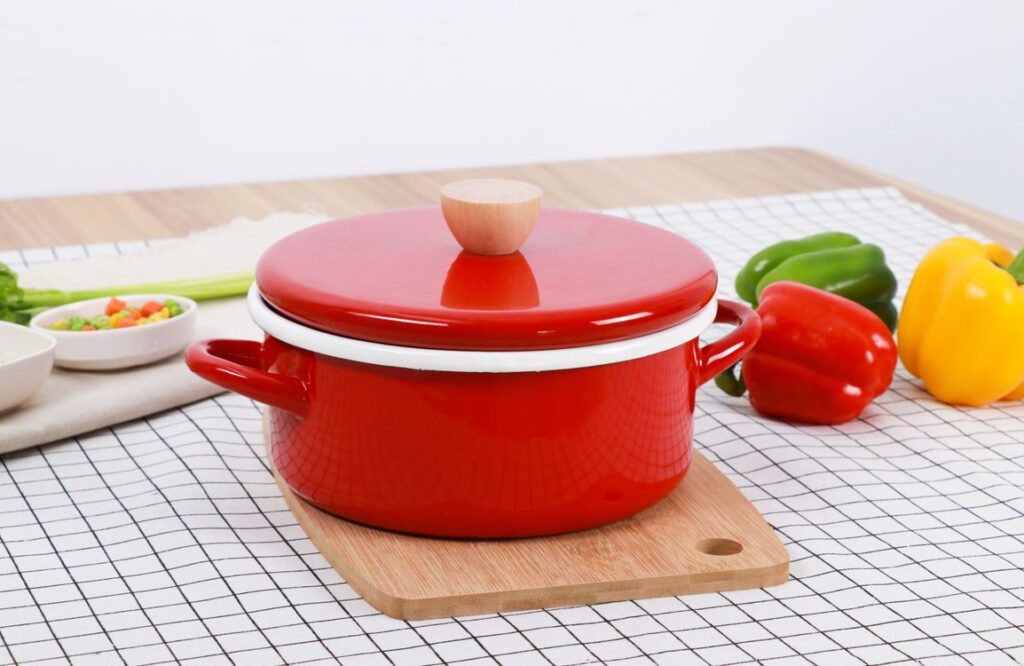
At first glance, a braiser looks like a dutch oven that skipped leg day — same heavy construction, same tight lid, but wide and shallow instead of tall and deep. The dutch oven vs braiser choice shapes how you cook low-and-slow: the dutch oven\’s depth suits soups, stocks, and big braises, while the braiser\’s wide surface excels at searing and shallow braising. This comparison explains when each shape wins and whether you need both.
Dutch Oven vs Braiser: The Quick Verdict
Buy the dutch oven first — its depth makes it the more versatile pot, handling soups, stocks, stews, bread, frying, and braising. Add a braiser when shallow braising, searing-then-simmering, and elegant stovetop-to-table serving become regular habits. The braiser is the specialist that does its few jobs superbly; the dutch oven is the generalist that does everything well.
| Feature | Dutch Oven | Braiser |
|---|---|---|
| Shape | Tall and deep (4–5 in+) | Wide and shallow (2–3 in) |
| Capacity | 5–7 quarts typical | 3–5 quarts typical |
| Searing surface | Smaller base, crowded easily | Large base — sears in one batch |
| Evaporation | Slow — deep, narrow opening | Fast — wide surface area |
| Soups and stocks | Excellent | Poor — too shallow |
| Bread baking | Excellent | Fair — loses steam |
| Serving presentation | Utilitarian | Beautiful — wide, low profile |
| Price | $60–$350 | $70–$350 |
The Shape Difference and Why It Matters
A dutch oven is a deep pot: its height roughly equals or exceeds its radius, creating a vessel optimized for volume. A braiser (sometimes called a braising pan or buffet casserole) is a wide, shallow pan with a tight lid: its cooking surface can equal a dutch oven\’s, but its walls rise only a few inches. Both are typically enameled cast iron with heavy, tight-fitting lids.
Shape governs two physical processes: evaporation and submersion. The braiser\’s wide opening evaporates liquid fast — ideal for reducing sauces and concentrating flavors. The dutch oven\’s deep, narrow profile minimizes evaporation — ideal for long, moist braises where you want the liquid level to hold. Neither behavior is better; they serve different dishes.
Braising: Each Pot\’s Home Turf
True braising — searing meat then cooking it partially submerged in flavorful liquid — is where the comparison gets interesting. The braiser was designed for exactly this: its wide base sears a full batch of short ribs or chicken thighs in a single layer without crowding, then the shallow depth means the liquid comes only partway up the meat, the defining geometry of a braise. The wide surface then reduces the braising liquid into a concentrated sauce quickly at the end.
Dutch ovens braise beautifully too, but their depth changes the technique: the same liquid submerges food more deeply (closer to stewing), and the narrower base often forces searing in batches. For large cuts — a whole pork shoulder, a big batch of stew — the dutch oven\’s volume is essential. For classic shallow braises of ribs, shanks, and thighs, the braiser\’s geometry is technically superior.
Searing: The Braiser\’s Secret Weapon
Because searing happens on the pot\’s base, the wider braiser base is a major practical advantage. A 3.5-quart braiser offers nearly the searing surface of a 5.5-quart dutch oven, with lower walls that let steam escape and give your tongs room to work. Searing four chicken thighs? One batch in the braiser, two in the dutch oven. Better browning, less time, less steaming — the braiser wins the sear-then-braise sequence that defines its purpose.
Versatility: The Dutch Oven\’s Moat
Here the dutch oven pulls away decisively. Its depth makes it a true multi-tasker: soups, stocks, and stews; deep-frying (the tall walls contain splatter); boiling pasta; baking crusty bread; even steaming. The braiser\’s shallowness disqualifies it from most of these — you cannot make stock in a three-inch-deep pan or deep-fry safely in one.
If you are choosing your first heavy pot, this versatility gap is the whole decision. The dutch oven covers perhaps a dozen cooking tasks; the braiser covers three or four brilliantly. First-pot buyers should not hesitate: dutch oven, every time.
Sauce Reduction and Flavor Concentration
The braiser\’s wide surface area is a sauce-maker\’s dream. After braising, the same pan reduces the cooking liquid into a glossy, concentrated sauce in minutes — evaporation that would take twice as long in a dutch oven\’s narrow profile. For cooks who finish braises with a proper reduced sauce rather than a thin broth, the braiser saves meaningful time and produces more intense results.
Dutch oven sauces tend toward the brothy — appropriate for stews and soups, less ideal when you want a clinging, reduced glaze. You can reduce in a separate skillet, but that dirties another pan. The braiser\’s one-pan braise-to-sauce workflow is its most elegant feature.
Serving and Presentation
Braisers are beautiful serving vessels. Their low, wide profile shows off the food — glistening short ribs in reduced sauce, a paella-like arrangement, a tarte tatin flipped tableside — in a way a deep pot cannot. Many cooks bring the braiser straight to the table, lid off, as the centerpiece. Dutch ovens serve perfectly well but present as what they are: deep pots of stew. For entertaining, the braiser has undeniable style points.
Heat Behavior Compared
Both are typically enameled cast iron, so thermal mass and heat retention are comparable — superb in both cases. The difference is in heat dynamics: the braiser\’s shallow depth means the lid sits close to the food, creating an intense self-basting environment where condensing steam rains directly back onto the meat. Dutch ovens self-baste too, but the greater distance softens the effect. For oven braising, both hold rock-steady low temperatures for hours.
Size, Weight, and Storage
Braisers are easier to store — their low profile slides onto shelves and into cabinets where a tall dutch oven will not fit. They are lighter at comparable cooking-surface sizes, and easier to maneuver in and out of the oven. Dutch ovens demand serious cabinet real estate. In small kitchens, the braiser\’s storage friendliness is a genuine point in its favor as a second pot.
Cost Comparison
Prices overlap heavily: $70 to $350 for braisers, $60 to $350 for dutch ovens, varying by brand and size rather than shape. Neither shape commands a systematic premium. Value brands offer excellent enameled braisers under $100, making the \”add a braiser later\” path affordable. Buy the dutch oven first at whatever tier fits your budget; add the braiser when your cooking justifies it.
The 2026 Angle: The Braiser\’s Rising Profile
The dutch oven vs braiser conversation has shifted as braisers gained visibility through food media — their photogenic, wide presentation photographs beautifully, and one-pan braise recipes have proliferated. Some manufacturers now market braisers as \”everyday pans\” for weeknight cooking, which overstates their versatility but reflects a real trend: cooks who already own dutch ovens are discovering the braiser as the ideal second heavy pot. It is a specialist whose time has come — after the generalist is already in the cabinet.
Adapting Recipes Between the Two Pots
The dutch oven vs braiser question often arises mid-recipe: can you swap one for the other? The answer is usually yes, with adjustments. Braiser to dutch oven: increase liquid by about a cup (the deeper pot evaporates less, so braises need more starting liquid), expect slightly longer reduction time at the end, and sear in batches since the base is smaller. Dutch oven to braiser: reduce liquid by about a cup (the wide surface evaporates faster), watch the final 30 minutes closely to prevent over-reduction, and enjoy the single-batch sear.
Temperature and timing stay essentially the same — both are heavy enameled cast iron with similar thermal behavior. The critical variable is liquid level: a braise should come one-third to halfway up the meat in either vessel, so adjust volumes to hit that mark rather than following the recipe\’s quantities blindly. Once you internalize the evaporation difference, the two pots become freely interchangeable for any braised dish.
Serving Straight from the Pot
One of the braiser\’s underrated joys — and a practical consideration in the dutch oven vs braiser comparison — is tableside presentation. A braiser of short ribs, glossy with reduced sauce, needs no platter: set it on a trivet at the table and let guests serve themselves. The low profile shows off the food; the heavy iron keeps it hot through second helpings. Dutch ovens serve family-style too, but their depth hides the food — guests fish blindly rather than choosing.
A few serving tips: warm the trivet (cold stone can thermally shock hot enamel), provide a large serving spoon and a ladle for the sauce, and keep the lid handy to cover between servings. For dinner parties, the braiser-to-table move eliminates a transfer step, keeps food hotter, and looks effortlessly impressive — the kind of practical elegance that justifies a specialist pot.
Final Verdict: Which Is Better?
The dutch oven is the better first purchase and the more versatile pot — it braises, stews, soups, fries, bakes bread, and boils. The braiser is the better braising specialist — superior searing surface, faster reduction, shallower true-braise geometry, and gorgeous presentation. Own the dutch oven for breadth; add the braiser for depth. Together they form the complete low-and-slow arsenal; apart, the dutch oven covers far more ground alone.
Frequently Asked Questions
Can a braiser replace a dutch oven?
No — the braiser\’s shallowness rules out soups, stocks, deep-frying, bread baking, and large braises. It replaces a dutch oven only for shallow braises and sear-then-simmer dishes. As a first heavy pot, the dutch oven\’s versatility is irreplaceable.
What size braiser should I buy?
Three to 3.5 quarts suits most households — the wide base sears four to six portions in one batch. Larger 5-quart braisers suit entertaining and big families but get heavy. Match the braiser to your typical braising batch, not your dutch oven size.
Can you bake bread in a braiser?
Not well. Bread baking needs a deep, lidded vessel that traps steam around the loaf — the braiser\’s shallow profile lets steam escape, producing a paler, softer crust. Keep bread duty on the dutch oven.
Is a braiser good for paella?
Surprisingly decent — the wide, shallow shape resembles a paella pan, and the tight lid helps finish the rice. It will not match a thin carbon steel paella pan\’s socarrat, but for occasional paella it works better than a dutch oven.
Do braisers work on induction?
Enameled cast iron braisers are naturally induction-compatible — cast iron is magnetic. The wide, flat base makes excellent contact with induction elements. This is one area where braisers have zero compatibility concerns.
Can I deep-fry in a braiser?
Not safely — the shallow walls leave too little clearance above the oil, increasing splatter and boil-over risk. Deep-frying needs a dutch oven\’s tall walls, with oil filled no more than halfway. Use the right vessel for hot oil.
Why are braisers so expensive?
They use nearly as much enameled cast iron as dutch ovens and the same manufacturing process — the price reflects material and craftsmanship, not size. Value brands have brought quality braisers under $100, making them far more accessible than premium French icons.
Can I make soup in a braiser?
Only small quantities — the shallow depth limits volume and causes splattering with brothy soups. A braiser handles a stew for two adequately but struggles beyond that. For soup, the dutch oven\’s depth is functionally necessary, which is why the braiser never replaces it as a first pot.
Do braisers come in nonstick versions?
Yes, but they defeat the purpose — braising relies on fond development and high-heat searing, exactly what nonstick prevents, and nonstick cannot take the oven temperatures braising uses. Enameled cast iron or clad stainless are the correct materials; skip nonstick braisers entirely.
Which is better for pot roast?
The dutch oven — pot roast is a deep, long braise where the dutch oven\’s depth keeps the meat properly submerged and its heat retention maintains the low, steady temperature that breaks down connective tissue. A braiser works for smaller roasts but the dutch oven\’s geometry suits this classic dish better.
