
Affiliate Disclosure: As an Amazon Associate I earn from qualifying purchases.
n
This kitchen deep cleaning checklist walks you room-by-room through every task: high zones and cabinets, the full cooking lineup, refrigerator and freezer, sink and dishwasher, pantry, small appliances, and floors. Print it, check items off as you go, and you’ll finish with a kitchen that’s genuinely deep-cleaned — not just tidied — in one focused weekend.
Checklists work because deep cleaning fails in two predictable ways: you forget the hidden zones (the range hood filter, the dishwasher seal, the cabinet tops) and you clean things twice because you lost track of what’s done. Below, every zone is broken into concrete, check-off-able tasks with the right cleaner noted for each. Work top to bottom within each zone so debris falls onto not-yet-cleaned surfaces.
How to Use This Checklist
- Work zone by zone, finishing each completely before moving on. Jumping around is how tasks get missed.
- Gather supplies first: dish soap, white vinegar, baking soda, all-purpose spray, degreaser or oven cleaner, microfiber cloths, a toothbrush or detailing brush, gloves, a bucket, and a step stool.
- Let chemistry work: apply degreaser or oven cleaner first in each zone, then do other tasks while it dwells.
- Estimated total time: 6–8 hours across two days for an average kitchen. Check off as you go — momentum matters.
Zone 1: High Zones and Ceilings
Start here. Everything above shoulder height sheds dust and grease downward.
- ☐ Dust the ceiling and corners for cobwebs (extendable duster or vacuum brush)
- ☐ Wipe the tops of wall cabinets with dish-soap solution; line with fresh shelf liner if desired
- ☐ Degrease the range hood exterior; soak the metal filter in hot soapy water with baking soda for 20 minutes, scrub, and air-dry
- ☐ Clean light fixture covers and wipe bulbs (dust dims light significantly)
- ☐ Wipe the top of the refrigerator
- ☐ Clean interior window glass and wipe sills
- ☐ Dust any open shelving, wiping each item’s base as you lift it
extendable microfiber duster Check Price on Amazon → reaches cabinet tops and ceiling corners without a ladder. If your range hood filter hasn’t been cleaned in months, let it soak while you work through Zone 2 — dwell time does the heavy lifting.
Zone 2: Cabinets and Drawers (Exteriors)
- ☐ Test your cleaner in a hidden spot (inside a door) before starting
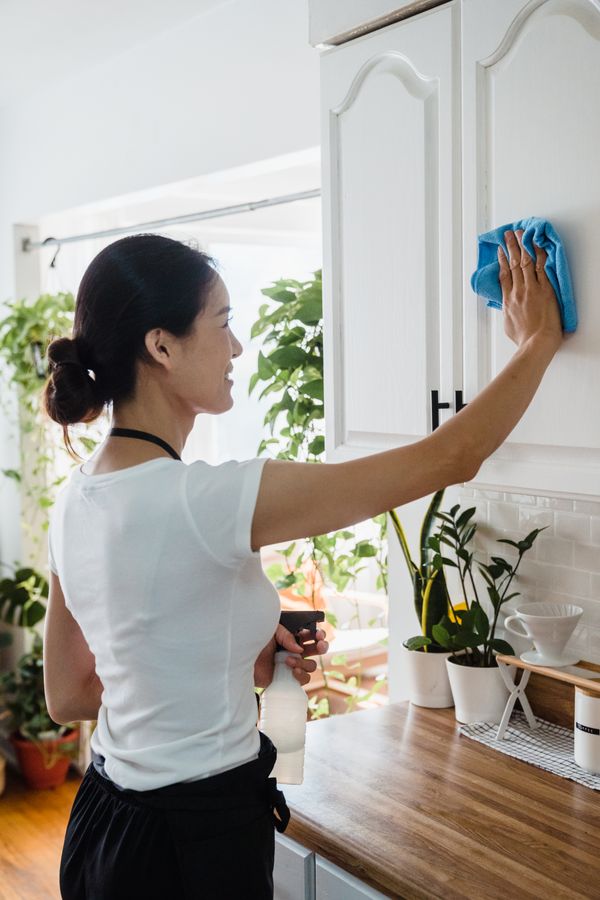
- ☐ Wipe all cabinet door fronts with well-wrung dish-soap solution, working with the wood grain
- ☐ Detail around handles and knobs with a toothbrush; remove hardware for a full clean if you’re comfortable
- ☐ Degrease the cabinets flanking and above the stove (baking soda paste for sticky buildup)
- ☐ Wipe drawer fronts and the frame rails around each door
- ☐ Rinse-wipe with a clean damp cloth to remove soap residue, then dry with microfiber
- ☐ Wipe light switch plates and outlet covers near cooking areas
Zone 3: Backsplash and Walls
- ☐ Spray backsplash with degreaser; let dwell 10 minutes
- ☐ Scrub grout lines with a grout brush and baking soda paste (tile backsplashes)
- ☐ Wipe down and buff (stainless or glass backsplashes — wipe with the grain)
- ☐ Spot-clean wall splatter behind the stove and near the trash area
- ☐ Wipe the kitchen door handles and any wall-mounted organizers
Zone 4: Stovetop, Oven, and Microwave
- ☐ Remove grates/burner caps/drip pans/knobs; soak in hot soapy water
- ☐ Degrease the cooktop per its type (gas, coil, or glass — see our stovetop guide)
- ☐ Scrub, rinse, and fully dry all removed parts before reassembling
- ☐ Clean the oven interior (self-clean cycle per manual, or oven cleaner/baking soda paste with dwell time); wash racks separately
- ☐ Steam-clean the microwave (bowl of water + lemon, 5 minutes); wash the turntable
- ☐ Empty and wash the toaster crumb tray; shake out crumbs
- ☐ Wipe the exterior of all cooking appliances, including handles and control panels
Zone 5: Refrigerator and Freezer
- ☐ Pull everything out one shelf at a time; check dates and discard expired items
- ☐ Remove shelves and drawers; wash in hot soapy water and dry
- ☐ Wipe interior walls and shelf supports with dish-soap solution
- ☐ Detail door seals with a toothbrush; check for mold in the folds
- ☐ Wipe the exterior, including handles and the water/ice dispenser area
- ☐ Vacuum condenser coils (behind or beneath — unplug first)
- ☐ Inventory the freezer; discard anything with heavy freezer burn or older than 6 months
- ☐ Place an open box of baking soda inside to absorb odors
Zone 6: Sink, Faucet, Dishwasher, and Disposal
- ☐ Scrub the sink basin with baking soda; vinegar rinse for stainless shine
- ☐ Detail around the faucet base and drain with a toothbrush
- ☐ Unscrew the faucet aerator; soak in vinegar 30 minutes to dissolve mineral buildup
- ☐ Run the dishwasher empty on the hottest cycle with a cup of vinegar on the top rack
- ☐ Remove and rinse the dishwasher filter; wipe the door seal
- ☐ Freshen the garbage disposal: ice cubes + lemon peels + baking soda, then cold water flush
- ☐ Check under the sink for leaks, and wipe the cabinet floor
- ☐ Replace or sanitize the sponge; launder or replace the dish brush head
Zone 7: Pantry and Food Storage
- ☐ Empty one shelf at a time; wipe the shelf before restocking
- ☐ Check every date; discard expired spices (ground spices fade after ~1 year), stale goods, and mystery items
- ☐ Decant open bags of flour, rice, grains, and sugar into airtight containers
- ☐ Wipe containers and jars before returning them; group like with like
- ☐ Check for signs of pantry moths (webbing, larvae in dry goods) — discard affected items and wipe shelves with vinegar
- ☐ Inventory and restock staples; note what’s running low on a shopping list
Airtight containers are the single best pantry upgrade for cleanliness and food longevity — airtight food storage container set Check Price on Amazon → keeps staples fresh and pest-free. Our food storage hacks guide has more on extending shelf life.
Zone 8: Small Appliances and Countertop Items
- ☐ Coffee maker: descale per manufacturer instructions (vinegar or citric acid cycle)
- ☐ Air fryer: wash basket and tray; wipe interior and heating element area (cool and unplugged)
- ☐ Stand mixer / hand mixer: wipe body, wash attachments
- ☐ Blender: blend warm soapy water 30 seconds, rinse; detail the gasket
- ☐ Electric kettle: descale with vinegar or citric acid; wipe exterior
- ☐ Knife block: empty, shake out crumbs, wipe slots; or wash a magnetic strip
- ☐ Wipe the fruit bowl, paper towel holder, and any countertop organizers
- ☐ Clean and refill soap dispensers
Zone 9: Floors, Baseboards, and Trash Areas
Always last — everything above has been shedding onto the floor.
- ☐ Pull out the trash and recycling; scrub the cans with dish soap (outdoors or in the tub for big cans)
- ☐ Sweep or vacuum the entire floor, including under appliances you can safely move
- ☐ Mop with a cleaner suited to your flooring; don’t soak wood or laminate
- ☐ Wipe baseboards with a damp cloth
- ☐ Shake out and launder the kitchen rug; replace if worn
- ☐ Restock trash bags and put a fresh deodorizer in the can
Finishing Touches
- ☐ Replace dish towels, hand towels, and oven mitts with fresh ones
- ☐ Restock cleaning supplies you used up; note what to buy
- ☐ Walk through with fresh eyes (or a phone flashlight) to catch missed spots
- ☐ Take a “done” photo — future-you will appreciate the motivation
- ☐ Set calendar reminders: monthly zone rotation, next seasonal deep clean
Supplies Checklist (Gather Before You Start)
| Supply | Used for |
|---|---|
| Grease-cutting dish soap | Cabinets, cooktop, general degreasing |
| White distilled vinegar | Mineral deposits, glass, dishwasher, disposal |
| Baking soda | Scrubbing paste, deodorizing fridge/trash/sink |
| Kitchen degreaser or oven cleaner | Heavy grease, oven interior, hood filter |
| All-purpose spray | Counters, appliance exteriors |
| Microfiber cloths (6+) | Everything — keep separate ones for greasy vs. clean zones |
| Non-scratch scrub pads | Cooktop, sink, baked-on spots |
| Toothbrush / detailing brush + grout brush | Seals, grout, hinges, crevices |
| Bucket, spray bottle, gloves, step stool | Logistics and safety |
The 3-Hour Express Deep Clean
Short on time? This condensed version hits the highest-impact tasks when a full weekend isn’t available — perfect before guests arrive or when the kitchen has simply gotten away from you:
- Minutes 0–20: Declutter all counters, load the dishwasher, take out trash. Clear surfaces first — everything else depends on it.
- Minutes 20–50: Degrease the stovetop, wipe cabinet fronts near the stove, clean the microwave with the steam method.
- Minutes 50–80: Fridge triage — toss expired items, wipe the worst shelf, clean the door handles and exterior.
- Minutes 80–110: Scrub the sink, wipe the faucet, run a hot dishwasher cycle, replace sponges and towels.
- Minutes 110–150: Quick pantry scan for expired items, wipe the most-used shelf.
- Minutes 150–180: Sweep and mop floors, wipe baseboards in visible areas, restock trash bags.
The express version skips the oven interior, range hood filter soak, and detailed pantry work — schedule those for the next full session. What it delivers is a kitchen that looks, smells, and hygienically is dramatically better in a single afternoon. The 80/20 rule applies to deep cleaning: a focused three hours captures most of the benefit.
Adapting the Checklist for Small vs. Large Kitchens
In a galley or apartment kitchen, you can often complete this entire checklist in 4–5 hours instead of 6–8 — fewer cabinets, smaller appliances, less floor. The trade-off is that grease concentrates: with the stove inches from everything, treat the whole kitchen as the grease zone and wipe all cabinet fronts, not just those near the range.
In a large kitchen with double ovens, a walk-in pantry, or an island cooktop, add 2–3 hours and consider splitting across three sessions instead of two days. Island cooktops deserve special attention — without a wall to catch it, their grease aerosolizes in every direction, so wipe surrounding seating-area surfaces too. Pantries larger than a closet get their own dedicated zone with the full empty-wipe-restock treatment rather than a quick scan.
Frequently Asked Questions
How long does a full kitchen deep clean take?
Plan 6–8 hours of active work across two days for an average kitchen: Saturday for high zones, cabinets, and cooking appliances; Sunday for the fridge, sink, pantry, small appliances, and floors. Small kitchens can finish in 4–5 hours; large or long-neglected kitchens may need a third half-day.
What room should you deep clean first in the kitchen?
Start with the highest zones — ceiling corners, cabinet tops, the range hood, and light fixtures — then work downward through cabinets, backsplash, appliances, and finally floors. This top-to-bottom order keeps dust and drips from dirtying surfaces you’ve already finished.
What is the hardest part of the kitchen to deep clean?
The oven interior and the range hood filter are usually the toughest, because baked-on grease and carbonized residue resist normal cleaners. Both respond to the same strategy: apply the right product (oven cleaner or alkaline degreaser), give it generous dwell time, and let chemistry do the work before you scrub.
Should I deep clean the fridge or oven first?
Do the oven on day one and the fridge on day two. Oven cleaning involves strong cleaners and fumes that pair well with a ventilated appliance day, while the fridge is easier to tackle when you’re not actively cooking around it. A Sunday fridge clean also means you start the week organized.
How often should you deep clean your kitchen?
A full checklist deep clean every three to four months suits most households, supported by a 10-minute daily reset, a 30-minute weekly clean, and a one-hour monthly zone rotation. Heavy daily cooking or frequent frying shortens the interval; light cooking stretches it.
What cleaners do I actually need for a kitchen deep clean?
Dish soap, white vinegar, and baking soda cover about 80% of the job. Add a dedicated kitchen degreaser or oven cleaner for heavy grease and the oven interior, plus an all-purpose spray for convenience. Specialty products beyond these are rarely necessary for a home deep clean.
How do I deep clean without harsh chemicals?
Use dish soap solution for grease, baking soda paste for scrubbing, vinegar for mineral deposits and glass, and steam (a kettle or steam cleaner) for stuck-on grime. The main trade-off is time: natural methods need longer dwell times than commercial degreasers, so apply them first and work elsewhere while they sit.
What should I throw away during a kitchen deep clean?
Expired spices and condiments, stale opened dry goods, freezer items older than six months or heavily freezer-burned, worn sponges, chipped storage containers, and anything in the fridge you can’t identify or date. When in doubt about a perishable item’s safety, throw it out.
