
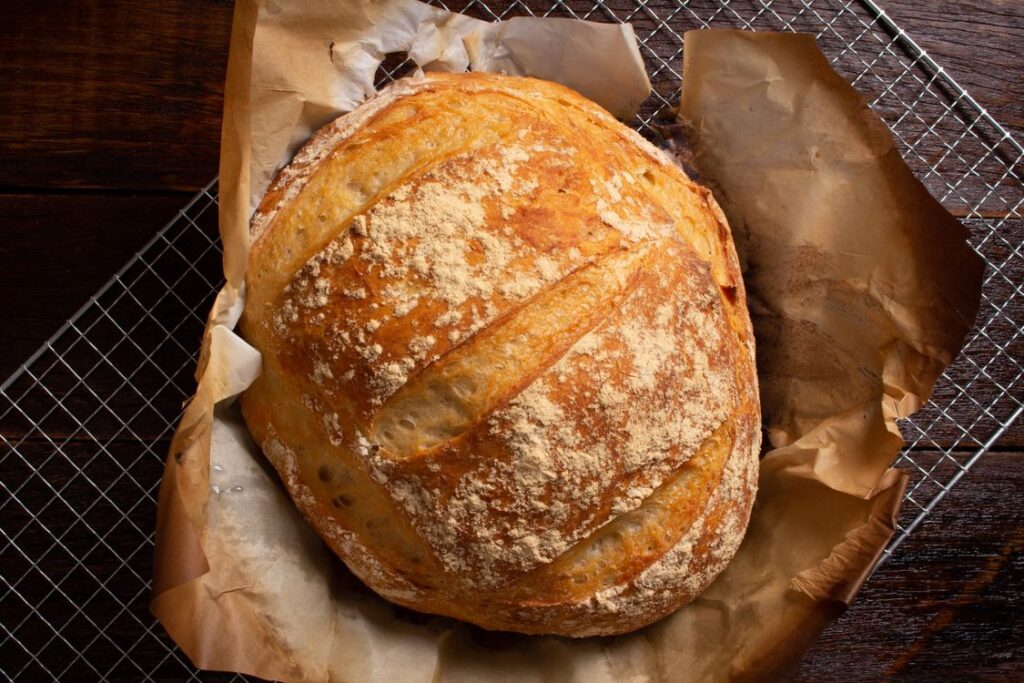
Sourdough bread vs regular bread — is the hype justified? Largely, yes. True sourdough, fermented slowly with a live starter of wild yeast and lactic acid bacteria, is easier to digest, gentler on blood sugar, and more flavorful than regular bread made with commercial yeast. Regular bread still wins on convenience, soft texture, and price — but nutritionally and digestively, sourdough takes the crown in most comparisons.
In this guide, we compare sourdough bread vs regular bread across fermentation science, nutrition, glycemic index, gluten content, flavor, home-baking effort, and how to spot fake \”sourdough\” at the store. Whether you bake or buy, you will know exactly what is worth your money in 2026.
What Actually Makes Sourdough Different
Regular bread is leavened with commercial yeast (Saccharomyces cerevisiae), a single fast-acting strain that inflates dough in one to three hours. It is efficient, predictable, and flavor-neutral — the dough rises before much flavor chemistry can happen. Most supermarket bread, from sandwich loaves to dinner rolls, is made this way, often with added sugars, dough conditioners, and preservatives to speed production and extend shelf life.
Sourdough is leavened with a starter: a living culture of wild yeasts and lactic acid bacteria maintained with regular feedings of flour and water. Fermentation takes 12 to 24 hours or more, during which the bacteria produce lactic and acetic acids. Those acids do three important things: they create sourdough\’s signature tangy flavor, they pre-digest some of the flour\’s starches and proteins, and they act as natural preservatives that keep the bread fresh for days without additives.
That long, slow fermentation is the entire ballgame. Time transforms flour in ways speed cannot: complex flavors develop, minerals become more bioavailable as phytic acid breaks down, and the bread\’s structure and keeping quality improve dramatically. A true sourdough contains just flour, water, and salt — nothing else needed.
Nutrition: Sourdough vs Regular Bread
| Factor (per typical slice) | True sourdough | Regular white bread |
|---|---|---|
| Calories | ~120–130 | ~75–100 |
| Fiber | ~1–2g (more if whole grain) | ~0.5–1g |
| Glycemic index | ~53–59 (medium) | ~70–75 (high) |
| Phytic acid | Reduced by fermentation | Fully present |
| Mineral availability | Higher (iron, zinc, magnesium) | Lower |
| Preservatives | None needed (acids preserve) | Often added |
| Probiotics | None survive baking | None |
Two myths need clearing up. First, sourdough is not probiotic — the beneficial bacteria in the starter are killed in the oven\’s heat. Sourdough\’s digestive advantages come from what fermentation does to the dough before baking, not from live cultures in the finished loaf. Second, sourdough is not automatically whole grain: many sourdoughs are made with refined white flour. A whole-grain sourdough combines both advantages and is the nutritional gold standard of bread.
Where sourdough genuinely shines is mineral bioavailability. Whole grains contain phytic acid, which binds minerals like iron, zinc, and magnesium and blocks their absorption. Sourdough\’s long acidic fermentation breaks down much of that phytic acid, so your body actually absorbs more nutrition from the same flour. Regular bread\’s quick rise leaves phytic acid largely intact.
Digestion: Why Sourdough Feels Lighter
Many people who feel bloated or heavy after regular bread report tolerating sourdough comfortably — and the science backs them up. During long fermentation, bacteria and enzymes partially break down gluten proteins and complex starches, effectively pre-digesting the bread before you eat it. Studies have found that sourdough fermentation can degrade a significant portion of gluten and reduce FODMAPs (fermentable carbohydrates that trigger IBS symptoms).
This does not make sourdough safe for celiac disease — it still contains gluten, and people with celiac must avoid it entirely. But for those with mild gluten sensitivity or IBS, traditionally fermented sourdough is often noticeably easier to handle than fast-risen commercial bread. The organic acids also slow stomach emptying slightly, contributing to steadier energy and greater satiety after eating.
Regular bread, by contrast, is essentially \”under-fermented\” from a digestive standpoint: commercial yeast inflates the dough so quickly that none of this beneficial pre-digestion occurs. Add the dough conditioners and preservatives common in mass-produced loaves, and it is unsurprising that many stomachs prefer the slow stuff.
Glycemic Index: A Clear Sourdough Advantage
Sourdough\’s glycemic index typically lands around 53 to 59, compared to 70-plus for regular white bread — a meaningful difference for blood-sugar management. The organic acids produced during fermentation appear to slow starch digestion, flattening the post-meal glucose spike. Research comparing identical meals found sourdough produced lower blood sugar and insulin responses than breads leavened with commercial yeast.
For people managing prediabetes or type 2 diabetes, swapping regular bread for true sourdough is one of the simplest dietary upgrades available — same sandwiches, gentler metabolic impact. Pairing any bread with protein, fat, and fiber flattens the curve further, but sourdough starts from a better baseline.
Is Sourdough Lower in Gluten?
Partly — but the details matter. Long fermentation can degrade a substantial fraction of gluten proteins, with some studies showing reductions of up to 90 percent in very long ferments. However, \”reduced\” is not \”removed\”: traditionally baked sourdough still contains enough gluten to harm someone with celiac disease, and it does not qualify as gluten-free by any regulatory standard.
For the much larger group with non-celiac gluten sensitivity, the reduction is often enough to make a real-world difference — many report eating sourdough without the discomfort regular bread causes. If you suspect gluten issues, though, get tested for celiac disease before experimenting: going gluten-free prematurely can invalidate the tests.
Flavor and Texture: No Contest
This is subjective, but the consensus is overwhelming: true sourdough tastes more interesting than regular bread. The long ferment produces acetic acid (vinegary tang), lactic acid (mild yogurt-like sourness), and a cascade of aromatic compounds that commercial yeast simply never generates. A good sourdough has a crackling caramelized crust, an open custardy crumb, and a flavor that evolves as you chew — nutty, tangy, wheaty, complex.
Regular bread\’s virtue is different: soft, mild, and inoffensive. A supermarket sandwich loaf makes an excellent vehicle for peanut butter precisely because it stays out of the way. Sourdough demands attention, which is wonderful for toast, bruschetta, and grilled cheese, but can overpower delicate fillings. Neither is \”wrong\” — they are different tools.
Keeping quality also favors sourdough: its acidity naturally retards staling and mold, so a sourdough loaf stays good for four to five days at room temperature, while regular bread stales or molds faster without preservatives.
Baking at Home: Effort vs Reward
Home sourdough has a reputation for fussiness that is half deserved. Maintaining a starter requires regular feedings (though refrigerated starters need only weekly attention), and the process spans a day or more of intermittent folding and waiting. The learning curve is real: first loaves are often dense, and reading fermentation by feel takes practice.
But the reward curve is steeper. Once your starter is mature and you have baked a few loaves, sourdough becomes a low-effort background process — ten minutes of active work scattered across a day, mostly waiting. The ingredient list is flour, water, and salt; the cost per loaf is a fraction of bakery prices; and pulling a crackling boule from your own oven never gets old. Regular yeast bread is undeniably faster (a sandwich loaf in three hours), so it keeps its place for weeknight practicality. Many home bakers end up doing both: sourdough on weekends, quick yeasted breads on demand.
Spotting Fake Sourdough at the Store
Here is the industry\’s open secret: much supermarket \”sourdough\” is regular bread in disguise — commercial yeast dough dosed with vinegar, citric acid, or \”sourdough flavoring\” for tang, without any long fermentation. It delivers the sour taste with none of the digestive or glycemic benefits.
Read the label. True sourdough lists flour, water, salt, and starter (sometimes listed as \”culture\”) — and little else. Red flags include commercial yeast listed alongside \”sourdough flavor,\” vinegar or acetic acid in the ingredients, dough conditioners, and preservatives like calcium propionate. Real sourdough from a bakery will often note a fermentation time (\”48-hour ferment\”). When in doubt, buy from a local bakery and ask — bakers are usually proud to talk about their process.
The Verdict
In the sourdough bread vs regular bread matchup, true sourdough wins on nutrition, digestion, blood-sugar impact, flavor, and keeping quality. Regular bread wins on speed, softness, price, and convenience. For daily health, sourdough — ideally whole-grain sourdough — is the better staple; for quick sandwiches and tight budgets, regular bread remains perfectly respectable. The smartest 2026 pantry stocks both, and reaches for the slow-fermented loaf whenever it counts.
Sourdough Discard: Waste Nothing
Maintaining a starter produces discard — the portion removed before each feeding — and throwing it away feels wrong because it is wrong. Unfed discard is still full of flavor, and it shines in recipes where it is an ingredient rather than the leavening. The classics: sourdough discard crackers (flour, discard, olive oil, salt, rolled thin and baked until shattering-crisp), discard pancakes and waffles (the acidity makes them exceptionally tender), and discard pizza dough (cold-fermented overnight for chew and tang).
Because discard is not very active, these recipes usually add a little commercial yeast or baking powder for lift — the discard is there for flavor, not rise. Think of it as a free flavor ingredient rather than a waste product. Bakers who use their discard regularly find the \”cost\” of maintaining a starter drops to nearly zero, and the crackers alone are worth the habit: tangy, crisp, and better than anything from a box.
Frequently Asked Questions
Is sourdough bread healthier than regular bread?
Yes, in most respects. True sourdough has a lower glycemic index, better mineral availability due to phytic acid breakdown, easier digestibility from long fermentation, and no need for preservatives. Choose whole-grain sourdough for the maximum benefit, combining slow fermentation with whole-grain fiber.
Is sourdough good for gut health?
Sourdough supports gut health indirectly: fermentation reduces FODMAPs and partially breaks down gluten and starches, making it gentler on digestion, and whole-grain versions feed beneficial gut bacteria with fiber. But baked sourdough contains no live probiotics — the oven kills the starter\’s bacteria.
Can celiacs eat sourdough bread?
No. Although long fermentation degrades some gluten, traditionally baked sourdough still contains far more gluten than the 20 ppm threshold for celiac safety. People with celiac disease must avoid all wheat-based sourdough and choose certified gluten-free breads instead.
Why does sourdough not spike blood sugar as much?
The organic acids produced during sourdough fermentation — lactic and acetic acid — slow the enzymatic digestion of starch, flattening the post-meal glucose curve. Studies show sourdough produces lower blood sugar and insulin responses than equivalent breads leavened with commercial yeast.
How can I tell if store-bought sourdough is real?
Check the ingredients: real sourdough lists flour, water, salt, and starter or culture, with no commercial yeast, vinegar, or \”sourdough flavoring.\” Avoid loaves with dough conditioners and preservatives. True sourdough also typically costs more and comes from bakeries willing to state their fermentation time.
Is sourdough bread good for weight loss?
It can help modestly. Sourdough\’s lower glycemic index and greater satiety — partly from its acidity slowing stomach emptying — may reduce overall calorie intake compared to regular white bread. But portions still matter: sourdough is not low-calorie, just more satisfying per slice.
How long does sourdough bread stay fresh?
Four to five days at room temperature, thanks to natural acidity retarding staling and mold — significantly longer than preservative-free regular bread. Store cut-side down on a board or in a bread bag, never in the fridge (which accelerates staling). Slice and freeze for longer storage.
Is making sourdough at home difficult?
The learning curve is real but overstated. Maintaining a starter takes minutes a week once established, and each bake needs only about 10–15 minutes of active work spread across a day of waiting. First loaves may be dense, but most bakers produce bakery-worthy bread within three to four attempts.
Sourdough bread vs regular bread is one of the rare food debates where the traditional option genuinely earns its reputation. Ferment slowly, choose real sourdough, and your bread becomes one of the healthiest things in your kitchen.
