Intro
The best pasta makers for homemade pasta turn a ball of fresh dough into silky sheets for lasagna and ravioli, or into neat strands of fettuccine and spaghetti, in a fraction of the time hand-rolling takes. Fresh pasta cooks in minutes, tastes noticeably better than dried, and a good machine is what makes it a weeknight possibility instead of a weekend project.
The buying question is manual roller versus electric extruder. A manual roller (the Marcato Atlas 150 is the classic) rolls dough into thin, even sheets you cut into ribbons or fold into filled pasta — it gives you the most control and the most authentic texture, but you do the cranking. An electric extruder (the Philips Pasta Maker is the benchmark) mixes, kneads, and pushes dough through shaped dies, so it makes penne, rigatoni, and fusilli that no roller can produce, with almost no hands-on work. Thickness settings are the second question on a roller: more settings mean finer control, from thick pappardelle down to paper-thin sheets for ravioli. On an extruder, the dies are the equivalent — more discs mean more shapes. Below, we have compared six pasta makers available right now, weighing sheet quality, shape range, ease of use, and cleanup.
Our Top Picks
Marcato Atlas 150 Pasta Maker
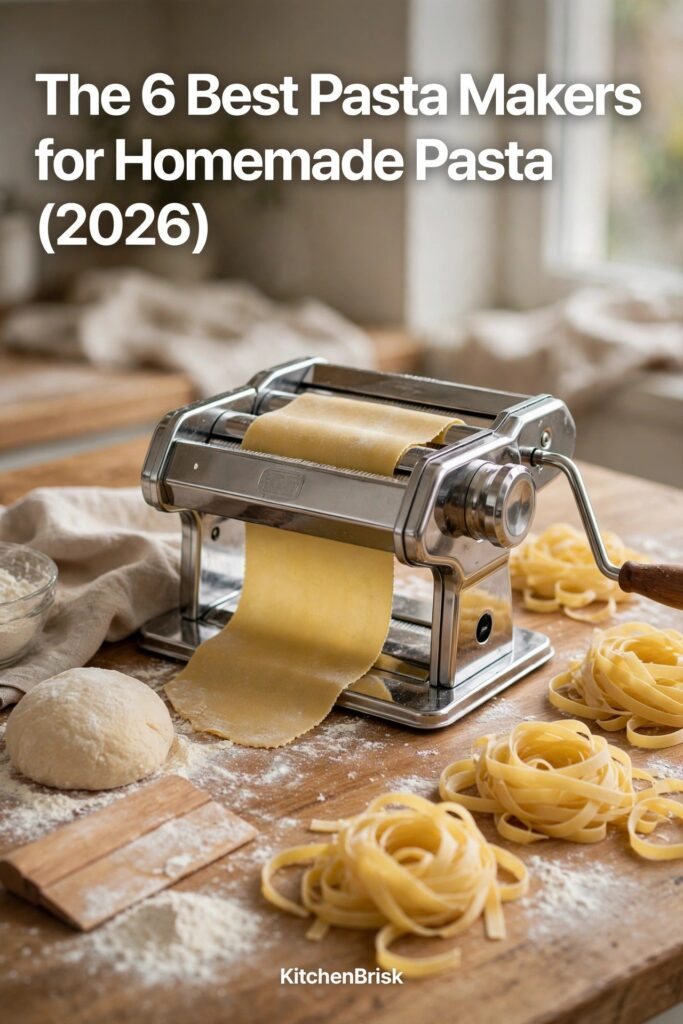
The Marcato Atlas 150 is our best overall pick. It is the manual roller the 2026 roundups keep naming first: Food Network named it the best overall pasta maker in its February 2026 roundup after testing nine machines, and America’s Test Kitchen named it the winner in its buying guide. The Italian-made, chrome-plated steel roller is 150mm wide, with nine thickness settings from 3mm down to 0.6mm — thin enough for delicate ravioli — and it ships with fettuccine and tagliolini cutters. Reviewers note its remarkably smooth mechanical operation, its ergonomic clamp and crank, and a 10-year warranty that backs up its reputation for lasting decades.
The Atlas 150 has been the home pasta roller benchmark since the 1930s, and that longevity shows in the details: the widest range of third-party attachments and spare parts of any roller here, from ravioli makers to motor attachments that convert it to powered rolling. In Food Network’s testing it performed best on settings one through six, rolling both egg and eggless doughs cleanly, and it also handled cracker dough in durability testing. If you want the classic homemade pasta experience — sheets, ribbons, and filled pasta — this is the machine to buy.
Pros:
- Food Network’s best overall pasta maker of 2026 and America’s Test Kitchen’s winner
- Nine thickness settings from 3mm to 0.6mm — thin enough for ravioli
- Italian-made chrome steel construction with a 10-year warranty
- The widest attachment and spare-parts support of any manual roller
Cons:
- Needs a counter-edge clamp mount — no freestanding option
- The thinnest settings can show slight tearing and sticking, per 2026 testing
- Hand-crank only out of the box — a motor attachment costs extra
Philips 7000 Series Pasta Maker
The Philips 7000 Series Pasta Maker is our best electric pick. It is the fully automatic extruder that 2026 roundups keep recommending for busy cooks: add flour and liquid, pick one of its 8 shaping discs, and its ProExtrude technology mixes, kneads, and extrudes the dough for you. Reviewers note it produces fresh spaghetti, penne, fettuccine, and more in under 10 minutes, and can make up to 8 portions in a single batch — the largest capacity in this guide. Food Network’s 2026 roundup called its performance flawless and easy to use, naming the Philips line the best electric pasta maker for beginners who want a hands-off process.
What sets the Philips apart from every roller here is shape range: extruders make tubular and short shapes — penne, rigatoni, macaroni — that a roller simply cannot produce. The newer Artisan Smart model adds a built-in scale and a smart screen with 10 discs, and 2026 roundups measured four portions in 10 minutes and up to eight in 15. The trade-off is that it makes extruded shapes, not rolled sheets, so lasagna and filled pasta are not its job. It also works best with the manufacturer’s own dough recipes, where manual machines accept just about any recipe.
Pros:
- Fully automatic — mixes, kneads, and extrudes with almost no hands-on work
- 8 shaping discs cover spaghetti, penne, fettuccine, and more
- Makes up to 8 portions in one batch, the largest capacity here
- Food Network’s best electric pick of 2026, praised for flawless, beginner-friendly performance
Cons:
- Cannot make rolled sheets, lasagna, or filled pasta — extruded shapes only
- Works best with the manufacturer’s own dough recipes
- The bulkiest machine here, with discs and parts to store and wash
Imperia Pasta Machine
The Imperia Pasta Machine is our best heavy-duty manual pick. It is the long-standing Italian rival to the Marcato and a fixture in professional culinary schools: a rugged, chrome-plated steel roller with a commercial heritage that 2026 roundups praise for handling stiffer, thicker doughs without complaint. Food Network named it the best value pasta maker in its 2026 roundup, and it rolls both egg and eggless doughs well. Unlike the Atlas, it ships with both a fettuccine (5mm) and a spaghetti (2mm) cutter included as standard — the Atlas needs a separate purchase for the second width.
Reviewers note the Imperia’s build feels slightly heavier and more industrial than the Marcato’s, and it is the machine traditionalists reach for when durability matters more than modularity. The trade-offs are real: Food Network’s testers found it less smooth than the Atlas, with dough tearing and sticking on the thinnest settings, and its frame felt less sturdy in testing despite the heavy build. It is best for occasional use or for cooks who want a classic Italian roller with two cutters in the box from day one.
Pros:
- Includes both fettuccine and spaghetti cutters as standard — no extra purchase needed
- Food Network’s best value pasta maker of 2026
- Heavy-duty Italian steel build with a commercial-kitchen heritage
- Handles stiffer, thicker doughs well, per 2026 roundups
Cons:
- Less smooth than the Marcato, with tearing and sticking on the thinnest settings
- Fewer thickness settings and a less refined adjustment mechanism
- Frame felt less sturdy than the Atlas in Food Network’s testing
KitchenAid 3-Piece Pasta Roller & Cutter Set
The KitchenAid 3-Piece Pasta Roller & Cutter Set is our best pick for stand mixer owners. It converts any standard KitchenAid stand mixer into a motorized pasta machine: a roller plus fettuccine and spaghetti cutters that attach to the mixer’s power hub, so the mixer does the cranking while you feed the dough. Reviewers note the motorized rolling gives consistent sheet speed and even thickness with far less effort than a hand crank, and the roller is 152mm wide — slightly wider than the Atlas. It is the pick that 2026 roundups and Reddit recommendations point to again and again for anyone who already owns the mixer.
The set is a smart buy only if you already own a KitchenAid stand mixer — without one, it is useless, and the attachment set alone costs more than a good manual roller. In Food Network’s testing, reviewers found it durable and easy to use, but noted it handled un-flattened dough poorly, so flatten the dough by hand before the first pass. If the mixer is already on your counter, this is the easiest path to fresh pasta: no clamp, no crank, no second appliance to store.
Pros:
- Motorized rolling via your stand mixer — no hand cranking at all
- Consistent sheet speed and even thickness with minimal effort
- Roller plus fettuccine and spaghetti cutters in one set
- The most recommended option for existing KitchenAid owners across 2026 roundups
Cons:
- Useless without a KitchenAid stand mixer — the attachment alone is not a machine
- Needs dough flattened by hand before the first pass, per Food Network testing
- The attachment set alone costs more than a good manual roller
CucinaPro Deluxe Pasta Maker Set
The CucinaPro Deluxe Pasta Maker Set is our best budget pick. It is the variety play in a manual roller: a chrome-coated steel machine bundled with three attachments that make five pasta styles — lasagnette, fettuccine, angel hair, spaghetti, and ravioli — including a ravioli attachment that fills and seals as you crank. The Spruce Eats and Food & Wine both named it the best value pasta maker, according to Jessica Gavin’s 2026 roundup, and it carries a 4.3-star rating on Amazon with more than 3,800 reviews. It is the cheapest way to try pasta making with real range, and it clamps to the counter like the Italian machines.
The CucinaPro is lighter and less refined than the Marcato or Imperia, and reviewers note the trade-offs: the cutters arrive unlabelled, the instructions are minimal, and the roller has fewer clearly marked thickness settings than the Atlas. Expect a learning session with the first batch. But for a first pasta machine — or for a cook who mainly wants to make ravioli without buying a separate attachment — the five-in-one set is hard to beat for the money.
Pros:
- Five pasta styles in one set, including a ravioli attachment that fills and seals
- Named best value by The Spruce Eats and Food & Wine, per Jessica Gavin’s 2026 roundup
- Chrome-coated steel construction with a table clamp included
- The lowest-cost way to try pasta making with real shape variety
Cons:
- Cutters arrive unlabelled and instructions are minimal
- Lighter, less refined build than the Italian manual rollers
- Fewer clearly marked thickness settings than the Marcato Atlas 150
KitchenAid Gourmet Pasta Press Attachment
The KitchenAid Gourmet Pasta Press Attachment is our best pick for shape variety. It is the extruder for stand mixer owners: it fits the same power hub as the roller set, but instead of rolling sheets it pushes dough through one of six shaping discs — spaghetti, bucatini, rigatoni, fusilli, large macaroni, and small macaroni — with a built-in wire cutter to trim each piece to length. Food Network named it the best variety pick in its 2026 roundup, and NBC Select’s review adds detail on its clean, consistent extrusion.
The press is the smart second attachment if you already own a KitchenAid and the roller set: together they cover sheets, ribbons, and extruded shapes from a single mixer. On its own it cannot make lasagna sheets or filled pasta, and like other extruders it is fussier about dough hydration than a roller — reviewers note that a dough that is too dry or too wet will jam or smear rather than extrude cleanly. It also needs the mixer, so it shares the roller set’s biggest limitation. But for short and tubular shapes without buying a standalone electric machine, it is the most versatile option here.
Pros:
- Six shaping discs — spaghetti, bucatini, rigatoni, fusilli, and two macaroni sizes
- Food Network’s best variety pick of 2026, with a built-in wire cutter
- Uses the mixer you already own — no second appliance to store
- Clean, consistent extrusion, per NBC Select’s review
Cons:
- Needs a KitchenAid stand mixer — useless without one
- Cannot make rolled sheets, lasagna, or filled pasta
- Fussier about dough hydration than a roller — wrong dough jams or smears
Buying Guide
Manual roller or electric extruder — decide by shape: If you want lasagna sheets, ravioli, and ribbons like fettuccine and tagliatelle, buy a manual roller or a mixer roller attachment. If you want penne, rigatoni, fusilli, and macaroni, only an extruder makes them. Many serious home cooks end up with one of each — a roller for sheets and an extruder for short shapes.
Thickness settings are the roller’s headline spec: The Marcato Atlas 150 offers nine settings from 3mm down to 0.6mm, and 2026 testers found it performed best on settings one through six. More settings mean finer control — thick pappardelle at one end, paper-thin ravioli sheets at the other. On an extruder, count the discs instead: the Philips ships with 8, the KitchenAid press with 6.
Clamp and stability matter more than the brand: A manual roller lives or dies by its clamp — it must grip the counter edge firmly while you crank with both hands on the dough. Food Network’s testers singled out the Marcato’s ergonomic clamp, while the Imperia’s frame felt less sturdy in the same tests. Test the clamp on your own counter before the first batch, and keep the counter edge clear.
Dough matters as much as the machine: 2026 testers found manual machines work well with just about any dough recipe, while electric extruders perform best with the manufacturer’s own recipes. For rollers, rest the dough 30 minutes before rolling and flour lightly between passes; for extruders, follow the recipe’s flour-to-liquid ratio exactly, since dough that is too dry or too wet will jam or smear.
Cleaning is a brush, not a wash: Never put a steel pasta roller in water or the dishwasher — brush off dried dough with the cleaning brush, wipe with a dry cloth, and let any stuck bits dry before brushing them away. Extruder discs need a soak and a rinse, and the Philips discs are the fiddliest part of that machine. Dry every part fully before storing to prevent rust.
Start with one shape and master it: Fettuccine is the forgiving first project on a roller — wide ribbons hide uneven thickness. On an extruder, start with spaghetti or penne before trying fusilli. Once the dough feel is in your hands, the rest of the shapes follow quickly.
FAQs
What is the best pasta maker for homemade pasta? The Marcato Atlas 150 is our top pick — Food Network’s best overall of 2026 and America’s Test Kitchen’s winner, with nine thickness settings and a 10-year warranty. For hands-off extruded shapes, the Philips 7000 Series is the pick; for mixer owners, the KitchenAid roller set.
Is a manual or electric pasta maker better? Manual rollers make better sheets, ribbons, and filled pasta, and they cost less and last decades. Electric extruders make short and tubular shapes rollers cannot, with almost no hands-on work. Choose by the shapes you actually eat most.
Do I need a KitchenAid mixer to use KitchenAid pasta attachments? Yes — both the roller set and the pasta press attach to a KitchenAid stand mixer’s power hub and are useless without one. If you do not own the mixer, buy a standalone manual roller or the Philips extruder instead.
How thin should pasta dough be rolled? It depends on the shape: fettuccine and tagliatelle are best around setting 5 or 6 on the Marcato’s nine-setting dial, while ravioli and filled pasta need the thinnest settings, down to 0.6mm. You should be able to see your hand faintly through the sheet for filled pasta.
Are pasta makers hard to clean? Manual rollers are the easiest — brush off dried dough and wipe dry, never wash them in water. Extruders take longer because the shaping discs need soaking and rinsing. Never run your fingers across a cutter blade to wipe it.
Can you make gluten-free pasta in a pasta maker? Yes, and 2026 roundups note fully automatic extruders like the Philips are widely considered the best electric option for gluten-free dough, since the machine controls mixing and hydration. On a manual roller, gluten-free dough is more fragile — roll it thicker and handle it gently.