
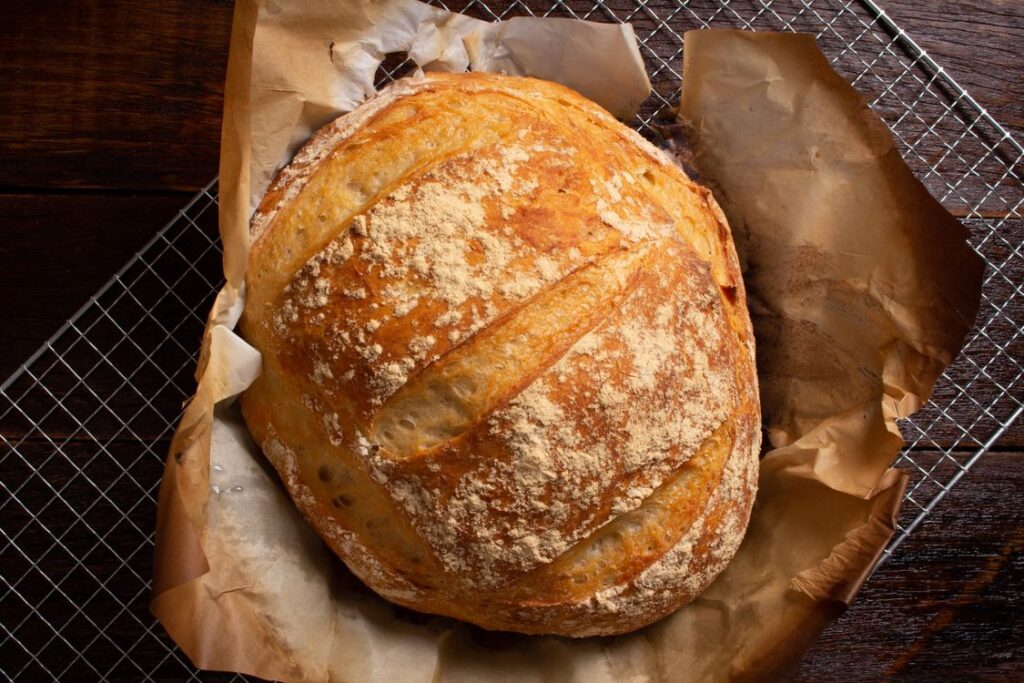
Learning how to knead bread dough by hand takes about 10 minutes of active work: push the dough away with the heel of your hand, fold it back over itself, give it a quarter turn, and repeat in a steady rhythm until it transforms from shaggy and sticky to smooth, elastic, and slightly tacky. The dough is ready when it passes the windowpane test, stretching thin enough to see light through without tearing.
Kneading develops gluten, the protein network that gives bread its structure and chew. Without it, bread bakes up dense and crumbly; with proper kneading, it rises tall with an open, airy crumb. This guide explains how to knead bread dough by hand with the classic push-fold-turn method, how to know when to stop, and how to rescue dough that is too sticky, too dry, or overworked.
What Kneading Actually Does to Dough
Wheat flour contains two proteins, glutenin and gliadin. When hydrated and agitated, they link into gluten, an elastic mesh that traps the carbon dioxide produced by yeast. Kneading does two things simultaneously: it distributes water evenly so every protein hydrates, and it mechanically aligns and strengthens the gluten strands into an organized, stretchy network.
You can feel this transformation happening. Freshly mixed dough is shaggy, lumpy, and tears easily. After several minutes of kneading, it becomes cohesive. After ten minutes, it turns smooth, supple, and elastic, springing back when poked. That spring-back is gluten doing its job. Under-kneaded dough cannot hold gas, so bread made from it rises poorly and bakes dense.
Interestingly, time can substitute for some kneading. No-knead bread recipes use long, slow fermentation, 12 to 18 hours, during which enzymes and gentle handling develop gluten with almost no mechanical work. But for same-day breads, pizza dough, and enriched doughs like brioche, hand kneading remains the fastest path to proper structure.
Setting Up Your Kneading Station
Knead on a large, sturdy surface: a clean countertop, a wooden board, or a silicone pastry mat. Lightly flour the surface, but use restraint; excess flour worked into the dough makes bread dry and dense. Many experienced bakers knead on a bare, unoiled counter for the first minutes, letting the dough\’s stickiness provide traction, then add only a dusting of flour as needed.
Keep a bench scraper (dough scraper) within reach. It is the hand-kneader\’s best friend: it lifts sticky dough off the counter, cuts portions cleanly, and scrapes up dried bits. A small bowl of flour for dusting your hands and a damp towel for wiping complete the setup. Wear short sleeves and remove rings; dough finds every crevice.
How to Knead Bread Dough by Hand: The Method
Step 1: Mix and Rest (Autolyse)
Combine flour, water, yeast, and salt per your recipe and mix until no dry flour remains. Cover and rest 15 to 30 minutes before kneading. This rest, called autolyse, lets flour hydrate fully and gluten begin forming passively, which can cut several minutes off your kneading time and produces a more extensible dough.
Step 2: The Push-Fold-Turn Rhythm
Turn the dough onto your floured surface. Using the heels of both hands, push the dough firmly away from you, stretching it across the counter. Fold the far edge back toward you over itself. Give the dough a quarter turn. Repeat. Establish a steady rhythm: push, fold, turn, push, fold, turn. Use your body weight rather than arm strength; kneading should feel like a comfortable workout, not a struggle.
Step 3: Manage Stickiness Without Extra Flour
Wet doughs stick aggressively in the first minutes, and the instinct is to add flour. Resist. Instead, use your bench scraper to lift and fold the dough, and keep your hands lightly floured or damp. After 3 to 4 minutes of kneading, the dough\’s surface dries as gluten organizes, and the sticking diminishes dramatically on its own. Flour added early becomes part of the dough\’s hydration math and throws off the recipe.
Step 4: Knead for 8 to 12 Minutes
Continue the push-fold-turn rhythm for 8 to 12 minutes total for most lean doughs. Enriched doughs with butter, eggs, or sugar take longer, 12 to 15 minutes, because fats coat gluten strands and slow their linking; add soft butter only after the dough is mostly developed. The dough is progressing well when it starts slapping the counter cleanly and feels alive under your hands.
Step 5: Test With the Windowpane
Pinch off a golf-ball-sized piece and stretch it gently between your fingers. Properly kneaded dough stretches into a thin, translucent membrane, the \”windowpane\”, without tearing. If it rips immediately, knead 2 to 3 minutes more and test again. The windowpane is the definitive doneness test and beats the clock every time.
Kneading Time Reference by Dough Type
| Dough Type | Typical Hand-Knead Time | Key Notes |
|---|---|---|
| Lean white bread | 8–10 min | Straightforward; windowpane comes quickly |
| Whole wheat bread | 10–12 min | Bran cuts gluten; slightly shorter windowpane |
| Pizza dough | 8–10 min | Smooth and elastic; rest improves stretch |
| Brioche / enriched | 12–15 min | Add butter after gluten develops |
| Bagel dough | 10–12 min | Very stiff; use body weight |
| Sourdough (lean) | 5–8 min + folds | Often uses stretch-and-fold instead |
The Stretch-and-Fold Alternative
For wet, high-hydration doughs like sourdough and ciabatta, traditional kneading is impractical; the dough is too slack to push and fold. Instead, use stretch-and-fold: with wet hands, grab one edge of the dough in its bowl, stretch it upward, and fold it over the center. Rotate the bowl a quarter turn and repeat three more times. That is one set. Perform 3 to 4 sets spaced 30 minutes apart during bulk fermentation.
Stretch-and-fold develops gluten gently while preserving the gas bubbles that create an open crumb. It is less work than kneading but spread over hours. Many bakers prefer it for artisan loaves because it is nearly impossible to overdo, unlike aggressive kneading of delicate high-hydration dough.
Troubleshooting Hand-Kneaded Dough
- Dough sticks to everything: normal for the first minutes. Use a bench scraper, keep hands lightly floured, and avoid adding flour to the dough itself. It will come together.
- Dough tears instead of stretching: under-kneaded, or needs a rest. Let it relax 10 minutes covered, then knead 3 minutes more; gluten tightens under work and relaxes with rest.
- Dough feels tough and springs back hard: overworked or low hydration. Let it rest 15 to 20 minutes to relax the gluten, and verify your recipe\’s water amount.
- Windowpane never quite forms (whole grain): bran particles cut gluten strands, so whole wheat rarely achieves a perfect windowpane. Aim for smooth, elastic, and stretchy rather than translucent.
- Arms exhausted: you are using arm strength instead of body weight. Lean into the push with your upper body and let gravity help; the rhythm should feel sustainable.
- Dough dries out while kneading: cover the dough with a damp towel during any pause, and work efficiently. A dry skin inhibits rising later.
After Kneading: Proofing Basics
Shape the kneaded dough into a smooth ball by tucking the edges underneath, creating surface tension that helps it rise evenly. Place seam-side down in a lightly oiled bowl, cover, and proof in a warm spot (75 to 80°F / 24 to 27°C) until doubled, typically 1 to 2 hours for yeasted dough. The poke test tells you it is ready: a gentle poke should leave an indent that springs back slowly. If it springs back instantly, it needs more time; if it collapses, it has over-proofed.
Kneading Enriched Doughs: Brioche, Challah, and Rolls
Enriched doughs containing butter, eggs, sugar, or milk behave differently from lean doughs and demand adjusted technique. Fat coats gluten strands and slows their linking, which is why brioche takes 12 to 15 minutes of kneading versus 8 to 10 for lean bread. The professional method: develop the gluten first with flour, water, eggs, and yeast, then add soft room-temperature butter gradually, a tablespoon at a time, kneading each addition fully in before adding the next.
The dough will look broken and greasy each time butter goes in; this is normal. Keep kneading and it comes back together, smoother and silkier than before. If the dough gets warm and sticky from friction, refrigerate it 15 minutes and resume; warm enriched dough is nearly impossible to develop properly. The finished brioche dough should be satiny, elastic, and pass the windowpane test with a buttery sheen.
Sugar above about 10 percent of flour weight also slows gluten development and yeast activity, which is why sweet doughs like cinnamon rolls proof more slowly. Salt, added at 1.8 to 2.2 percent, tightens gluten and controls fermentation; adding it after the autolyse rest gives the dough a head start on hydration. Understanding these interactions turns enriched doughs from frustrating to predictable.
Frequently Asked Questions
How long should you knead bread dough by hand?
Most lean doughs need 8 to 12 minutes of steady push-fold-turn kneading. Enriched doughs with butter and eggs take 12 to 15 minutes. Time is only a guideline, though; the windowpane test is the true measure. When a small piece stretches thin enough to see light through without tearing, the dough is ready regardless of the clock.
Can you over-knead dough by hand?
It is very difficult to over-knead by hand. Over-kneading is mainly a risk with powerful stand mixers, which can tear the gluten network apart past the point of no return. By hand, you will tire long before the dough is damaged. If dough feels tight and resists stretching, a 15-minute rest relaxes the gluten and solves the problem.
What is the windowpane test?
The windowpane test checks gluten development: stretch a small piece of dough thin between your fingers. If it forms a translucent membrane you can see light through without tearing, the gluten is well developed and the dough is ready. If it rips, knead a few minutes more. Whole grain doughs may never pass perfectly because bran cuts gluten strands.
Should I add flour while kneading sticky dough?
Add as little as possible. Early stickiness is normal and resolves as gluten develops; flour worked in now becomes part of the dough and makes the bread drier and denser. Use a bench scraper to handle sticky dough, dust your hands lightly, and flour the counter sparingly only if the dough truly will not release.
Is hand kneading better than using a stand mixer?
Neither is inherently better; they suit different situations. Hand kneading gives you intimate feedback on the dough\’s development and needs no equipment, making it ideal for learning. Stand mixers save effort on stiff or large batches and enriched doughs. Many professional bakers use both, choosing by dough type and quantity.
Why is my dough still sticky after 10 minutes of kneading?
Some doughs are formulated wet, like ciabatta at 75 to 80 percent hydration, and stay tacky even when fully kneaded; that is correct for the recipe. If your recipe targets 60 to 65 percent hydration and still sticks badly after 10 minutes, your flour may absorb less water than the recipe assumed; add flour a tablespoon at a time until manageable.
Do I need to knead no-knead bread dough?
No, that is the point of no-knead methods. Long, slow fermentation of 12 to 18 hours develops gluten enzymatically with only a few gentle folds. No-knead breads produce excellent open crumb with almost no effort, though they require planning ahead. For same-day bread, traditional kneading remains faster.
Can I knead dough in a food processor?
Yes, for lean doughs: process with the dough blade or metal blade for 45 to 90 seconds, which develops gluten remarkably fast through high-speed shear. Watch closely, as over-kneading happens quickly by machine. Rest the dough 10 minutes afterward and finish with a brief hand-knead to assess texture. It is less suitable for very wet or enriched doughs.
What does over-kneaded dough look like?
Truly over-kneaded dough, rare by hand, feels tight, tears easily instead of stretching, and may look slightly shredded or separated. Machine over-kneading can also overheat the dough. The fix is a long rest of 20 to 30 minutes to let the gluten relax, though severely damaged dough from a mixer may never fully recover.
