
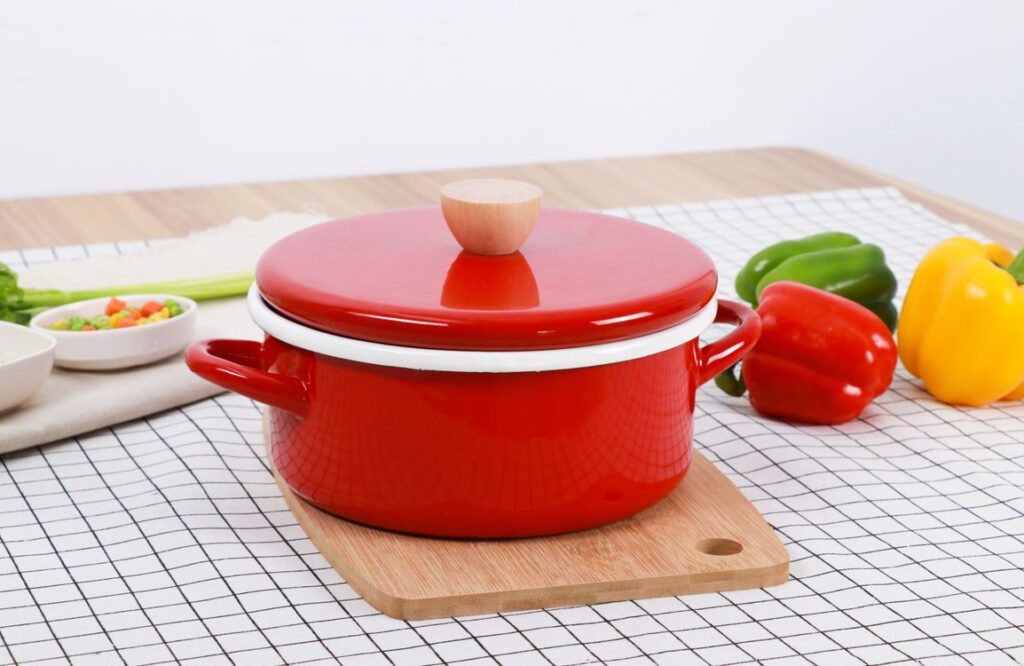
Both are big, both have lids, and both handle large-format cooking — but the stockpot vs dutch oven choice comes down to tall-and-light versus short-and-heavy. Stockpots are thin-walled volume vessels built for boiling and simmering; dutch ovens are thick-walled heat batteries built for braising, baking, and searing. This comparison explains what each pot does best and which one your kitchen actually needs.
Stockpot vs Dutch Oven: The Quick Verdict
Choose a stockpot if you make stock, boil pasta for crowds, or need maximum volume at minimum weight and cost. Choose a dutch oven if you braise, stew, bake bread, or sear before simmering — its heat retention transforms those dishes. Most cooking enthusiasts eventually own both: the stockpot for water-based volume cooking, the dutch oven for everything where browning and heat retention matter.
| Feature | Stockpot | Dutch Oven |
|---|---|---|
| Shape | Tall and narrow | Shorter and wider |
| Walls | Thin — heats fast | Thick — retains heat |
| Typical material | Stainless steel or aluminum | Enameled or bare cast iron |
| Weight (6–8 qt) | Light — 3–6 lbs | Heavy — 10–15 lbs |
| Stocks and boiling | Excellent — built for this | Good, but heavy overkill |
| Searing and braising | Poor — thin base scorches | Superb — the gold standard |
| Bread baking | No | Excellent |
| Price | $40–$150 | $60–$350 |
Design Philosophy: Volume vs Thermal Mass
A stockpot is engineered around a single idea: hold a lot of liquid and bring it to a boil efficiently. Its tall, narrow shape minimizes surface evaporation (good for long stock simmers), its thin walls keep it light enough to lift when full, and its wide-open top accommodates pasta, steamer baskets, and crab legs. It is a vessel, not a heat engine.
A dutch oven is engineered around heat: thick cast iron walls absorb enormous thermal energy and release it slowly and evenly, while the heavy lid seals in moisture and recirculates it. Its wider, shallower profile maximizes the searing surface and keeps braising liquids at the right depth. It is a cooking instrument, not just a container.
Stocks, Soups, and Boiling: Stockpot Territory
For the jobs with \”stock\” in the name, the stockpot is purpose-built. Its tall shape means less evaporation during multi-hour simmers; its light weight matters enormously when you are straining 8 quarts of hot stock; and its thin walls bring huge volumes to a boil faster than heavy iron. Pasta for a crowd, corn on the cob, seafood boils, and canning all favor the stockpot\’s volume-to-weight ratio.
Dutch ovens make fine stock — many cooks do it — but they are working against their design: heavy to lift when full, slow to boil, and overkill for a task where heat retention barely matters. If stock-making is a regular ritual, the stockpot\’s ergonomics win every time.
Searing, Braising, and Stewing: Dutch Oven Territory
The moment browning enters the picture, the dutch oven takes over completely. Its heavy base sears meat deeply without scorching; its heat retention maintains a steady braise for hours; its tight lid self-bastes. Beef bourguignon, pork shoulder, short ribs, chili with real depth — these dishes are defined by the dutch oven\’s thermal behavior.
Stockpots sear poorly: thin bases develop hot spots that scorch fond before it browns properly, and their tall narrow shape crowds meat into steaming rather than searing. You can brown in a stockpot, but the results remind you why the dutch oven exists. In the stockpot vs dutch oven matchup, any recipe starting with \”brown the meat\” belongs to the dutch oven.
Bread Baking and Frying
Dutch ovens are the home bread baker\’s essential tool — preheated, lidded, they create the steamy, fiercely hot environment that produces bakery crusts. They also deep-fry beautifully: thermal mass keeps oil temperature stable when food is added, and tall walls contain splatter safely. Stockpots can deep-fry (tall walls are actually good here) but their thin bases let oil temperature swing wildly. For bread, there is no contest: dutch oven only.
Weight and Handling: The Practical Divide
This is the most underrated difference. A 12-quart stockpot weighs 4 to 6 pounds empty; a 7-quart dutch oven weighs 12 to 15. Full of liquid, the stockpot is manageable; the dutch oven is a two-person lift. For cooks with strength or mobility limitations, for small stoves, and for anyone who moves full pots to the sink, the stockpot\’s lightness is a major functional advantage.
Conversely, the dutch oven\’s weight is its performance: that mass is the heat retention. You cannot have the braising performance without the heft. Choose with open eyes — the best pot is the one you will actually lift, fill, and use.
Heat Behavior and Responsiveness
Stockpots are responsive: thin walls mean quick boiling and quick adjustment — turn down the burner and the simmer settles fast. Dutch ovens are the opposite: slow to heat, slow to cool, supremely stable once at temperature. For active cooking with frequent adjustments, responsiveness wins. For set-it-and-forget-it braising, stability wins. Neither is universally better; they suit different cooking rhythms.
Maintenance and Durability
Stainless stockpots are nearly indestructible and dishwasher-safe — the lowest-maintenance big pot you can own. Aluminum stockpots are lighter and cheaper but need hand washing and dent more easily. Enameled dutch ovens need hand washing, careful handling to protect the enamel, and no thermal shock — more demanding, but the cooking payoff justifies it for enthusiasts. Bare cast iron dutch ovens need seasoning maintenance but are otherwise immortal.
Cost and Value
Stockpots are the better value purely on price: $40 to $150 buys an excellent stainless stockpot that lasts decades. Dutch ovens range from $60 (value enameled) to $350+ (premium French), with the sweet spot around $80–$120 for outstanding performance. Per task, the dutch oven arguably delivers more cooking value — it does more things — but the stockpot delivers more volume per dollar. Budget for the pot matching your most frequent big-pot task.
Which Dishes Belong Where?
- Stockpot: chicken and vegetable stock, bone broth, pasta for crowds, blanching, corn on the cob, seafood boils, canning, steaming large batches.
- Dutch oven: braised short ribs, beef stew, pork shoulder, chili, coq au vin, no-knead bread, deep-frying, baked beans.
- Either works: simple weeknight soups, reheating large quantities, cooking for a crowd (choose by whether browning matters).
The 2026 Angle: Right-Sizing the Big Pot
The stockpot vs dutch oven decision in 2026 increasingly hinges on household reality rather than aspiration. Smaller households are discovering that a 5.5-quart dutch oven handles 90 percent of big-pot cooking, while dedicated stock-makers keep a lightweight 12-quart stockpot for quarterly broth sessions. The trend is away from owning giant versions of both and toward right-sized pieces that actually get used — a 6-quart dutch oven plus an 8-quart stockpot covers most families better than the traditional 7-quart-plus-12-quart pairing.
Right-Sizing Guide for Real Households
The stockpot vs dutch oven decision gets easier with concrete household math. For 1–2 people: an 8-quart stockpot and a 3.5-quart dutch oven cover nearly everything — big enough for stock and stews, small enough to lift and store easily. For 3–4 people: the classic 12-quart stockpot plus 5.5-quart dutch oven pairing, the most-recommended combination in cooking literature. For 5+ or frequent entertainers: consider a 16-quart stockpot for big-batch stock and a 7-quart dutch oven for large braises — but verify your stove can physically accommodate them and your sink can wash them.
The common error is buying for aspirational cooking rather than actual cooking: the 16-quart stockpot for the annual seafood boil that happens every three years, or the 7.5-quart dutch oven for a household of two. Oversized pots waste energy, store awkwardly, and discourage use. Audit your last twenty big-pot meals — the sizes that would have served those meals are the sizes to buy. Right-sized pots get used weekly; aspirational pots gather dust.
Multi-Pot Cooking Strategies
Holiday cooking and batch sessions are where owning both pots pays off strategically. The classic Thanksgiving deployment: turkey in the roasting pan, stock simmering in the stockpot for gravy, mashed potatoes holding in the dutch oven (its heat retention keeps them warm without overcooking). For meal prep Sundays: grains in the stockpot, braised protein in the dutch oven, soup in whichever finishes first.
Stagger start times by thermal behavior: the dutch oven\’s slow heat-up means it should go on first for braises, while the stockpot\’s quick boil makes it the last-minute pasta pot. And remember the division of labor during serving — the dutch oven holds temperature at the table far longer than the stockpot, so transfer anything that needs to stay hot into iron before guests arrive. Thinking of the two pots as a system rather than separate purchases unlocks cooking capacity that neither provides alone.
Final Verdict: Which Is Better?
Neither — they are different tools for different jobs. The stockpot is better for water-based volume cooking: stocks, pasta, boiling, and anything where light weight matters. The dutch oven is better for heat-driven cooking: searing, braising, stewing, frying, and bread baking. If you buy one big pot, choose by your most frequent task: weekly soup-and-pasta cooking points to the stockpot; braising, stewing, and bread point to the dutch oven. The complete kitchen eventually holds both, each doing what it was designed to do.
Frequently Asked Questions
Can I make soup in a dutch oven?
Absolutely — dutch ovens make wonderful soup, especially soups that start with browning meat or vegetables. The only downsides are weight when full and slower boiling. For simple boiled soups, a stockpot is lighter and faster; for developed, browned soups, the dutch oven adds flavor.
Can I braise in a stockpot?
Technically yes, but poorly — thin bases scorch during the long simmer, the narrow shape crowds meat, and heat retention is weak. A braise started in a stockpot tastes noticeably less developed than one from a dutch oven. Use the right pot for braising.
What size dutch oven is most useful?
Five to 5.5 quarts is the sweet spot for most households — big enough for a whole chicken or a family stew, small enough to lift and store. Larger 7-quart models suit big families and batch cooking but get very heavy when full.
What size stockpot is most useful?
Twelve quarts covers stock-making, pasta for crowds, and seafood boils. Eight quarts suits smaller households that do not make large-batch stock. Go bigger only for canning or serious entertaining — huge stockpots are unwieldy on home stoves.
Is a dutch oven worth it if I already have a stockpot?
If you braise, stew, bake bread, or deep-fry with any regularity, yes — the dutch oven does things a stockpot fundamentally cannot. If your big-pot cooking is exclusively boiling and simmering, the stockpot suffices and the dutch oven would be a luxury.
Can you put a stockpot in the oven?
Stainless stockpots with all-metal handles are oven-safe, useful for finishing large braises — though a dutch oven does this better. Check handle materials: plastic handles limit oven use. Aluminum stockpots are generally fine in the oven at moderate temperatures.
Which pot is better for induction?
Both work if magnetic — most stainless stockpots and all cast iron dutch ovens are induction-compatible. Plain aluminum stockpots need a magnetic base layer. The dutch oven\’s flat, heavy base makes particularly good induction contact.
Can I cook pasta in a dutch oven?
Yes — a dutch oven boils pasta perfectly well, and its heat retention keeps the boil vigorous. The downsides are weight when draining and slower initial boiling. For occasional pasta it is fine; for weekly large-batch pasta cooking, the stockpot\’s lightness and speed earn their keep.
Which pot is better for making chili?
The dutch oven, decisively — chili benefits from browning meat first (the dutch oven\’s strength) and from long, even simmering that melds flavors. A stockpot makes acceptable chili but misses the fond development that gives great chili its depth. Start chili in iron whenever possible.
Can one pot really do everything?
No — and that is the honest answer behind this whole comparison. The stockpot and dutch oven optimize for opposite physics (fast boiling versus heat retention), so each compromises where the other excels. If forced to one pot, pick by your most frequent task; if you cook regularly, both earn their cabinet space within a year.
